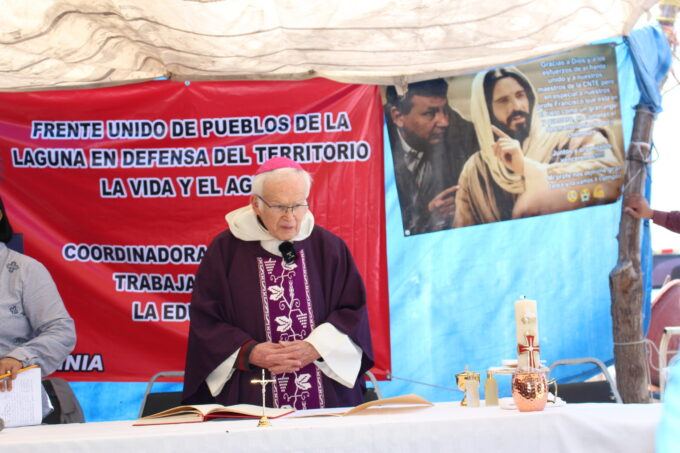
Catholic bishop Raúl Vera celebrating mass at Camp El Siete in December 2023. Photo: Paulina Rocío del Moral González.
The struggle of the United Front of Pueblos of La Laguna in Defense of Life, Land, and Water in Durango – birth state of the legendary revolutionary, Pancho Villa– against the transnational corporation Chemours, a spin-off of DuPont de Nemours, since 2017, has reached a climax due to thuggish armed repression organized by economic, political, municipal and state authorities, aided by the Army and the National Guard, against 28 farmers, of both sexes, and factory workers jailed in March and one woman jailed in April, on trumped up charges. This is the second major armed repression; the first occurred on March 9, 2018, also with the use of extreme violence by state and municipal police of Durango at the time, against men, women, children and elders in the ejido El Siete, in Dinamita, Durango.
The United Front of Pueblos of La Laguna in Defense of Life, Land and Water is a peoples’ organization which combines 23 ejidos and rural communities[1] of Gómez Palacio[2] in the Lagunera Region of Durango since 2017, and whose main battle has been to defend their homes, families and land against the pollution from the installation of a sodium cyanide industrial megaplant in the Ejido El Siete, Dinamita, Durango, and in addition, as it has developed, to take on other agrarian and labor causes.
From 2017 to the present the legitimate environmental cause the United Front raises has generated support from diverse environmental organizations from the Lagunera Ecological Region as this ecological region is known, including populations in Durango and Coahuila linked by the rivers Nazas and Aguanaval, associations for civil rights, as environmentalists and organizations for campesino struggles from other parts of the country, and including the emeritus bishop of Saltillo, José Raúl Vera López, known for his activism for social causes, have united in its collective struggle against the contamination of the extraction zone of Dinamita, Durango and its rural surroundings. And the reason is simple – to fight for the United Front’s cause is to fight – as it’s name says, in defense of the life, land, and water of the Lagunera District of Durango and Coahuila.
BACKGROUND
On the afternoon of March 18 this movement against the environmental contamination of Dinamita and its surrounding region was violently suppressed, this time by all three levels of government, by means of the fabrication of crimes, by different orders, with the aid of the Durango prosecutor’s office, the chambers of commerce, and the clear collusion between the PRI governor, Esteban Villegas Villarreal, and the president of Gómez Palacio, Betzabé Martínez Arango, a chapulina[3] of the Morena Party.
In an operation involving 80 official vehicles, and the use of abusive force by municipal and state police, even with the unjustified participation of the Army and National Guard, 28 rural citizen workers committed to the defense of their human rights, farming, civil and environmental rights were attacked for demonstrating against Sotomex, a trucking firm that transports explosives, since March 17, for the unjustified firing of four workers, and imprisoned, without justifiable indictments, in el Cereso (Centro de Rehabilitación Social) Number 1 in Durango.
A few days later, on March 21, three more campesinos were arrested in Ejido Noé on the trumped up charge of stealing nuts –their properties invaded by Alfredo Becerra, previous tenant of the property, who had been ejected for nonpayment– being sent to jail in Durango on March 23rd. One of them, Javier Mendoza Martínez, a 65-year-old diabetic, with hypertension and compromised vision, died in custody due to negligence and under suspicious circumstances on April 12, 2026, without any proper notice to his family. It was only thanks to communication from families of other prisoners that the family of Mendoza Martínez could recover his body for funeral rights with the recommendation by prison authorities not to open the coffin. It should be noted that some 20 of the detained are senior citizens with health problems. Bernardino “Nino” Ochoa, a spokesman for the United Front, wasn’t arrested but appears to have disappeared and there is no news of his whereabouts.
This sequence of coordinated actions culminated in a slanderous declaration issued by the very same Secretary of Security and Citizen Protection of México, Omar García Harfuch, in La Mañanera, the presidential news bulletin, on April 14, when, in presenting the results of his National Security Strategy, he inexcusably included in a list of “alleged extortionists” [sic] the rural settlers arrested in Dinamita, Durango, a village with a population of less than a thousand persons.
Meanwhile, in April, police harassment continued with roadblocks in the access roads to the towns of Dinamita, El Siete, Abisinia, and others, trying to intimidate the residents to break their political participation, in open violation of their constitutional rights to free demonstrations and defense of their territory. This obviously coordinated action shows the complicity of the governor of Durango, the mayor of Gómez Palacio, the security apparatuses of the three levels of government, in collusion with agribusinessmen and industrialists in the zone. The list of accountable agencies would include Semarnat (Secretariat of Environment and Natural Resources), a federal agency, then under PRI administration, which had started the problem by issuing an unfounded environmental opinion in 2017.
At dawn on the 25th of April, Teresita de Jesús Ochoa Hernández, daughter of former spokesman for the Frente Unido, Bernardino Ochoa, was seized, without a warrant, by the Gómez Palacio police, and taken to the Durango jail, where she remains a prisoner. The crime authorities impute to Teresita is the destruction of a barbed wire fence and a subsequent fire, which was typified as damage by fire due to activities that happened in 2023 on a piece of land in Tlahualilo, a town in Lerdo, in other words, in a distant locale, in no way linked with the territory in dispute. Rubén Favela, her defense attorney, points out that there are no legal grounds for her arrest, that her preventative imprisonment is excessive and her detention doesn’t merit the intervention of the National Guard. Other members of the Nino Ochoa family were detained while at church in Dinamita, not even participating in the demonstration.
Despite continual marches of the families and little children of the political prisoners and sit-ins in front of Gómez Palacio City Hall, the Morena Party mayor, Betzabé Martínez Arango, could not care less; on the contrary, she sends patrols to watch over the marchers and to intimidate them with uniformed policemen who record them on their cellphones. The judicial action of moving the political prisoners to the Cereso (jail) in the city of Durango, the state capital, instead of confining them in the Cereso of Gómez Palacio, is part of a strategy to wear down the movement. In spite of this, the settlers have gathered collections and contributions to help the families of political prisoners with their travel expenses to the state capital, three hours from Gómez Palacio.
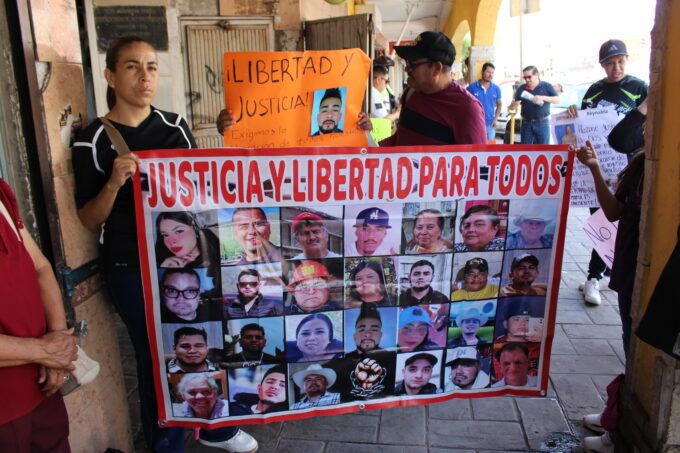
Frente Unido asking for the liberation of 28 political prisoners in March, 2026. Photo: Paulina Rocío del Moral González.
Hipólito Trujillo Silva, member of the CNTE (National Coordinating Committee of Education Workers), and of the United Front, has taken on the spokesman duties for the movement to liberate the political prisoners, joined by the women and senior citizens of the above-mentioned rural communities. The United Front has posted on its webpage a history of the movement and has received messages of solidarity from diverse city and country organizations both in the region and nationally. You can follow the movement at this link.
Seeking new possibilities for political advocacy, on Monday, April 27th, a commission of activists from the United Front traveled to México City for an interview with the Ministry of the Interior, and on the next day, they were in negotiations with the secretary general of government for the state of Durango. At this time, the dialogue remains open yet the 28 (minus one deceased) people in jail have not been released.
Background of Dupont in Dinamita, Durango, México
From the time of the authoritarian reign of Porfirio Diaz (1884-1910), the region of Dinamita, Durango, has been the focus of international capitalist interest, particularly in the chemical explosives industry. First, it was a group of Paris bankers who obtained from the Mexican Minister of Finance, José Yves Limantour (1893-1911) the monopoly for the exploitation of dynamite in exchange for consolidating the Mexican foreign debt, excluding the trust of the Alfred Nobel, who had patented dynamite in 1867, to establish nitroglycerine –invented by Ascanio Sobrero in 1847— using diatomaceous earth. Thus, a group of entrepreneurs connected to Diaz, Brittingham-Terrazas-Creel went into business with the French Central Dynamite Society, the first and largest business of its generation in Latin America, whose French capital was 3,400,000 gold pesos, an astronomical figure for the era, and together founded the National Mexican Dynamite and Explosives Company. Juan Brittingham was originally from the US and is remembered as a promoter of the industrial development of Gómez Palacio, Durango; Luis Terrazas was a Mexican politician, military officer and entrepreneur, the largest landowner in Chihuahua, which he governed; Enrique Creel was the son of the US consul in Chihuahua, married to Ángela Terrazas, daughter of the latifundista Luis Terrazas, forming the wealthy and powerful clan Terrazas-Creel, linked to the expansion of railroads, mining and banking, who was also a governor of Chihuahua. Also included among the prominent associates of the brand-new Mexican Dynamite and Explosives Company was Lt. Profirio Díaz, Jr., son of the then-Mexican president. La Jabonera de Gómez Palacio (soap factory, formerly La Esperanza) provided them with glycerin, produced from cotton grown in La Laguna. Consequently, the company built a factory and a town called La Dinamita, in a rural area, 10 kilometers far from La Jabonera glycerin plant, supplied by a branch of the Central México Railroad. According to technical information provided by French financier Auguste Génin, the dynamite produced in Durango was of a higher quality than US dynamite.
Circa 1925, DuPont set up in Dinamita, Durango. DuPont (E. I. DuPont de Nemours and Co.) born as a French financed US company, was funded by Éleuthère Irénée DuPont de Nemours. Éleuthère Irénée DuPont was the son of Pierre Samuel DuPont, a businessman, economist, and French politician, who got his second name, Nemours, as a noble title granted by King Louis XVI of France in return for his favors to the crown. A nephew of Éleuthère Irénée, Samuel Francis DuPont, was a real admiral in the US Navy and took part in the Mexican American War. Éleuthère Irénée began making gunpowder in 1802 in Wilmington, Delaware, and founded a dynasty of wealthy, prominent families on the East Coast of the US. With time, the industrial giant, DuPont, diversified into synthetic fibers, petroleum based fuels and lubricants, like nylon, Teflon, Lycra, neoprene and others.
Throughout its international history, DuPont has faced demands and criticism for its use of contaminating material and industrial wastes. Dupont and 3M knew the risks of the use of PFAS (per- and polyfluoroalkyl substances), a group of more than 10,000 artificial chemicals, created since the 1940s, and they didn’t inform the EPA, founded in 1970, or the public for decades. DuPont invented Teflon (PTFE) and used PFOA (C8) in the fabrication of anti-adherent products for decades. The exposure of the PFAS, known as “forever chemicals,” are related to cancer, thyroid diseases, high colesteral and bad fetal development. These substances do not easily degrade and persist in the water and in the environment. It wasn’t until 2019 that PFOA was prohibited worldwide. DuPont says that now it doesn’t make PFOA and that it only uses other PFAS when essential, under controlled circumstances. Really?
In 2014, this appeared in El Siglo de Torreón:
“With an investment of more than $18 million, the industrial explosives firm, Austin Powders will be expanding its operations. Located in the town of Dinamita in this district, the firm is owned by the international Austin Bacis.”
The firm persuaded the then-PRI governor of Durango, Jorge Herrera Caldera, to inaugurate the new industrial explosives plant.
In 2026, Austin Bacis presents itself online as: “We are a firm with a background in security, innovation and service, dedicated to the sale and fabrication of explosives mainly for use in mining and construction. The history of Austin Bacis begins in 1997 it bought DuPont’s business in México. Austin Powder México begins with a plant built in 1905, which has constantly evolved. Since 1999, it has become an active firm in the Mexican market, offering the full gamut of products necessary in the sector. In 2008, we celebrated our 175th anniversary, as the oldest explosives company in the world.”
In March 2024, La Confederación Autónoma de Trabajadores y Empleados de México (CATEM) got the labor contract for Austin Bacis. Now we know that CATEM is not exactly serving the workers, being themselves the true extortionists of the community, as it came to dominate the public in the Lagunera District at the end of 2025.
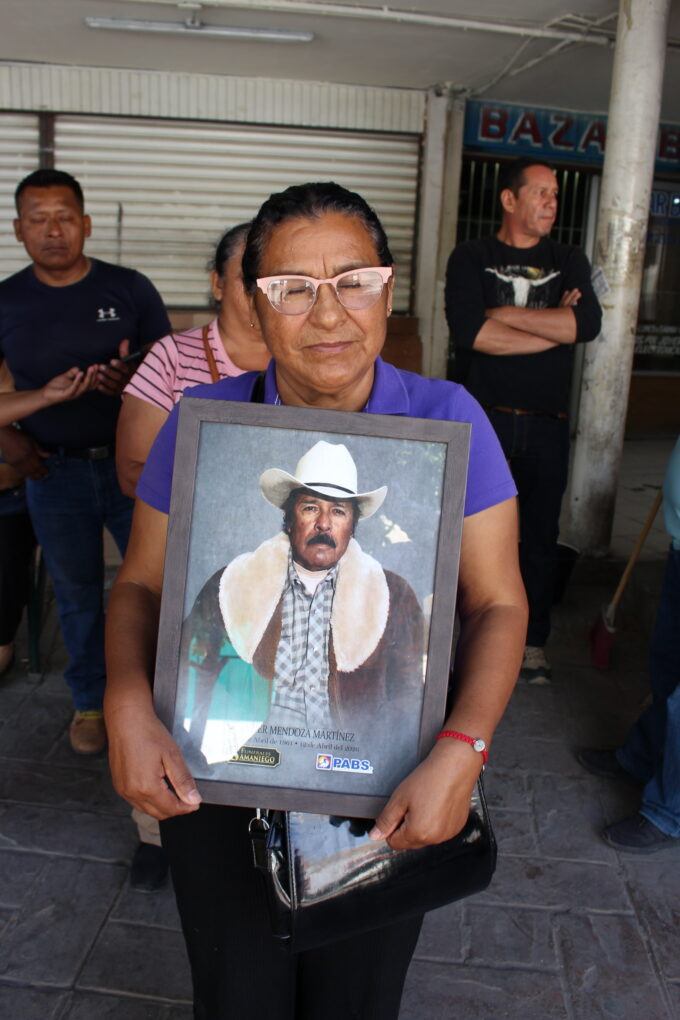
Javier Mendoza’s wife holding the picture of his deceased husband during a protest in Gómez Palacio, Durango, in April 2026. Photo: Paulina Rocío del Moral González.
DuPont, The Hydra with Seven Heads
Throughout its existence, DuPont has diversted and merged with other firms (partially mentioned here). DuPont has spun off its most controversial divisions, like explosives and the petrochemical division connected to PFAS, converting them into new firms. Besides Austin Bacis, which continues to manufacture explosives, the Chemours Company – also with its headquarters in Wilmington, Delaware – is a US chemical company, separated from DuPont in July 2015, which inherited iconic trademarks like Teflon (PTFE) and the refrigeration chemical Freon, and Viton (a fluorinated hydrocarbon rubber product). Even though they are separate entities, DuPont and Chemours, both companies together have faced environmental litigation for PFAS contamination.
In 2016. Parkersburg, a small town in Wood County, WV, was shocked to discover the mysterious deaths of nearly 200 cows. DuPont had been the main source of income for the community for more than 50 years, but what was discovered afterwards was that the company had discharged 7,100 tons of mud contaminated with PFOAS (Perfluorooctanoic acid, known as C8) a type of PFAS, in the Ohio River and in an uncovered dumpsite near its plant, Washington Works, in Parkersburg WV, for decades, since the 1990s, contaminating the air and water in Parkersburg and communities all along the Ohio. Victims suffered from kidney and testicle cancers, as well as from other illnesses deriving from the consumption of contaminated water. In 1999, one man demanded and others followed until it became a collective demand, to know where the evidence was of the toxicity of the chemical waste the negligent multinational had dumped in the river. In 2017, DuPont and Chemours (its spin-off) spent millions on legal defense without admitting its guilt. Finally, DuPont agreed to pay more than $670 million to compensate more than 3,500 people for associated illnesses. Previously, in 2005, they had agreed to nearly $236 million for medical care for more than 70,000 people.
A movie was made from this case, called Dark Waters (dir. Todd Haynes, 2019, Participant Media/Killer Films), known as Aguas oscuras (Spain) or El precio de la verdad (Latin America). The film is based on various articles by US journalists published in 2015 and 2016.
For decades, the petrochemical firm Chemours has also contaminated the Cape Fear River, the source of drinking water for Fayetteville NC, where it has another plant. Faced with the claims of US citizens, Chemours had to test the well water in various localities surrounding its Fayetteville plant, and even then its petition in 2025 to increase production of PFAS compounds, fell on deaf ears in that community. Now not even the gringos have confidence in Chemours. Is this why they want to install themselves here in México in the last northern stronghold of the PRIAN Party (the combination of PRI and PAN).
Another child of DuPont, born when DuPont split with Dow Chemical, is Corteva, an international agribusiness firm. In litigation for PFOA contamination in various Ohio districts, they had to pay $83 million for inherited responsibilities before their respective departures from DuPont.
After the fusion with Dow Chemical in 2017 and subsequent split, the actual DuPont Corporation has come to be a multinational focused on biopolymers, electronics, water, industrial solvents, security, smart cities and highly profitable materials.
For its part, Chemours is a world leader in titanium production (trademark Ti-Pure), and supplies markets in Latin America, South America, Europe and Asia. Chemours Titanium Technologies is the major producer worldwide of titanium oxide (TiO2), a key component in some of the whitest, brightest, most efficient and durable applications for architectural coatings, the automotive and aerospace industries, plastics, laminates and paper.
In addition to the US and Taiwan, since 1960 Chemours has had a titanium dioxide plant in Altamira, Tamaulipas, México.
Chemours planned to put a cyanide plant in Dinamita, Durango, in the Lagunera District. But for the brave defenders now incarcerated, who opposed its installation from 2017 to the present, today we would be more contaminated than ever. To continue, the hydraulic reasons:
The rivers and their subterranean springs do not distinguish political jurisdictions. Rain or overflows of whatever type on the semidesert evaporate or sink into the groundwater in the closed basin of our Nazas-Aquanaval system.
Remember that groundwater contamination is caused above all by human activities like agrochemical pollution, industrial and mining wastes, waste water and leaching from garbage. Deforestation, overexploitation and failure to treat sewage also increase contamination.
What is sodium cyanide and what does it do?
Sodium cyanide (NaCN) is mainly used in mining to extract gold and silver from rocks via a leaching process. It is a white solid, highly toxic, and is also fundamental in industrial chemical processes for electroplating, hardening of metals, plastics production, resins and pesticides.
Durango is a leader in México for production of gold, silver, zinc and copper. Aside Mexican mining giants such as Industrias Peñoles, most of the mining companies are foreign, above all Canadian, sometimes in partnerships with Mexican associates.
Sodium cyanide is included in the List of Dangerous Substances.
The risks:
+ Sodium cyanide can be inhaled and absorbed through the skin.
+ Contact can irritate skin and eyes.
+ Breathing sodium cyanide can irritate the nose, throat and lungs, causing coughing, wheezing, or shortness of breathe.
+ High exposure can cause headache, dizziness, elevated heart rate including loss of consciousness and death.
+ Sodium cyanide causes thyroid swelling.
+ Exposure to sodium cyanide can harm the nervous system and cause changes in blood-cell count.
+ Repeated low exposure can cause secretions, hemorrhage, and lesions in the nose.
With frequent dust storms from the semidesert Lagunera, cyanide spreads like pollen through the atmosphere and directly into the interior of the homes and the lungs of its residents in Durango and Coahuila. It would be like the song from the 70s by Roberta Flack, “Killing me softly with his song,” from Killing me softly, Full Album, 1973, but somewhat paraphrased:
Strumming my life with his cyanide
Fucking my land with his swords
Killing me softly with his dustKilling me softly with his dust
Fucking my whole life with his swords
Killing me softly with his dust…
Legal triumph of the United Front
Thanks to the legal struggle, by means of injunctions and the nine years of heroic resistance by community blockades, The United Front of the Laguna Communities in Defense of Life, Land, and Water has succeeded in stalling the operation of the Chemours plant which plans to produce 65,000 tons of sodium cyanide annually. In this period of disputes, police and judicial abuse by state government since 2017, the inhabitants of Dinamita Durango put up camps in 2020 to keep watch day and night on the gradual evacuation of the Chemours plant outside of their farms.
Members of the El Siete community presented a demand for nullification, including 10 legal challenges before the Full Jurisdiction of the Superior Court of the Federal Tribunal of Administrative Justice for the Northern Region, in Torreón, Coahuila. Analysis of only one point, loading and transportation of ammonium, caustic soda and other primary materials used to produce cyanide, was reason enough to revoke the environmental permit issued illegally to Chemours by Semarnat (National Ministry of Environment and Natural Resources) because the company had lied by declaring that there were no communities within five kilometers of the site, among other omissions.
Earlier, Chemours had tried to establish its cyanide plant in Salamanca and San Luis de la Paz, Guanajuato, but there, despite authorization by the PAN ex governor Márquez Márquez, it crossed the path of environmental organizations and more, a municipal leader with common sense who decided not to authorize the permit. Remember that the Lerma River, which, in addition to Guanajuato, touches four other states, is registered as one of the most contaminated rivers in México and Latin America. Then Chemours came to the Lagunera District, and in the record time of only a few months Semarnat grant them an environmental permit on May 8, 2017. Thus, in June of that year, at the community of El Siete Pueblo Nuevo, Chemours lays the first stone, with the consent of the then-governor of Durango, the Panista José Aispuro, and the PRI mayor of Gómez Palacio at that time, Juana Leticia Herrera Ale. In August of that year, about 20 communities organized themselves and formed the United Front, as they are now known.
Rural repression in Dinamita, 2018, Legal Protection and the Complicity of the Federal Supreme Court of Justice
The tardiness of the Tribunal in admitting the demand motivated more than 400 inhabitants on March 9, 2018, women, children and elders, of El Siete, Dinamita, La Aurora, El Volado, Las Américas, and Abisinia to demonstrate peacefully for a healthy environment on the access road to the plant. With the complicity of the authorities, state and local security forces, coordinated by Jaime López, director of Public Services of the city of Gómez Palacio, the demonstration was brutally suppressed. With great violence, they trespassed houses, destroying private property, beat the elderly and infants, and made arrests without any legal justification. There were 43 people detained, who were liberated after 13 days thanks to the struggle of the United Front in front of the Hall of Justice.
Thanks to timely protection against the violation of collective human and environmental rights, managed by lagunero attorney Víctor Manuel Pinedo Ledesma, of Pro Defensa del Ciudadano, A.C., temporary suspension of the project was successful until August 2019 when the Torreón Bench of Judges revoked it. In May 2020, Chemours announced the resumption of its activities due to the decision of the Supreme Court of Justice, at that time under PRI control. By then city construction permits had expired, all the same Chemours continued building secretly, which motivated resisters to put a permanent watch on access roads to the plant. From then on, the two 24/7 watch camps have been harrased by different agents of coercion in episodes of intimidation, threats and physical force.
New Transnational Offensive and a Governor in Collusion
In December 2021, the Czech firm of Draslovka Holdings, Inc. bought Mining Solutions, a division of Chemours, for $521 million, including the failed project to install a cyanide plant in Dinamita, Durango. Nevertheless, our battle-seasoned laguneros continued resistance to the onslaught of the transnational, and Draslovka stopped construction and in 2023 began to dismantle the plant. In 2024, Draslovka asked México for an indemnization of $240 million before International Center for Settlement of Investment Disputes for the World Bank.
In 2026, the governor of Durango is floating the idea of constructing an industrial park on 52 hectares of land in Dinamita. In reality, what Esteban Villegas is promoting is a platform for industrial development in order to begin the total contamination of the zone, without having criteria for evaluating viable and sustainable investments for a semidesert region with little available water.
The International Context and the Puppeteers
In 2026, the Iran-Israel/USA war altered the international configuration of supply routes for essential goods, not only those related to oil, but other industrial and agro-industrial commodities like fertilizer, certain metals required for the auto industry, aerospace, aeronautic, electronic and military industries, for example supplies of rare earth minerals. The rare earth minerals are a group of 17 metallic chemical elements, mainly the 15 lanthanides more Scandium and Yttrium, essential for modern technology (magnets, batteries, computer monitors, defense).
As we know, these metals exist in diverse regions of Latin America and México is no exception. México has traces of rare earths (Cerium, Lanthanum, Neodymium, Terbium) in Sonora, Chihuahua, Durango, Coahuila, and Oaxaca, with an estimated potential of 1.7 million tons. Even though deposits exist, actually they have not been commercially developed because they are found in low concentrations, limiting industrial scale production. Its strategic value stems from its technological use. The states that figure to have the most potential are: Sonora (especially areas rich in Lithium), Chihuahua, Coahuila, Durango, and Oaxaca.
So, let’s pull the rabbits out of the hat…
After all, who is Chemours?
(Text in italics from internet)
The Chemours Company (NYSE: CC) is a public company with an ownership structure dominated by large institutional investors, since its split from DuPont in 2015. The principal actors include asset management firms like Vanguard Group, BlackRock, State Street and JPMorgan Chase, which indicates a high degree of institutional ownership.
Principal institutional actors (approximate data at the ends of 2025-2026):
Vanguard Fiduciary Trust Co.: One of the largest owners, with about 11-12% stake.
BlackRock Inc.: Holds a considerable stake, situated frequently between the principal investors.
Other principal investors: Goldman Sachs, Cooper Creek Partners, American Century Companies, UBS Group AG, and Geode Capital Management.
Who is the Vanguard Group?
The Vanguard Group is one of the largest asset managers in the world founded in 1975 by John C. Bogle, known for its low costs and unique structure where the funds are owned by the investors. Based in Pennsylvania, it manages around $12 billion in global assets, offering mutual funds, ETFs, and financial planning services. Vanguard is considered one of “Big Three” asset managers worldwide with BlackRock and State Street.
Who is BlackRock Inc.?
BlackRock is the largest asset management company in the world, with assets under management (AUM) of more than $10 billion, positioned as one of the most influential financial institutions in the world. Founded in 1988 by Larry Find, it offers investment solutions, risk management and assessment to institutional, intermediate and small clients.
Key aspects of BlackRock:
Assets under management: BlackRock manages an amount greater than the GNP of most countries, owing to its enormous corporative influence:
iShares: It is the world leader in exchange-traded funds (ETFs), known as iShares;
Diversification: BlackRock participates in and has influence in transnational corporations in areas such as technology (Apple, Microsoft, Google), energy, finance (banks), and pharmaceuticals.
In México: BlackRock began investing in México in 2008 by making a large investment in the stock market, energy, and pension funds.
Focus: BlackRock is based on rigorous management of risks and, under the direction of Larry Fink, has emphasized the importance of sustainability and the social impact of investments.
BlackRock is considered a fiduciary that manages funds for pensions, governments and private clients.
Who is State Street Corporation?
State Street Corporation is a multinational US holding company, bank, and financial services provider, based at One Congress Street, Boston. It is the second oldest US bank in continual operation, originally with Union Bank, founded in 1792.
Who is JPMorgan Chase & Co.?
JPMorgan Chase & Co. Is the largest financial institution in the USA, and one of the principal financial institutions in the world, with reported assets in April 2026 of $4.9 trillion. It offers commercial banking, investment, asset management, and corporate payments worldwide. In México, the company has had a presence for more than 125 years, with offices in México City and Monterrey.
National context of foreign investment in México
At the beginning of April 2026, the President of México, Claudia Sheinbaum Pardo, held key meetings at the Palacio Nacional with Larry Fink, CEO of BlackRock, and with Adebayo Ogunlesi, president of Global Infrastructure Partners (GIP), to discuss strategic investments in the county.
Here are the key points covered at the meeting;
Focus on investment: The dialogue centered on mixed projects, infrastructure and digitalization of the Mexican economy.
Interests of BlackRock: Despite preoccupations with the high power of its asset management committee in México, BlackRock reaffirmed its vision of México as a “key global investment opportunity”.
Context of the meeting: It concerned the third approach of the asset management committee with the Sheinbaum administration to strengthen its presence in the country.
T-Mec and Investments: It addressed the relevance of the commercial treaty T-MEC and opportunities derived from the relocation of enterprises (nearshoring),
Agreements: The president said that concrete agreements would not be signed at this time, but the meeting was useful for discussion of “future investment.”
This meeting was part of the “Infrastructure Investment Plan for the development with welfare 2026-2030” previously announced by the Mexican government, which is trying to direct significant funds to sectors like energy, highways, trains and ports.
On the issue of “fracking,” President Sheinbaum appointed a commission of academic experts to analyze a “new method of fracking,” in which it seems to be an outline as a technical guarantee for potential interventions in the mineral branch of our national territory.
We have hope and confidence in the ecological vision and the independent sovereignty of President Sheinbaum to make decisions to improve industrial cleanup in México and create a new platform for development less aggressive in nature.
Final exhortation
Up to this point, the investigation, in historical perspective with an analysis of the situation, on who are the repressive puppeteers of Durango who are handing over the dominion of the earth and its natural resources of the extractive zone of Dinamita, Durango to the most predatory capitalism in the world at the service of the chemical, military-industrial, and aerospace contaminations of nature, that kill innocent people throughout the world.
The Lagunera Region now encounters the risk of being the dystopic scene of the following movie on industrial contamination.
The Lagunera District now is one of the 30 regions in a state of environmental and sanitary emergency in the Republic of México, better known as “industrial hells” or “zones of sacrifice” by their elevated levels of contamination of air, water, and soil.
If the Laguna public in particular and environmentalists in general don’t do something to prevent these poor scenarios, then we will have to think up a new title of such a film, because since 1954, we’ve had “The creature from the Black Lagoon”, dir. Jack Arnold, Universal Pictures.
The heroic guardians of Dinamita today, unjustly detained by the repressive PRI government of Durango lead a movement going forward. We have no way to pay them for their steadfastness, devotion and resistance before the attacks of the multinationals and their accomplice municipal, state and federal governments. Due to the repeated attacks on them and imprisonment, somebody online baptized them as “The Martyrs of Dinamita”.
Political inaction on environmental issues could lead to dystopic scenarios: “Mad Max” (dir. George Miller, Kennedy Miller Productions/Crossroads/Mad Max Filsm, 1979), whose plot is the following:
In a near future with an apocalyptic aura marked by a shortage of water, oil and energy, economic crisis and growing social chaos, where governments reduce funds for the police, gangs of delinquent drivers dominate the roads of Australia, where the state is absent due to economic crisis.
Let us not permit that song of the rocker Jaime López “Nobody comes to Durango” (album “Unplugged” 1998) to become predictive:
[Lines of the song picked-up here and there…]
The hand of God is far from here […]
And for this we are so alone in Durango, […]
Now the horizon is no wild colt,
There are no golden pumpkin seeds at hand,
This gambusina fever no longer exists
Will this be why nobody comes to Durango? […]
There is no longer any madness for the desert
The evening puts on its deer face
And hope dies like a wolf
Will this be why nobody comes to Durango?
The organic expansion of neocapitalist multinational corporations in the shadow of the new world order, requires us to once again bring out the traditional forms of local activism, now aided by electronic media, in defense of our ecosystems and, equally, to articulate the collective struggles for environmental defense with larger movements of a national and transnational character.
Comarca Lagunera, June 2026.
Notes.
[1] Dinamita, Pueblo Nuevo El Siete, Martha, Poanas, Morillo, La Aurora, Brittingham, San Ramiro, Numancia, El Cuatro, Las Américas, Santa Cruz, Las Playas, Noé, Las Lechuzas, Abisinia, El Volado, San Roque, La Torreña, Transporte, Seis de Octubre, Veintidós de Febrero and Maravasco.
[2] The municipality of Gómez Palacio, Durango, México has a population of 392,953 inhabitants including rural and urban areas (INEGI, 2024).
[3] Chapulin is a Mexican political term, meaning “grasshopper,” which defines politicians from rightwing parties, the PRI and others, who jumped to the left to join the successful Morena Party, now in power, but behave like Blue Dog Democrats in US politics.
Translation: Bill Hatch.