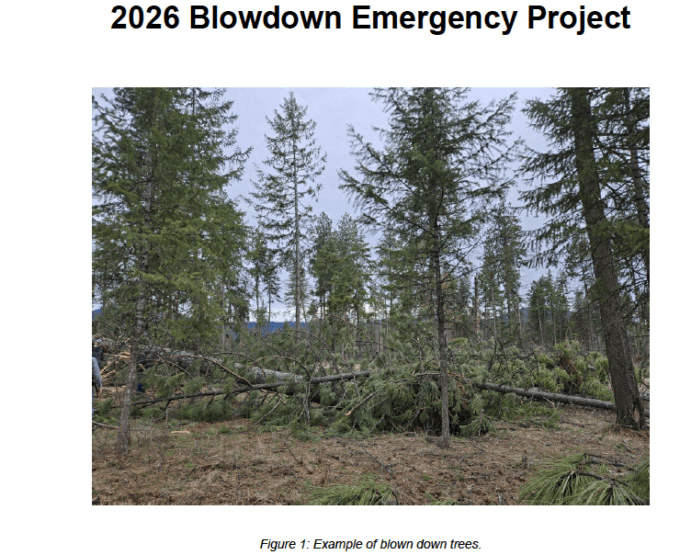
The plans for a U.S. Forest Service project happened after a December storm. This picture is from that public report, which was only being circulated for about a week for public comment.
Twenty-three years ago, the Bush administration and Republican majorities in both chambers of Congress passed the so-called “Healthy Forests Restoration Act.” Falsely claiming our forests were “unnaturally dense,” they redefined living forests full of trees as unacceptable “fuel loading,” and set about to promote “landscape scale” logging, thinning, and burning projects across millions of acres of National Forests to return them to “health.”
But then the unintended consequences began to mount and have only grown more dire in the last two decades.
Historically, the Forest Service has served the timber industry, not the forests. Having lost the “timber wars” of the ’90s due to widespread opposition, the agency had to come up with a reason to continue logging our dwindling forests. As higher temperatures and extreme drought impacts from a rapidly overheating climate continued to grow, the agency, as well as both Democratic and Republican politicians, turned to fear of wildfire as the latest excuse for widespread deforestation.
Fear is one of the great motivators — and the politicians and Forest Service spared no effort to project exaggerated fears to the populace, regardless of science or the historical record.
Their solution was to reduce “fuels” by “streamlining” logging, thinning, and burning projects on our National Forests, via “emergency” declarations and “categorical exclusions” from such foundational environmental laws as the National Environmental Policy Act, the Endangered Species Act, and the Forest Lands Planning and Management Act. Not coincidentally, public opportunities to review, comment, or object to massive logging, thinning, and burning projects were severely limited. The “experts” didn’t need nor desire input from the uninformed citizens who actually own these forests.
Ironically, these massive deforestation projects were supported by the Montana Wilderness Association, the Wilderness Society, and a handful of other public interest groups as well as Montana’s former senator Jon Tester. They lauded “collaboration” — in which former advocates for forests, fish, and wildlife would find consensus with the extractive industries, so our forests could be returned to health.
Thus, “landscape scale” deforestation moved forward, heralded by the collaborators as they sang “Kumbayah” with their former foes in the timber and mechanized recreation industries. The forests, however, did not share in their joy.
Two decades later, having deforested millions of acres, the unintended consequences are becoming undeniable, not the least of which are increasingly common “high wind” warning days, which a quick online search will confirm are due to increased deforestation. Cut down the trees and the wind speed increases. With less shade, less snow retention, and higher wind speeds, not only do the few trees left in the thinning projects face a higher risk of wildfire, but they are also blowing down in astounding numbers.
On June 22, the Forest Service announced the 2026 Emergency Blow Down Project in the Idaho Panhandle, Nez Perce-Clearwater, Lolo, Flathead, Bitterroot, and Kootenai National Forests due to “catastrophic blown down timber” from “straight line wind” events. The one-week comment period is laughable since the agency has declared logging will commence before it issues a Finding of No Significant Impact.
As one knowledgeable Montanan noted: “Almost all of the blowdown I have seen is in areas recently thinned. On the Lolo on the Marshall-Woods project area, there is a unit where every single tree that they left blew down. It looks like a tree graveyard.”
Ironically, the picture in the announcement shows a forest that has obviously been thinned and burned to “health” full of blown-down trees. It’s the perfect illustration of the ever-mounting unintended consequences of these inane projects, which in truth are creating the hazardous conditions they claim to be reducing.