The following piece was funded by the CounterPunch Investigative Fund.
Plastered onto the side of the glassed-in immigration office at the dock in Necoclí – the northwestern Colombian city just across the Gulf of Urabá from the Darién Gap – is a poster warning of the hazards of northbound migration. Over recent years, more than 1.2 million people from a mind-boggling array of countries have risked their lives to cross the Gap, the 106-kilometer stretch of roadless territory and formidable jungle that spans Colombia and Panama and constitutes the only land bridge between South and Central America. Most of them hoped to reach the United States, the very country that makes much of the world unlivable in the first place while simultaneously criminalizing migration, thereby forcing the global have-nots down increasingly lethal routes.
The protagonists of the poster are the Díaz family – mom, dad, and two young daughters – whose portrait appears superimposed over an image of a small boat packed with passengers. According to the poster, which is in Spanish, la familia Díaz had set out “in search of a better future,” boarding just such a boat as they made their way toward los Estados Unidos: “Two days later, a rescue team found their lifeless bodies, together with 59 other people who had also succumbed to the river’s fury.”
When I last visited Necoclí in January, the sign had already lost its intended audience. Hardly any migrants transit the Darién Gap these days, a result of the decision by current gringo sociopath-in-chief Donald Trump to effectively shut down the US border with Mexico and dispense with the concept of asylum. In the first three months of 2026, for example, Panama recorded a total of 92 arrivals from Colombia via the jungle; in August 2023 alone, there were 81,946. I, however, certainly found myself thinking a lot about la familia Díaz over the two-hour course of a high-speed, spine-shattering boat ride from Necoclí to the village of Capurganá, which lies inside the Darién Gap and which, along with the nearby village of Acandí, served as the principal points of departure for migrants entering the jungle.
This was my second visit to Capurganá, the first having taken place in January 2024, when I, too, entered the jungle as a “migrant.” Like in 2024, I flew into Medellín and took a nine-hour bus ride north to Necoclí, a gloriously scenic trip that came with complimentary vomit bags, handed out by the bus attendant for use on interminable mountain curves. Physically speaking, I was better prepared for the continuous lurching this time around as I had taken an uncharacteristic break from alcohol consumption, thanks to which I did not even realize until my second day in Necoclí that the city had implemented ley seca, a temporary ban on alcohol sales. This was on account of recent tire-burning and other local upheaval over the lands comprising the Necoclí hacienda Virgen del Cobre, which had formerly been utilized by paramilitary and narco-trafficking outfits and which the government of Gustavo Petro had undertaken to redistribute to peasant victims of Colombia’s armed conflict.
One woman I spoke with in Necoclí suggested that ley seca was one of the reasons the city seemed like a ghost town, in the absence of the customary ubiquitous music and alcohol-fueled ruckus. The other reason, of course, was that the city was no longer brimming with migrants, who had filled hotels and rental apartments, as well as the beach and sidewalks, for those who lacked the money to put more than a tent, a cardboard box, or a hammock between themselves and the elements. Every morning, the Necoclí dock became a vibrant hub of activity as boat after boat departed for Acandí and Capurganá, with vendors hawking arepas, waterproof cell phone pouches, rain ponchos, and anything else the jungle-bound migrant might need. By January 2026, the atmosphere was more subdued; most of the passengers on the Capurganá boat were tourists from other parts of Colombia and Europe, who emitted synchronized yelps as the vessel crashed against the waves.
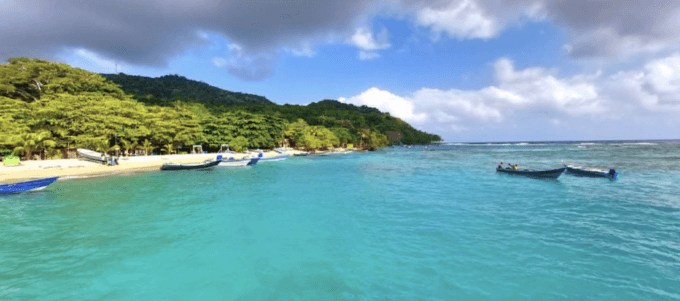
Capurganá, image by Belén Fernández.
From the dock in Capurganá, a hamlet boasting intermittently turquoise waters and no more than a few thousand inhabitants, migrants had been marched to waiting auto rickshaws that transported them to the albergue, or shelter. This was the final stop before commencing the trek across the Darién Gap, a trajectory that could take anywhere from a few days to a few weeks – for those that survived the crossing, that is. The “shelter” was not so much a shelter as a place for migrant smugglers to verify that all travelers were properly extorted before being dispatched into the jungle in groups with guides, who generally abandoned the migrants and turned back before even reaching the border with Panama, leaving them vulnerable to robbery and sexual assault for the remainder of the journey. 
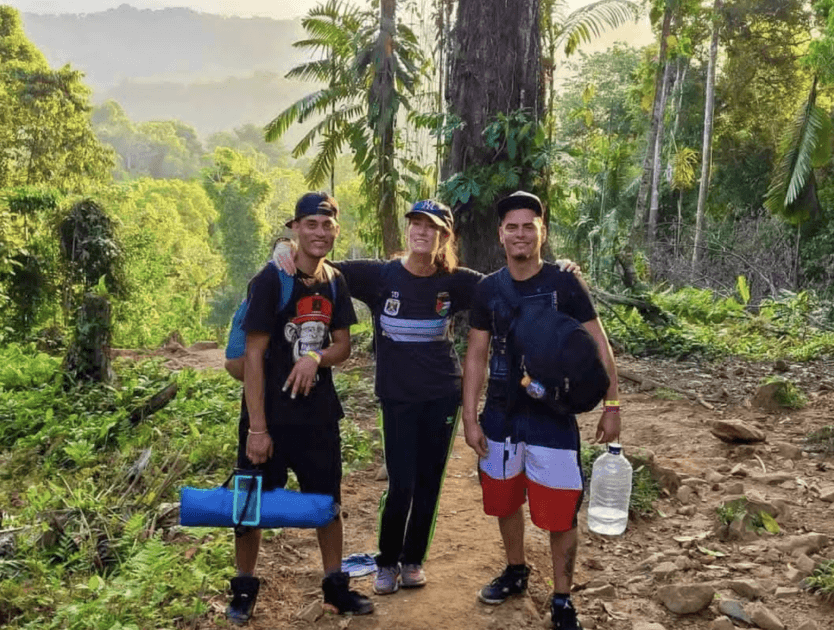
During my brief jungle incursion in 2024, I had also turned back with the guide, owing in part to logistical considerations – such as that I had left my computer behind in Necoclí – but mostly to the fact that I was too scared shitless to brave the Darién Gap in its entirety. I was traveling with two young Venezuelan men who had agreed to accompany me, and we had paid $280 apiece at the albergue for what would ultimately be nine hours of walking: five hours in the direction of Panama and four hours back, the quicker return pace attributable to the diminished size of our group, which now no longer included families with children. Our guide was a 28-year-old Afro-Colombian woman with two children of her own; she was training to be a nurse, but had jumped at the chance to earn some extra cash with the smuggling gig. As I had revealed neither the journalistic nature of my Darién trip nor my US citizenship, she was thoroughly baffled by my apparently spontaneous decision to renounce the American dream and retreat to Capurganá. To her credit, she refrained from asking too many questions and simply gave the two Venezuelans her WhatsApp number in case they wanted to try the crossing again without me.
This year, on the other hand, I disembarked at the Capurganá dock and boarded an auto rickshaw to a glamping establishment, as much as the term “glamping” gave me an aneurysm every time I thought about it. There I would spend two nights violating my personal ley seca with wine made from the borojó fruit and would make the acquaintance of an older woman from Bogotá who had lived in the US for decades and was now attempting a vacation with her son amidst unseasonal downpours. Having perfected the self-righteous entitlement of well-heeled Colombians who had migrated to the US by plane rather than walking through the Darién Gap, the woman lamented that today’s crop of migrants simply devoted themselves to robbing drugstores and otherwise refusing to lead respectable lives.
I had not come to Capurganá with any fixed plan aside from checking out the post-migration panorama, but I had figured I might as well attempt to track down a certain Darwin García Pérez, alias “Maradona,” who had been a key coordinator of the trans-Darién migrant route. In a September 2023 New York Times dispatch titled “‘A Ticket to Disney’? Politicians Charge Millions to Send Migrants to U.S.”, García was identified as an elected community board member and one of the “entrepreneurs behind the migrant gold rush,” who informed the Times: “We have organized everything: the boatmen, the guides, the bag carriers.” He was also quoted as declaring the deluge of migrants to be “the best thing that could have happened” to a chronically poor town, and had categorically denied affiliation with the Clan del Golfo, Colombia’s most powerful drug trafficking organization, whose overarching control of the migration enterprise was not exactly a secret. The same Times article cited President Petro’s calculation that the Clan del Golfo was raking in $30 million a year in its cut of the migratory proceeds – to say nothing of the billions it accrued from drug running, illegal gold mining, and other pursuits. In October 2023, the Colombian investigative news outlet Vorágine revealed that a portion of the migration funds accumulated by Maradona and colleagues was being funneled into the mayoral campaign of none other than Maradona’s half-brother, Luis Fernando Martínez Pérez, who was duly elected that year.
Fast forward to January 2025, and the Colombian Fiscalía – or Attorney General’s Office – took to X to announce migrant trafficking and other charges against García, who was said to be the proprietor and administrator of, inter alia, an albergue and a maritime transport company in the service of trafficking operations. The corresponding press release specified that García was accused of collaboration with the Clan del Golfo and of redirecting a percentage of migrant profits into the illicit outfit’s coffers, which had resulted in his arrest in a “coordinated action” between the Fiscalía, the Colombian National Police, the Colombian army’s Seventh Brigade, and Colombian migration authorities.
Shortly after his dramatic capture, García was quietly released, and I could find no further updates as to his subsequent activities. While waiting for my boat to Capurganá at the dock in Necoclí, I inquired about his alleged maritime transport company and received only defiant assertions that he had never owned any such company. However, one woman selling black garbage bags to passengers who did not wish to have their belongings soaked had told me that García had passed through just days before, meaning there was a good chance he was now in Capurganá. And so I set out from the glamping site armed with my notebook and the silly conviction that it would not only be a piece of cake to locate García but that he’d also be thrilled to talk to me about whether he continued to consider migration “the best thing that could have happened” to a village that despite substantial migratory windfalls still lacked regular electricity and anything resembling a health care system.
My fantasies were quickly dispelled by my very first interlocutor, a resident of Capurganá whom I’ll call Marcos. He said that of course he knew García, as everyone knew everyone else in Capurganá, and did me the favor of calling him right then and there on speakerphone to see if he might be up for a meeting. García’s answer was clear: absolutely not. The New York Times had distorted his words, he said, and he had no interest in talking to journalists who were simply out to smear his image. Marcos thanked him and hung up, then proceeded to become visibly agitated: “Please don’t ask me any more questions, and pretend we never had this conversation.” Upon hearing that I had envisioned swinging by the albergue-cum-migrant extortion center for old times’ sake, he warned that such a visit would not go unperceived by the local powers that be, and advised me for my own good to put my notebook away at once and restrain the urge to inquire about anything at all. Apparently noting that he had put the fear of god in me, Marcos assured me that I’d be perfectly fine as long as I didn’t go poking my nose where it didn’t belong. Capurganá, after all, was a very safe place, he said – a theme I had also heard repeatedly on my first visit – and I could roam about at any hour of the night with no danger of being robbed. This security, he added pointedly, was not thanks to the police, but rather to “los que mandan” – the ones in charge – who had made it understood that tourists were not to be touched.
Indeed, although there was a cosmetic presence in the village of Colombian police – whom I had observed in 2024 riding around on motorcycles and taking selfies while migrant smuggling operations were conducted entirely out in the open – they were definitely not the ones in charge. The ones in charge could not be named but in fact had many interchangeable names: the Clan del Golfo, the Urabeños, the Ejército Gaitanista de Colombia (the Gaitanist Army of Colombia, a reference to the politician Jorge Eliécer Gaitán, who was assassinated in 1948), the Autodefensas Gaitanistas de Colombia (Gaitanist Self-Defense Forces), and a revolving array of other titles. These were the same folks who had cracked down on physical violence against migrants on the Colombian side of the Darién Gap, which is why most sexual and other assaults occurred on the Panamanian side. The Afro-Colombian guide who had chaperoned my jungle incursion and exit with the two Venezuelans had informed us that migrant “security” was such a priority for those running the show that, for example, anyone who raped a migrant was liable to end up dead. Naturally, this was not out of any fundamental concern for migrant rights but rather was regarded as a better business model and a manifestation of territorial control. The enduring paradox in Capurganá and elsewhere in Colombia, then, is that a criminal organization imposes law and order and metes out justice for crimes.
This is not to imply that various Colombian governments have not also qualified as criminal organizations in their own right; ditto for their US backers. Recall the blood-drenched reign of far-right US buddy Álvaro Uribe (2002-10), a recipient of excessive American aid for his ostensible war on drugs and terror – never mind that Uribe himself had appeared on a 1991 US Defense Intelligence Agency list of the “more important Colombian narco-terrorists contracted by the Colombian narcotic cartels.” Uribe presided over such episodes as the “false positives” scandal, which broke in 2008 and entailed the slaughter of thousands of civilians by members of the Colombian army, who passed the corpses off as left-wing guerrillas and were rewarded with bonus pay and extra holiday time while the Colombian government utilized the ostensible battlefield successes in its appeals for yet more US aid.
As luck would have it, the Clan del Golfo was also born on Uribe’s watch – a result of the official demobilization of the Autodefensas Unidas de Colombia (United Self-Defense Forces of Colombia, or AUC), the notorious paramilitary and drug trafficking organization that had long operated in cahoots with the Colombian army and political and business establishment and that was responsible for carrying out all manner of massacres and other misdeeds. Carlos Castaño, who cofounded the AUC in 1997, boasted in his biography Mi Confesión of having copied the whole “autodefensa” concept from none other than the Israelis – because who better than the state of Israel to cast mass killing and forced displacement as “self-defense”? Castaño’s brother Vicente, one of many AUC warlords who ditched demobilization in favor of carrying on with business, laid the foundations for the Clan del Golfo or Autodefensas Gaitanistas de Colombia (AGC), the latter name preserving the old “self-defense” theme. However, as scholars Reynell Badillo and Luis Fernando Trejos Rosero point out in a 2023 paper on post-AUC violence in Colombia, the Clan del Golfo/AGC is not a paramilitary organization in the traditional sense in that it is neither oriented toward counterinsurgency nor toward cooperation with the state, with which it is instead often in direct conflict – although there is collaboration with law enforcement and other officials on an individual level. In certain areas of the country controlled by the Clan del Golfo, the authors note, the group’s power penetrates society to such an extent that even the minutiae of daily life, as well as domestic and interpersonal matters, are subject to AGC adjudication.
+++
Following my encounter with Marcos, I largely confined my activities in Capurganá to wandering around trying to look like a tourist and keeping my mouth shut. So it wasn’t my fault when on my second day in town I stumbled upon a group of exhausted, sunscreen-slathered Venezuelans who had just been boated in from Panama – part of the mass “reverse migration” fueled by Trump’s border shutdown and another side hustle for the Clan del Golfo. I had already spoken with Venezuelan acquaintances of mine who had made the return trip from Mexico and reported it to be even more harrowing and costly than the trip up, despite the fact that the maritime route from Panama spared them from having to recross the Darién Gap on foot. As I walked past the group in Capurganá who were making their way to the boat ticket lines to Necoclí, one of the children said hi to me, which I used as an excuse to strike up a conversation with the adult family members. No sooner had they told me they were coming from the US border than a man in a white polo shirt decided I needed to be ushered into a separate ticket line to reconfirm my own departure for the next day.
The reconfirmation complete, I retraced my steps to the auto rickshaw stand, where I had noticed a tent belonging to the Colombian Red Cross that presumably served returning migrants. Thinking that perhaps at the very least the Colombian Red Cross would be willing to talk to me, I approached the tent but was intercepted by a young woman involved in the auto rickshaw operations, who addressed me as though I was committing some sort of crime: “Are you looking for something?” I went with the first innocuous response that popped into my mind: I was looking for the path to Sapzurro, a reportedly stunning coastal village directly on the border with Panama, which had come highly recommended by Marcos. She pointed me in the proper direction with a smirk and the assurance that I’d reach my destination in 90 minutes.
And so it was that I found myself on my way to Sapzurro, which turned out to be a fairly grueling trek of much more than 90 minutes up and down a mountain through dense and sweltering forest. I had thankfully had the foresight to fill my backpack with cold beer – and, judging from the contents of a random mid-jungle trash can, I had not been the only hiker to have had this idea. I crossed paths with a smattering of other humans, one of them a gregarious young Colombian man who spoke to me openly on a range of matters, albeit never invoking the Clan del Golfo by name, instead relying on the pronoun “they.” But when I later asked if he’d be amenable to being quoted anonymously in an article – even just on the subject of the regional economic effects of migration – he freaked out and declined. I continued on to Sapzurro, wondering whether “security” was worth living in fear, not that “security” means much in a country that is consistently among the deadliest in the world for human rights activists, environmental defenders, and trade unionists.
At Sapzurro, I took a much-needed plunge into the magnificent aquamarine sea and then climbed several hundred concrete steps up to the border with Panama, where the Colombian and Panamanian flags flew side by side and no one asked for my passport. Descending to the Panamanian village of La Miel below, I paid a visit to the duty-free store and negotiated boat passage back to Capurganá for around $5 – a trajectory that, according to certain media reports, could cost up to $200 for reverse migrants. The Colombian boat captain who received my fare endeavored, to no avail, to persuade me to gift him my Ciudad Juárez baseball cap, as well, which I had acquired during a January 2025 trip to the Mexican border city just as Trump’s “deportation blitz” was kicking off. The man was a Capurganá native, and upon hearing I was a journalist, preempted any questions I might have with the blanket dismissal: “I don’t know anything.”
The vessel that would be transporting us for 45 minutes to Capurganá was a rickety wooden number that would have held approximately four people comfortably but into which ten of us had been loaded including the captain, who thought better of it at the last minute; by this point, though, it was too late for anyone to dismount as the waves had whipped themselves into such a fury that we would have crashed into the dock. We thus took off frantically out to sea for a ride that made the Necoclí-Capurganá boat look like a soothing meditation session. I had been placed at the very front for maximum terror and greatest impact as the boat rose almost perpendicular to the sea and then slammed back down again. Walls of water hovered over us like cartoon tidal waves as we lurched perilously close to rocky cliffs, and the Díaz family from the immigration poster waved to me from my mind while I clung to the thin wooden slat that served as my seat. I lived to tell the tale, of course, and the following day I returned to Necoclí feeling that I had simultaneously learned a lot and nothing at all in Capurganá.
A few months after I left Colombia, in June 2026, the New York Times reported on a request made earlier in the year by the Colombian defense minister, who had asked the Trump administration to issue financial sanctions against the country’s illegal gold industry, one of many lining the pockets of the Clan del Golfo. Per the Times writeup, “the request put the Treasury Department in an unusual situation: It had, for many years, been buying gold that originated with the very industry that it was being asked to blacklist.” Of course, imperial hypocrisy is nothing “unusual” – much as it may shock the US newspaper of record – as any cursory review of the recent history of US-Colombian relations attests. In 2001, for example, the US designated the AUC as a Foreign Terrorist Organization and yet continued flinging gobs of money at a Colombian government intimately linked to that very group. In December 2025, the US designated the Clan del Golfo as a Foreign Terrorist Organization but continued buying its gold, not to mention presiding over the criminalization of drugs and migration that renders the organization’s trafficking activities lucrative in the first place.
And as the whole “unusual” business proceeds as usual, there are a whole lot of questions that should be asked.