Joelyn and I talked through the bars on the stall windows as we shoveled manure into large buckets. We had gotten to know each other one Saturday morning after another, swapping stories while hoisting heavy buckets of horse shit into a small John Deere tractor at the barn where I worked and he volunteered each weekend. He’s telling me about a trip he took to Pine Ridge Reservation, where he went to photograph Indian Relay Races.
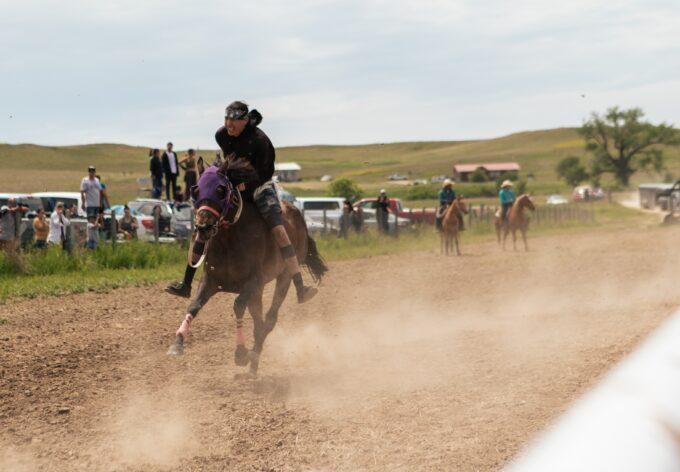
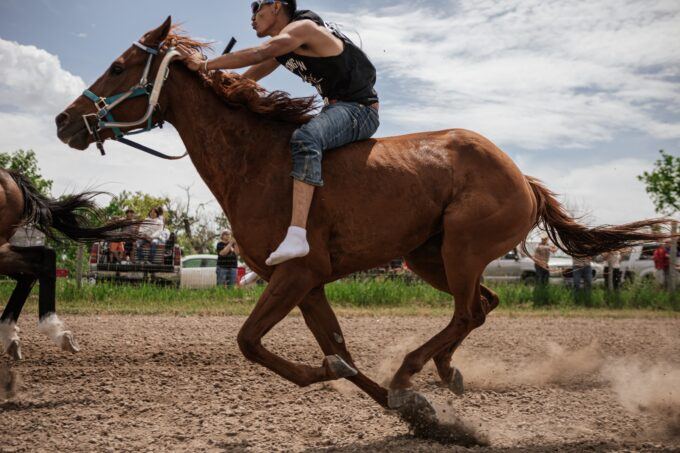
“It’s incredible watching the racers,” he says, “They run down the track to their horse bareback, leap onto them from the ground, then take off running.” He held his phone out to show me a picture of a jockey who wore a purple folded bandana around his forehead, his hair whipping in the wind. He smiled through gritted teeth, his eyes were studded with a steely desire. He was mid-leap, soaring through the air onto his horse. They were already running, all six legs suspended, a plume of dust behind them. He and a few of the other jockeys rode for “The Brew Crew,” Pine Ridge’s relay team, owned by a Lakota horseman named Stan Brewer, and they worked as wranglers at Sage to Saddle in the off-season. Sage to Saddle is a non-profit started by Stan and Nate Bressler as an effort to teach Lakota kids on the reservation to ride and to reconnect them to their culture as horse people.
The image of the jockey on Joelyn’s phone stuck with me, and a few months later, I was on a plane to South Dakota, looking out my cloudy porthole as we descended into Rapid City. I had come for the week to meet Joelyn, to watch Stan’s jockeys work their horses ahead of racing season, and to see the work Sage to Saddle is doing for the kids in Pine Ridge. Joelyn had invited me partly because I’m a horse person but also because I’m a writer – he hoped I might be able to write about the program, bring some attention to it, and maybe even help them raise a little money.
I drove my rental car two hours south to Pine Ridge, past fields of horses, casinos, RV parks, roadside restaurants, and towering bluffs. I drove with the windows down, exhilarated by the open roads. When I got to Pine Ridge, I turned onto the Oyate Trail, a two-lane highway running along the Nebraska panhandle through the southern half of the reservation. The hills seemed to go on forever, with little but land and sky breaking the horizon. Cattle and horses grazed freely in small herds washed in gold light. I pulled over to watch a few feral dogs root through a ditch before running off together deep into the tall prairie grass that ran along the highway.
I turned onto a gravel road as I got closer to the ranch. Outside my window, FEMA trailers were scattered across the fields in all stages of ruin. It was hard to tell which ones were inhabited. Car tires sat on most of the roofs, weighing them down so they didn’t blow away in the bad windstorms, which are relentless throughout the plains, but wreak particular havoc on the insubstantial Pine Ridge infrastructure. Some of the trailers I drove past had their roofs completely torn off, walls stripped of siding, or blown in entirely. A few miles down the gravel path towards Stan’s ranch, I came upon a horse in the middle of the road. Jet black with a white snip and two white socks. He turned to stare for a minute, walked over to my window, then ambled down into the ditch to graze. Nearby, a patch of barbed wire fence had been flattened to the ground, and a bay and white Paint stood next to a mule on the other side, too cautious to cross.
I plugged Stan’s GPS coordinates into my phone, but didn’t get cell service. There aren’t really addresses in this part of the reservation, just markers. I pulled out the notebook where I’d jotted down instructions from Joelyn. Drive across four cattle guards and one black gate until I reach a driveway with a large wooden stump, where I’m to pull off the gravel road and onto a winding dirt road leading to the ranch. Three small dogs begin to circle the car as I pull into the driveway – a small fat bulldog named Sally, a beagle with sagging red eyes named Hazel, and a black and white border collie with one blue eye named Dandy. I parked behind a large horse trailer and welcomed the barking dogs into my outstretched arms. Nate stepped out of the camper, waving. He had a bronzed Florida tan, a compact cowboy body, and a thick mustache. He wore a tan cowboy hat, round metal frames, and a dark brown Carhartt jacket. He looked like so many of the cowboys I’ve met in my life, walking as though he were still in the saddle.
I shook his hand, and then we hugged. Nate opened his arms out toward the vista in front of him. Stan’s property stretched out for what seemed like miles, nothing but sky, tall grass, and pines flanking the hills. Joelyn was haying Nate’s horses across the gravel driveway. We hug, and I grab a large flake of hay from the jumbo bale and follow him. Nate introduces me to his horses, a chestnut named JayJay, a chocolate palomino named Chockie, and a buckskin named ZeZe. For the past eight years, he’s driven them to Pine Ridge from Florida, where he lives part of the year. It’s a four-day trip, Nate says, gesturing toward the stock trailer, “but I can make it in three.” Nate shows me around his airstream, where he lives on Stan’s property. “I tell my mom she should be proud of me for having my own place,” he laughs, “it’s got everything: kitchen, bed, pullout couch, and a small dining nook.”
Like me, Nate was raised in the Midwest but eventually found himself in the city. He was accustomed to ranch life and spent his childhood around horses. He went to powwows with his aunt and felt a connection to Native culture from a young age. At 18, he began working with Native kids, while living in Arizona, and has worked with kids ever since. He spent the first part of his career as an archaeologist before turning to photography full-time. He’d lived in New York for a few years, working as a freelance photographer, when he first came to Pine Ridge on assignment for Outside Magazine in 2016. Outside was doing a piece on Pine Ridge’s Indian Relay Racing team, and the death of their jockey Hermis Tall. Tall was one of the most legendary racers in the history of the sport. Before his death, he’d led the Brew Crew to the championships three years in a row. Nate followed the Brew Crew for weeks as they began their first season without Tall.
He got to know Stan and his racers intimately. They stayed up each night talking, and the longer Nate spent with Stan, the more he knew he wasn’t going to want to leave. He’d watched how hard the racers trained, how beautiful their relationships with their horses became, and how difficult life on the reservation could be. If he were to stay, he wanted to find a way to give back. He imagined a photography campaign, with images of the racers wheatpasted around the reservation. Something to inspire a bit of hope and pride, but it didn’t feel like enough. For one, the weather is too extreme, anything he posted would be destroyed in no time.
Photograph by Joelyn Dalit.
He was moved by what he experienced spending time with Stan and his uncle Shorty Brewer, both of whom had been riding their whole lives. They had dedicated themselves to reconnecting the next generation of kids to their cultural roots, to horses and the traditional ceremonies that were stolen from them during colonization. And like Stan and Shorty and the racers, Nate understood that horses can be a powerful antidote to sadness. No matter how dark it gets, a horse always sheds just a little light.
On his last day in town, Nate photographed the Brew Crew’s race at the Oglala Lakota Nation Fair. He told me that as he was setting up his camp that night, he had a vision. Together with Stan, they would create a place for Lakota kids to come ride, to learn from one another, and escape, even if just for a little bit, whatever difficulties their home lives might present. He wanted the program to serve as a community of Lakota riders, preparing the next generation to reclaim the sovereign nation that once belonged to them, practicing the traditional ceremonies that were once taken from them, and restoring their cultural legacy as a horse nation.
Stan would need a ranch to keep his 200 head of cattle and his horses, an indoor arena where kids could escape the cold and ride during the winter months, and they’d need money to sustain it all. “We put it to the universe, and the universe answered,” Nate said. Only a few months later, the ranch across the road from Stan’s went up for sale, along with its acres of pasture, corrals, and a heated indoor arena. Stan got a loan, and Nate put up some of the money for him to buy it. Soon after, Nate left his photography career, bought a camper, and relocated to Stan’s ranch.
While summer months are spent on horseback, the brutal South Dakota winters drive up Pine Ridge’s already staggering suicide rates, with teen suicide rates over 150% higher than the national average. Many residents lack reliable heat during these brutally cold winters, exacerbating all the other difficulties of life on the reservation. It was crucial to Nate that kids have a place to be with horses during these long, isolating winters. They employed the Brew Crew racers as wranglers, in the off-season and began developing partnerships with local schools so they could ensure kids would have something to do when they weren’t in class and that they would have somewhere safe to go, somewhere with electricity and running water, which homes do not always have on the reservation. Anyone can be part of Sage to Saddle, but there are conditions they must meet: they must attend school, stay sober, and stay out of jail.
Pine Ridge is defined to most outsiders by its staggering statistics–as one of the poorest places in America, with the highest infant mortality rates, the highest unemployment rates, and one of the lowest life expectancies. Most Americans will never go to Pine Ridge, or any reservation for that matter, but when outsiders do, it is often just to document. To film, photograph, record, or write about the bleakness. To fetishize remarkable resilience, or to yearn for cultural identity. I, too, had come to document, just as Nate and Joelyn had. I’d come to write about the vital relationship between horses and people and to understand the particular and enduring bond between horses and the Oglala Lakota, set against the history of colonial violence. I had come as a writer and a horse person, trying to find a way to be useful in a place that had no particular need for me.
⥈
I’d been on the reservation for maybe an hour before we got in Nate’s truck and left. There aren’t many restaurants on the reservation, so we drove across the border into Nebraska for breakfast at a diner called the Twisted Turtle. Nate makes a show of telling the server that Joelyn and I are visiting from New York City. I remind him I was born just one state over. I drink three cups of black coffee and devour a thick stack of pancakes. Joelyn talks about watching The Brew Crew race a few summers before, when he’d photographed the World Championships and met Nate for the first time.
After breakfast, Nate drove us past the Pine Ridge Sanitation Center, which offers one of the few jobs available on the reservation. With over half of the population living in poverty and unemployment rates as high as 89%, jobs like these are highly sought after. Pine Ridge is one of the largest reservations in the U.S., at 3500 square miles. We spent all day driving the length of its southern edge, through Porcupine, Manderson, Whiteclay, Wanblee, and finally north, up to the Badlands. Nate pointed things out while we drove. We passed the skate park, designed and built by a Lakota skater, with backing from Vans, the Tony Hawk Foundation, and Pearl Jam bassist, Jeff Ament. A group of young men filmed as a teen caught the lip of his board onto a metal rail, grinds down it, then jumps off, his board landing a few feet away in a clatter.
Photograph by Joelyn Dalit.
In town, Nate waves to people as we pass, explaining how so-and-so is related to a Sage kid, or a Brew Crew racer. On the highway, we pass a large modernist building, all concrete and dark-plated glass, set back off the highway, surrounded by a parking lot. Now a Lakota cultural center, it was once a Jesuit boarding school called Red Cloud Indian School, founded in 1888 after the Massacre at Wounded Knee. Despite being established by the Jesuits at the request of Chief Red Cloud, in order to teach Lakota children to read and write, it operated like other Indian boarding schools, with an assimilationist mission to strip Lakota children of their language and culture, and separate them from their families. Driving through Pine Ridge, this history looms just beyond the present like an incessant shadow.
We drove through the southern tip of Badlands National Park. We wound through towering rock faces, in shades of blush, umber, and bright orange, some striated with ferrous rings. We pulled over at a lookout spot and walked to the edge of the cliff, which seemed to drop for miles below. Bighorn sheep balanced on protruding cliffs, making their way down the cascading rocks that formed a staircase to the valley of sand sculptures below, where bright orange hoodoos grow upward toward the sky, amid the vast canyons layered with reds, pinks, even streaks of blue. I walked through the sandy coves of the cliff face and ran my hand along mottled walls, reaching inside small crevices to collect the dust.
Just across the highway, Pronghorn clipped through lush grasses toward the pine-clad mountains of the Black Hills. The Black Hills, which the Lakota call Ȟe Sápa are the spiritual center of the universe for the Lakota people. It was the hills that birthed the Lakota people from the underworld, where they were guided into the world by the spirits of ancestors and the bison. It is believed that the hills are mirrors to the heavens, aligning with the cosmos, creating a multidimensional spiritual grid across the landscape.
It was also where, during the summer of 1874, while traveling with Custer’s 7th Cavalry, a prospector named Horatio Ross struck gold at French Creek. When reports of his finding made national headlines, the Black Hills Gold Rush began when thousands of prospectors flooded the Lakota’s sovereign land.
We drove a few miles to the Badlands Visitor Center to pee. Dandy and Bud hopped out of the cab and lifted their legs on a large boulder at the base of an American flag ripping in the wind. Inside, I browsed souvenirs: a baseball hat with a black-footed ferret, bison jerky, postcards of spectacular vistas, bison rattlesnakes, colorful kiddie compasses, a small burlap sack of candied gold.
Before we head back to Stan’s, we drive to a little town called Interior, which looks like an old western movie set, with an abandoned theater, two saloons, and a white clapboard church. We go to a saloon called “The Wagon Wheel,” with hitching posts outside. Inside, the bar is dimly lit, a man sits alone in a booth watching grainy football replays from the TV hung in the corner, two cowboys shoot pool in the middle of the room. We grab stools around the bar, which has a long mirrored wall, and Christmas lights strung from its old, wooden eaves. We ordered a round of red beers—tomato juice and watery beers, and bags of corn chips.
⥈
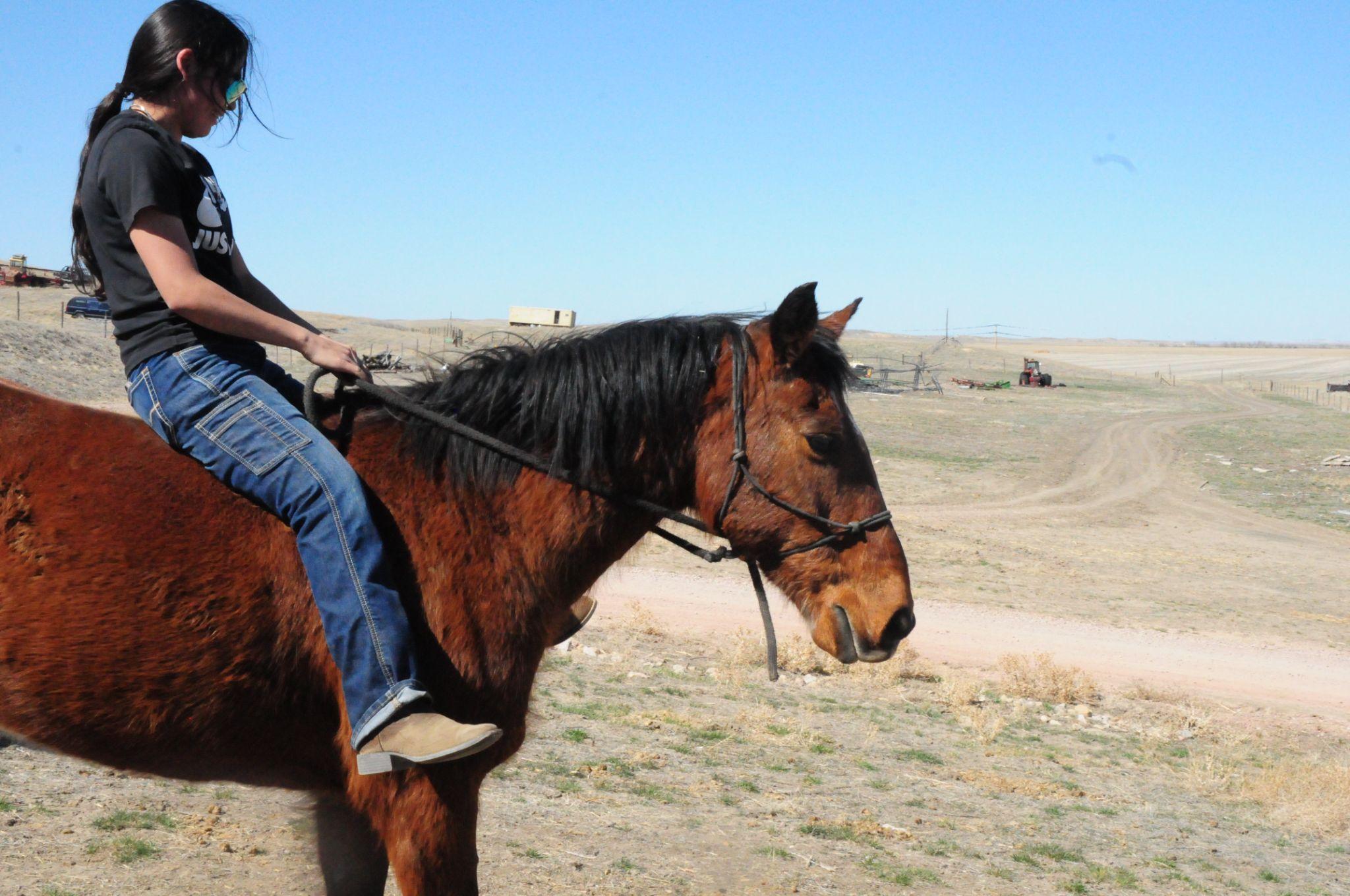
Arianna and horse, photograph by Alyse Burnside.
The next day, I arrived at the barn around two to help get the horses ready for the first day of the Sage to Saddle afterschool program.
I wander into the arena to see the Brew Crew racehorses in their holding stalls. A tall, lean chestnut hangs his head over his stall door, puts his face close to mine, and blows hot air onto my back. Nate introduces me to Stan and to Sage’s wranglers: Kalijah, Davis, Joe, and Maria. Kalijah and Davis hop on a four-wheeler and ride up the hill to grab a few horses from the far paddocks. “Joelyn, get your camera out so you can photograph them riding in with the horses,” Nate says, “It’s a sight to watch them all ride down together.” I take my cell phone out and record as Davis rides Nate’s chocolate Palomino, Chalkie, down the hill, ponying three horses behind him.
Soon after, the low growl of the four-wheeler grows louder, and Kalijah turns down the hill holding two leadropes, one horse at each side of his quad. Joe and his girlfriend Maria hop onto their horses in a nearby pasture, jumping from the ground, wrapping their arms around their horses’ necks as they move off. Maria rides up next to a stocky bay horse, swings a rope around his neck, and halters him. They ride down the hill, horses in hand like a gallant procession. Joelyn’s shutter clicks in double-time with the sound of hooves on the gravel.
The wranglers tie the horses to posts in the arena. Nate hops in a Sprinter van and head to pick up the Sage kids from school on the other side of the reservation, nearly an hour away. Joelyn, Stan, and I help the wranglers get the horses ready. Stan is friendly, with a youthful warm smile. He is the kind of guy you can tell has a good sense of humor even if you never hear him crack a joke. We make a little small talk, but he is focused on the horses and the kids. He keeps moving, busying himself trimming one of the pony’s hooves, haying the Thoroughbreds, and setting up the arena for the day’s lesson. When the horses are tacked, we polish our cowboy boots and wait for the kids to arrive.
Davis sets up a plastic steer and practices roping. He flicks his lasso over his head, turning it back on itself before casting it out in front of him. The waxy rope makes a swish as it falls over the steer’s head, then a ziiippp when he pulls it back, taut around the steer’s horns. When he misses, the rope makes a hard thwack against the plastic, and Davis sucks air through his teeth. I sit on a bench next to two barn kittens huddled together on a dusty office chair. Joe begins to tell stories. He’s the performer of the group. His personality is made even bigger in comparison to the other wranglers, whose quiet temperaments leave room for him to take the stage. His girlfriend Maria, sits next to him, smirking, holding the beagle on her lap, interjecting at times to tease him gently or add her own details. Kalijah cracks sunflower seeds in his lap, shimmying loose shells onto the ground.
I recognized Joe immediately from Joelyn’s photos. I began asking him about racing, how long he’d been with the Brewer team, if he had a favorite horse, and if he ever felt afraid hopping wildly from horse to horse. “I think she might be my favorite,” he said, pointing at a sinewy chestnut with his head hanging out his stall window, “Fast as fuck!”
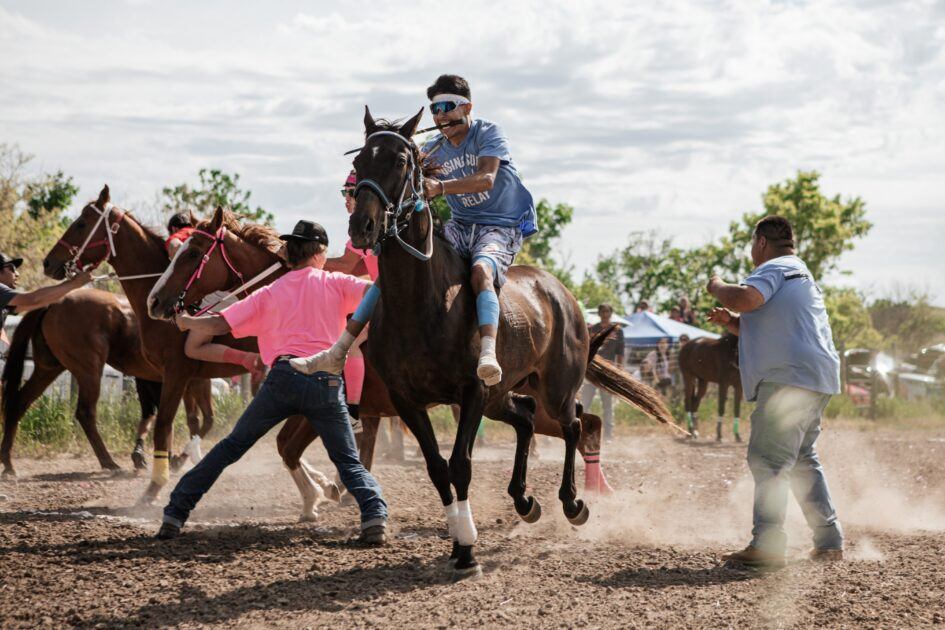
Unlike in typical racing where a jockey races one horse for the length of a race, in a relay, a jockey rides three horses, each for a single lap, jumping off one and immediately onto the next. The loud crack of a gun sounds, and the racers run to their horse’s side, place their hands on their horse’s withers as they leap into the air and hurdle onto them, as though they were throwing themselves over a fence. Sometimes they’d mount by “ass-hopping,” running up behind the horse, placing their hands on either side of their hind, and leapfrogging onto their horse’s back. As they mount, the handlers struggle to hold the horses back, their whole bodies pulsing with energy. They pull against the metal bit in their mouth, swing their hind ends into one another as though to kick, and some begin to rear, lifting their front ends into the air. It is a spectacle to see bodies colliding, energy coming together, and taking off.
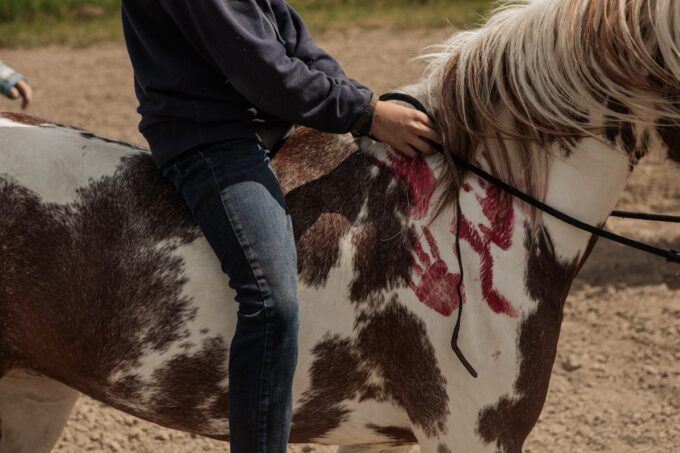
The jockeys ride bareback, sometimes at over 35 miles an hour. They often dress in traditional regalia,–breechcloth, beaded moccasins, and warbonnets. They wear team jerseys or ride bare-chested. They mark their horses with symbols painted in colored chalk. A circle painted around their horse’s eye heightens their instincts, stripes grant them speed, a handprint grants them protection and safe return from battle.
Occasionally, the racers overshoot their mounts and hurdle right over their horse’s back, tumbling to the ground. Sometimes the muggers fail to catch an incoming horse, causing a pile-up, sometimes jockeys get trampled. Even winning could be dangerous.
I’d seen videos of Joe racing before I came. I’d seen him leaping wildly onto and off his horses, sometimes ass-hopping. I’d watched with great anxiety as he barreled down the track, thrusting his hands forward with each stride, his legs wrapped around his horse’s barrel. I asked him if he’d ever been injured in a race, and he lit up excitedly, leaned forward in his chair, and began to tell a story.
Once, while making his way to the winner’s circle, Joe began to do a celebratory dance, scaring a young Thoroughbred. The horse spun around and double-barreled him, kicking him in the stomach until he doubled over. He picked himself off the ground and posed for his victory photos. At his team’s urging, he visited the medic tent, where he was brushed off and told to take some Aspirin for his pain. It was a Lakota nurse who had seen the accident, who insisted he go to the hospital to be checked for internal bleeding. A decision that ultimately saved his life. He laughs now as he tells the story—in that same effervescent, almost maniacal way he’s told all the stories I’ve heard since I arrived—the sad, hysterical, and absolutely terrifying.
He was taken to a nearby hospital, then life-flighted to Rapid City for emergency surgery to stop his internal bleeding. By this point, Joe is so excited his smile takes up almost his whole face. He pulls his t-shirt up to reveal a scar running from his left hipbone to his right ribcage. “Check this shit out,” he says. Maria rolls her eyes and laughs along with us, even though I’m sure she’s heard this story a million times by now. She laughs, as we do, even though the story sounds terrifying to me.
“Were you afraid to race after that?” I ask stupidly. “Hell nah! I’m a goddamn maniac,” he yells, and we roar. “For real, though, life is short for Indian men, so I figure why the hell not race? Why not die doing this?” His eyes harden a bit, “I hit middle age at 18. I’m a geezer already!” He hunches forward a bit, as though pushing his invisible walker, making his voice pinched like an old man. I have laughed all the air out of my lungs. We are still laughing, the muscles in my face begin to cramp. Joe laughs the most and the loudest. He wraps his arm around his stomach and doubles over. His laughter becomes squeaky, like a deflating balloon, then devolves into gasps for air. “I’m not even kidding,” he says one last time, and we laugh all over again.
Photograph by Joelyn Dalit.
When the kids arrive, they set their backpacks down on a bench lining the arena wall. Nate tells them there are visitors from New York City who have come all the way to see them ride. I tell them that it is illegal to gallop a horse in the city, one of the few horse facts I can bring that might surprise them. The kids are shocked, but Stan and the wranglers find this particularly outrageous. “I’d be getting pulled over all the time,” Kalijah says, “Yeah, I can’t go there,” Davis agrees. The kids begin to joke, “please officer, I didn’t know how fast I was riding,” one girl begs. A few of the kids seem intrigued by the idea of the city, but most of them don’t. We all stand and form a circle in front of the horses. Each ride begins with a ceremonial saging. Nate lights a small bundle of sage in an Abalone shell. He gathers the curling smoke with a cupped hand, and raises it up over his head. We pass it around the circle, each of us dropping it over ourselves like a veil of protection. Once the circle is completed, the kids put on their riding helmets and find their horse.
Stan tells me I can ride one of the ponies called Peggy. A gelding with a long, crimped mane and light bay coat. “He’s a gelding named Peggy, kind of like ‘A Boy Named Sue,’” Stan laughs. Peggy pushes his nose into my pockets looking for treats. I scratch his shoulder, and he extends his neck and his top lip twitches, grooming the air.
The wranglers help the kids mount their horses. Everyone else is riding full-sized horses, and I only come up to their knees on Peggy. While he might be child-sized, he isn’t as trustworthy as he’d need to be for kid riders. I take him around the ring with the others. We trot a few laps in each direction, then I lope him around a bit, and he throws his head down, arching his back to throw a few crowhops, lifting his hind end only slightly off the ground. At his size, the hops don’t unseat me, but feel as though I’m bouncing on a pogo stick. One of the girls laughs a little when she sees us hopping together.
We lined our horses up along the arena wall, taking turns riding them through a chute and over a ground pole raised a foot or so on one side, wedged between two slats of a metal fence panel. We learned to use our weight in the saddle to help our horses move over objects on the ground, creating a sense of safety so that we could clear these obstacles together. The first rider manages seamlessly, her horse hopping effortlessly over the pole. The second horse refuses at first, and after a little coaxing, walks over.
Soon it is my turn. Peggy was a roping pony, used to speed and quick turns. He had a fearless but flighty energy that reminded me of my old horse, Shirley, whose strong will broke several of my bones, but who was my refuge during the most difficult moments of my childhood. We make our turn into the chute, and Peggy starts dancing. I bring my weight out of the saddle and off his back. He pushes his nose out and lowers his head. Ego takes over a bit, and I think of how mortifying it would be to be the New Yorker who fell off Peggy the pony. Peggy surely senses my ego and wants nothing more than to obliterate it. He would love to be the pony to throw a New Yorker to the ground.
The kids were shy, as preteens tend to be. I was shy too, a bit worried my presence is an intrusion on their time together. I asked one of the girls whether she likes riding, and she nodded, a bit bashfully. One thing horses can teach us is how to communicate beyond words, and watching the kids ride together, they seemed at home on their horses, and at home together in this arena.
Nate calls them “Bucky.” “It’s hard to get a lot out of them,” he explains, “But they like to spend time with their friends, and they like to spend time with horses, and that’s all I really need to hear.” Some of the kids have difficult home lives. Many have had loved ones die, and most have seen people close to them struggle. Time spent riding can be a small reprieve from these heavy realities, and time spent riding together can make life less isolating.
⥈
Photograph by Joelyn Dalit.
Nearly every night, I make the drive from the ranch back to my motel in Hot Springs in the pitch dark. I look up the Pine Ridge Reddit, which warns me not to linger after dark because of the high crime rates, but most nights I don’t pass a single soul. I’m more worried about hitting feral dogs, cattle, or horses that might wander onto the road.
Instead, it’s my drive into Hot Springs that unsettles me. I’m pulled over almost immediately, a cop with an unmarked car squeals its sirens, unveiling a panel of lights at the top of his windshield. The officer walks slowly toward me, his flashlight beaming through my rearview window. His hulking trunk is all I see out my driver’s side window. He’s wearing a tight black t-shirt, a bulletproof vest, a gator pushed down over his neck, his badge, and a blue brass pin. He looks like he’s on his way to a militia meeting rather than nightly small-town rounds. He asks me where I’m from and what I’m doing here. He’s pulled me over because I’m driving a little slowly, seeming a little lost. I know not to mention the reservation. Instead, I spin a strange story about visiting my husband’s grandmother in Rapid City, of being awed by my surroundings and wanting to take them in slowly. I laugh a little, knowing that despite my anxiety, I will drive away soon with just a warning.
The lodge is motel-style, with doors facing the driveway across from a strip mall. A large Chevy truck sat in front of my room most nights with a bumper sticker that read L.G.B.T., which I’d quickly noticed on my first night here. When I walked closer, I saw that LGBT stood for Liberty. Guns. Beer. Trump.
Each night, I’d park my rental car, take out my dull pocket knife, and dart across the parking lot to my door, nearly tripping every time on the uneven concrete. Once inside, I’d push the couch in front of the door and close the blinds. The room itself was to be expected. A bible on the nightstand, a painting of cowboys riding over a rocky cliff, and a small mini fridge. The walls were thin, and the room smelled strongly of sickly sweet Febreze, spring glade, or lilac sunrise, or some other powdery annihilation.
I called my girlfriend. At some point, I started calling Pine Ridge “The Rez.” It came out of my mouth easily, but didn’t feel like it belonged to me.“The Rez,” she says, teasing, she’d heard it too.
In the morning, I wake up early and drive through the Black Hills, to Custer, where the Gold Rush began. As I drive, the terrain turns from lush green hills to craggy mountains mottled with tall naked pines, charred from wildfire. As I climbed up the hills, the road began to narrow, and granite rock pillars on either side of the road closed in around me, massive eroded granite spires jutting out of the ground like pointed blades. Billboards line the highway outside of Custer: Mt. Rushmore tours, Wall Drug, “Shoot a Machine Gun Today,” and Big Thunder Gold Mine.
Now overrun with tourist shops and sham gold panning excursions, this was once Lakota sovereign land. After the discovery of gold in 1874, white prospectors pillaged the hills in hopes of striking gold. When Lakota tribal leaders Sitting Bull and Crazy Horse refused to sell the land that was so sacred to them, the army set out on a crusade to force them into reservations. In 1876, in what is now known as the Battle of the Little Bighorn, the Lakota surrounded the Cavalry and killed all 210 of them, including Custer. The battle marked a decisive victory for the Lakota, but resulted in intensified efforts to separate the Lakota people and confine them to reservations.
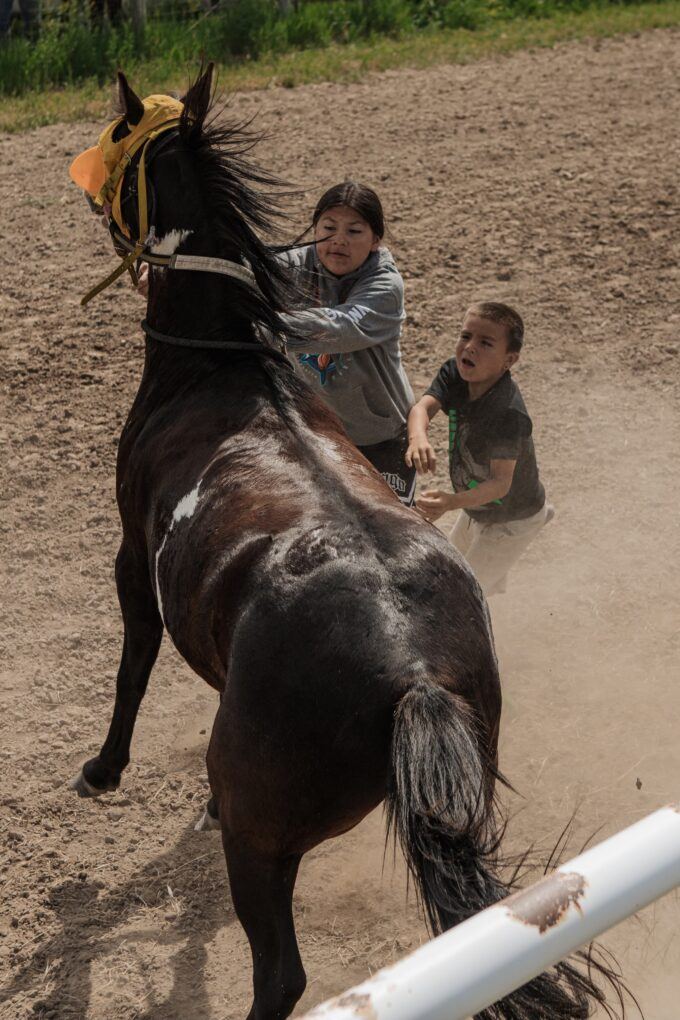
Photograph by Joelyn Dalit.
After the victory at the Battle of the Little Bighorn, the Cavalry also set out to separate the Lakota from their horses. The Lakota were referred to by other tribes as “Horse Nation” because horses were the backbone of their culture, and their innate connection to horses is central to their way of life. The U.S. Army recognized this power and sought to destroy it. 1876 is commonly known to Lakota people as “The Year We Lost Our Horses.” Simultaneously, they launched a crusade to systematically eliminate the buffalo, the Lakota’s primary food source.
Bereft of their horses, the Lakota were immobilized, and the following year, Crazy Horse was marched to Fort Robinson, Nebraska, and killed after resisting orders to surrender his (now starving) tribe to reservation encampments. By 1877, the government had carved the sovereign land into the reservations, which would become Pine Ridge, Standing Rock, Rosebud, and Cheyenne River. The Lakota people were separated, confined, and tightly controlled by the US government.
Back at the ranch, Joelyn watches as Joe works a colt in the round pen. A beautiful red roan with a rabicano tail, just three and not yet greenbroke. He’s had a few rides, Joe says, he’s doing alright. The colt lopes around Joe in circles, his head hanging low to the ground in a sign of cooperation. Joe stops, and he turns in towards him, walks tentatively to the center of the ring, and follows Joe as he walks to get a bridle hanging from the gate. Joe swings his split reins over his saddle horn and puts his foot tentatively in the stirrup. The colt shuffles a little, then stands still. Joe swings his leg over the saddle and moves his horse off around the pen without resistance. He rides with a serious concentration; he sits back in the saddle, his long legs reaching out a bit in front of him like a cowboy. He’s wearing a red flannel shirt and dark blue Wranglers. A pair of Oakleys sits on the brim of his hat. “Hey man, could you take some pictures?” Joe asks Joelyn. All the wranglers want Joelyn to take professional pictures of them so they can post them to their Instagrams.
The week moved quickly, and before I knew it, this was my last night. Nate and Stan had organized a trail ride with some of the Sage to Saddle kids for the following day. The weather was nice, the sky streaked with purple as the sun began to set, so I drove the long way back to the motel, along the Black Hills Scenic Highway to the Buffalo Gap Grassland, listening to KILI, the reservation’s radio station. A solitary buffalo stood at the side of the road, the first one I’d ever seen. I pull over a few hundred yards away from him and open my door.
I kept my distance, but it was difficult to imagine this animal could even really harm me. Its size was the only thing that felt remotely menacing. It was much larger than a cow, with humped shoulders and a bushy mane that made him look like he was wearing a shrug around his neck. By contrast, he had a slender, virtually hairless backside, which made him seem almost mythic, like the human bottom of a satyr or centaur. It, he?, stood completely still, gazing across the highway, over the shrubland that stretched across the horizon to the base of the black hills. Just when I began to think he wasn’t real, that maybe he was a stuffed bison placed near the park’s entrance, he lowered his massive head to the ground and blew air through his leathery nostrils, picking up a small plume of dust.
I ripped open the plastic wrapping of my vegan jerky, and he turned his glassy eye on me. He moved like an animatronic dinosaur. Now that I knew he was alive, I felt the impulse to photograph him, lifted my phone, and took a few grainy shots. After a few minutes, another car pulled over on the other side of the highway to take pictures, so I closed my door and drove on.
⥈
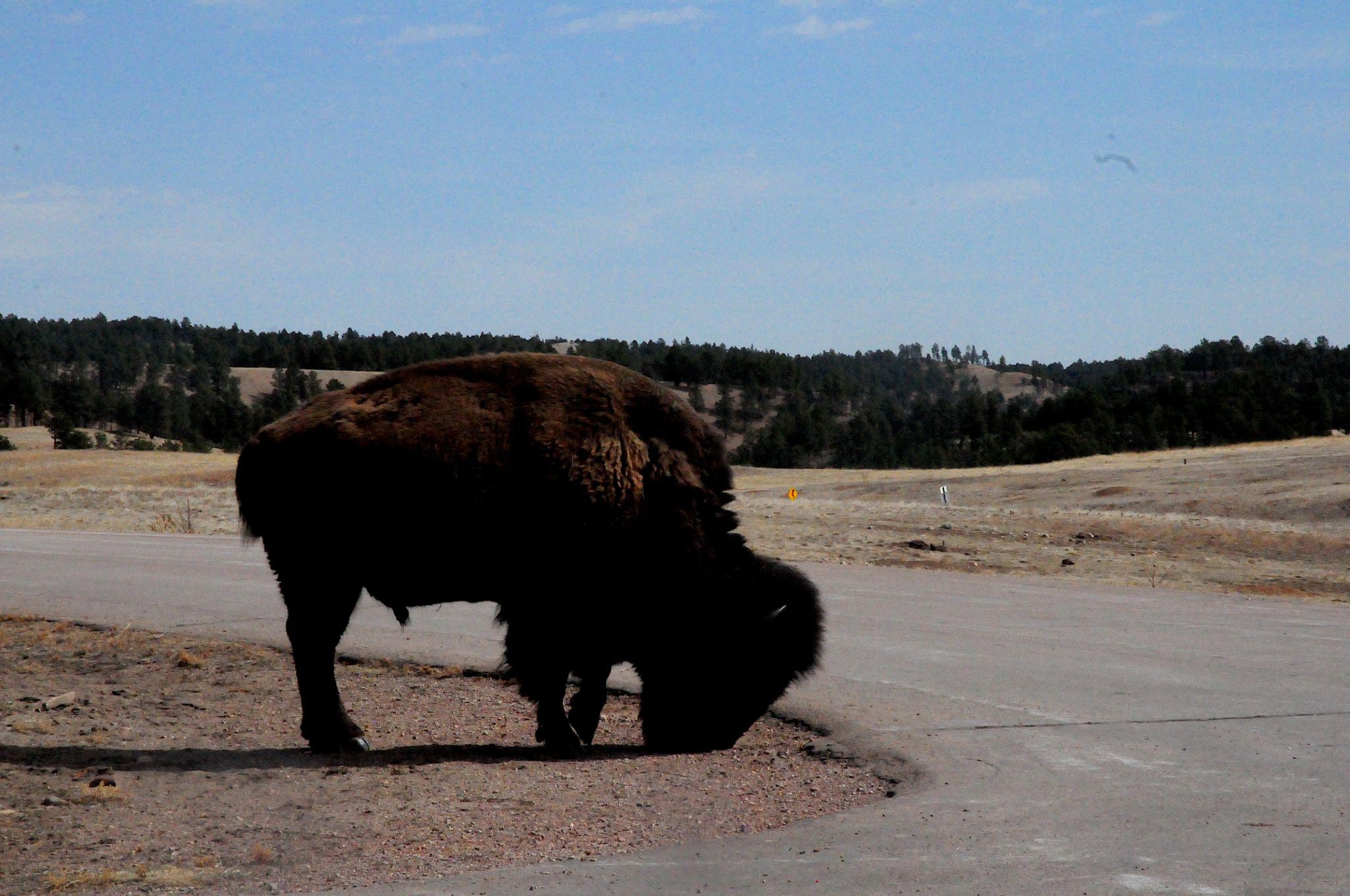
Lone bison, photograph by Alyse Burnside.
On my last day, I made my final drive from Hot Springs, Marty Robbins crooning through my speakers, I’m as free as the breeze, and I ride where I please. It was early and it would be a full day, but there was so much I would not see. I felt sad that my trip was ending, and a little conflicted about having enjoyed myself so much, worried that I was taking something away from my time and not giving much back in return.
Before heading to the ranch, I stopped at the Wounded Knee Memorial. I drove to the top of the hill and parked in a small parking lot facing the entrance to the cemetery, marked by two white-brick pillars connected by a metal arch with a small, plain crucifix on top.
In 1890, nearly ¼ of the U.S. Army was sent to Pine Ridge and Rosebud reservations to “subdue” what they claimed to fear would become a military uprising. On December 29th, amid a treacherous blizzard, the U.S. 7th Cavalry, the same regiment that had been defeated at the Battle of the Little Bighorn, surrounded Chief Bigfoot and his band of Lakota people at Wounded Knee Creek. The army ordered the Lakota to surrender their weapons, and a struggle broke out when one man refused. In the struggle, a shot was fired, and the cavalry soldiers opened fire on the Lakota, shooting their rifles into the crowd, now defenseless without their weapons or their horses. They shot cannons from a nearby hill, slaughtering women and children. The massacre marked the end of the Indian Wars on the Great Plains. In all, 300 Lakota were killed, their bodies left to freeze in the blizzard, and were buried in a mass grave.
The ground around the cemetery is arid, and grass struggles to grow in small patches. Just before the cemetery, a metal plaque painted red with white trim tells a brief and skewed history of one of the most brutal events in Lakota history. Like most historical markers, this is a history written from the victor’s point of view, softening the brutality to a tragic misunderstanding rather than a genocidal slaughter. The plaque ends with the line, “The wounded knee battlefield is the site of the last armed conflict between the Sioux Indians and the United States Army. The word “last” blacked out with spray paint.
Each December, the Brewer family organizes the Chief Bigfoot Memorial ride, an arduous 300-mile ride, trial that connects young people to their ancestors, and an experience that forges a deep bond between riders and their horses. It begins in Standing Rock, where Chief Sitting Bull was killed on December 15th, 1890, and travels the path his followers fled, toward Wounded Knee, and ends at the site of the massacre.
⥈
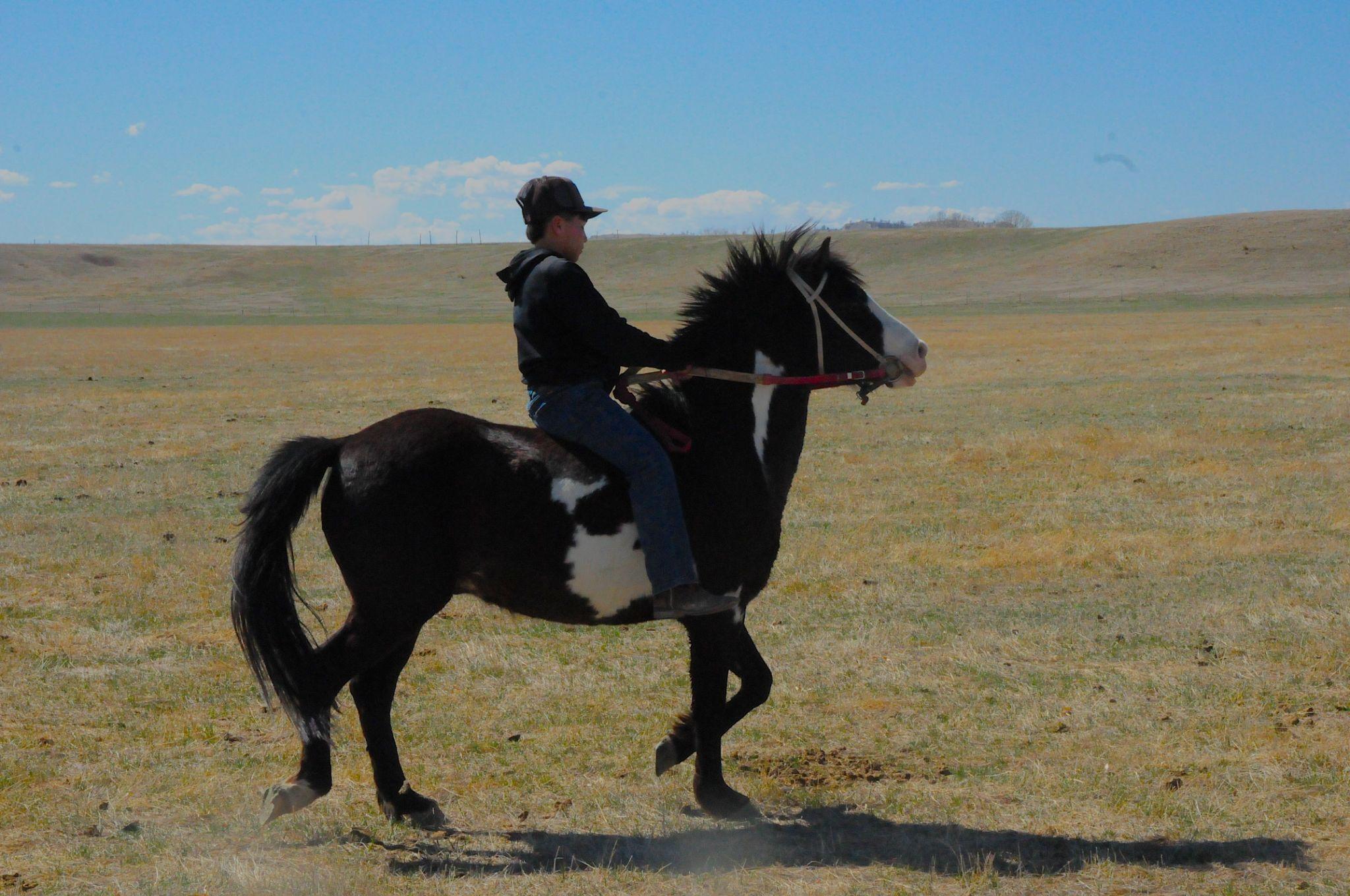
Calvin and Sparky, photograph by Alyse Burnside.
When I arrived at the ranch, the wranglers were working with their horses, practicing moving invisible herds of cows, pivoting, and stopping quickly. In a few weeks, they’d set out to brand this season’s herd. For now, the babies lay in piles around the cow pasture, and their mothers grazed a little ways away.
Joe, Maria, Kalijah, Davis, and another racer named Arianna went to catch horses. Arianna’s horse was difficult and moved quickly from one pile of hay in the paddock corner to the next, just before she could grab him. When she finally did, he began to trot off as she mounted. Joe and Maria laughed as she pulled herself onto her horse’s back, grabbing a handful of his mane.
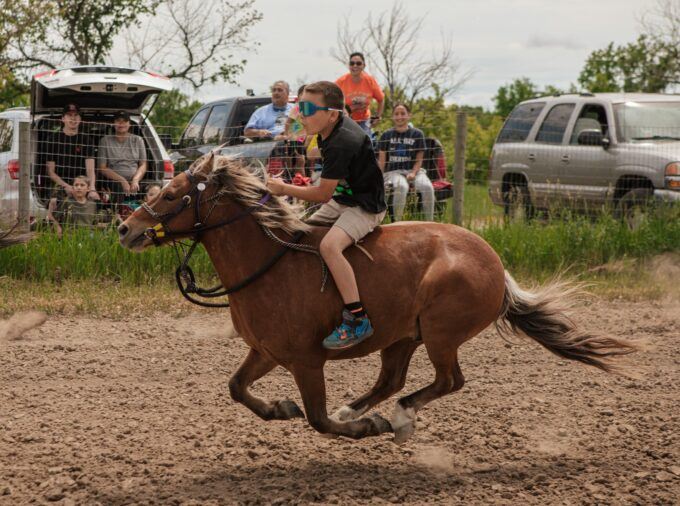
Stan’s nephew Calvin and a few Sage kids arrive to ride. We stood in a large circle and saged ourselves, then rode out of the barn in a long procession. Calvin was 11, and rode his small black and white Paint pony Sparky bareback, in his racing bridle. He hopped onto the pony just like the wranglers do, and rode with the same cowboy posture, his legs long and straight, feet just slightly in front of him as though coming in for a sliding stop. He told me he’d been riding as long as he could remember, and had begun racing in the Junior Relays a few summers ago.
It was only March, but it felt like summer. My face was an angry red and slick with sweat. Gnats buzzed around Peggy’s face, and he shook his head to throw them off. The wranglers rode ahead, taking a detour so they could run across the open field. Their horses pranced and pushed against their bits, but they held them back until we rounded a bend of trees down a lowland path toward a creek. Then they cut off to run across the open field. The rest of us rode together with the dogs running alongside us, the sound of the wranglers ahead, tearing through the trees, our horses snorting in anticipation, or to force the bugs from their noses.
A light breeze blew through the creek. Peggy pawed at the water vigorously, water splashing all around us, soaking my pant legs and the ends of my braids. He stuck his muzzle into the water to drink, then slapped the water’s surface with his mouth, blowing bubbles, then pawing again with his other leg. This was mutual joy, the temporary suspension of vigilance. Each splash of the water’s surface pulled out any anxiety I might have had, obliterated, even if momentarily, any mask I might have been wearing. Together in the creek, we played.
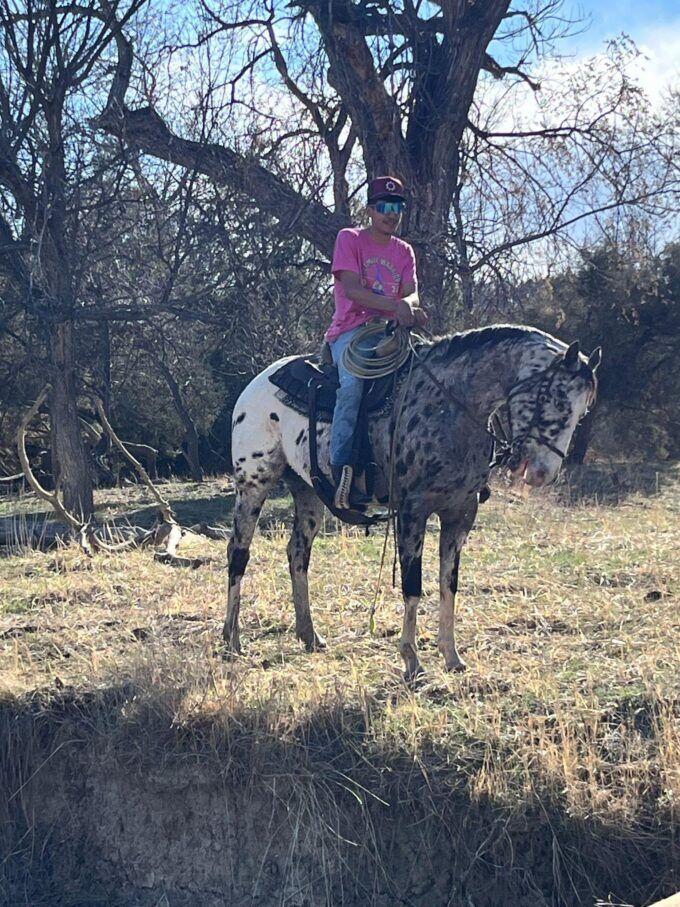
Kalijah and Pepper, photograph by Alyse Burnside.
The other horses began to paw too, the sound of crashing hooves almost eclipsing our laughter. Overcome with such genuine pleasure, my eyes begin to water. Arianna lay back on her horse, hands laced on her stomach, looking up at the sky as her horse waded slowly into the water. Aubree, one of the Sage riders, was riding Chockie when he buckled at the knees. He hovered for a moment before lowering his body into the water, overcome by the irresistible desire to roll, to feel the water over his shoulders and back. Aubree stepped off into the waist-deep creek. Nate took hold of her reins and pulled him up mid-roll as she climbed out of the water, wrung the water from her t-shirt, and got back on.
As we rode back towards the barn, the horses began to speed up, eager for the familiarity of home. I felt Peggy’s breath quicken, his body becoming tense underneath me. Up ahead, the wranglers let their horses run home. The sound of their horses’ hooves against the tall grass made a deep whirring, like a blade beating at stalks. Echoes of ecstatic laughter reverberated across the open field.