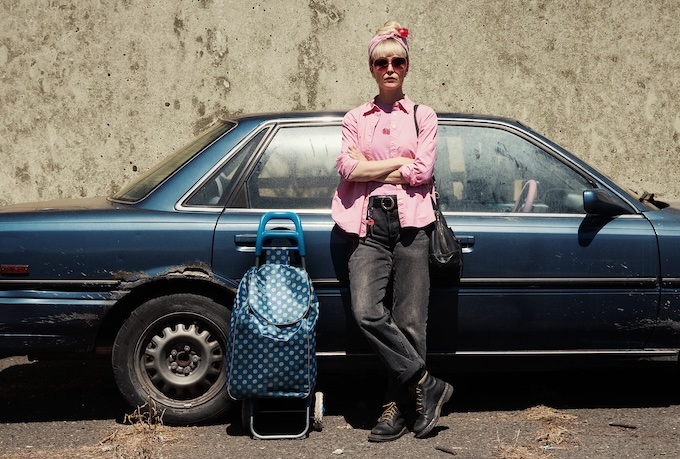
Rose Byrne in a still from “Tow.”
There are many victims of the social class struggle in the United States since the postwar economy ended at the close of the Vietnam War, the death knell for Pax Americana. An estimated 3 million Americans, euphemistically called the unhoused, live in their vehicles, roughly equivalent to the population of the state of Arkansas.
On that dismal note, Tow is a feature film, set in Seattle, Washington, and streaming on Kanopy. Tow dramatizes the life of one woman, a victim of the class war, Amanda Ogle, a divorcee with a teenage daughter. The mother-daughter duo lives apart, a trauma for them.
Rose Byrne’s characterization of Ogle is spot on. She blends resiliency and vulnerability, portraying a low-income American who spends a year of her life in financial and legal limbo while battling corporate predators. They monetize her stolen and impounded car, resulting in a $21,634 tow bill. It’s a payday loan on steroids, in effect.
Dominic Sessa shines as Ogle’s lawyer. He’s fresh out of law school, wet behind the ears, and eager to prevail over their corporate foe, personified by Corbin Bernsen, playing a villain. It’s a David-and-Goliath battle, capital versus labor.
Octavia Spencer portrays the head of a women’s shelter who offers Ogle a haven in a heartless society, and does so in a tough way that ultimately works. Spencer’s solid performance continues her string of high-level work in the films Hidden Figures, The Help, The Shape of Water and Fruitvale Station, a partial list.
Standouts in the supporting cast playing homeless women living alongside Ogle in Tow are Demi Lovato and Ariana DeBose. Together, the working-class women are critical and supportive of one another. They clash and coalesce.
Simon Rex nails it as hired help for the towing company that exploits Ogle. At the end of the day, he’s a precarious worker like her. Their consciousness of a shared commonality unfolds slowly.
Stephanie Laing is the director of Tow, which had a June 7 world premiere at the 2025 Tribeca Festival, releasing stateside a few months earlier. Jonathan Keasey and Brant Bolvin are the writers of Tow, blending attitude and verisimilitude in the characters.
Apartness from Ogle’s vehicle is the central theme of Laing’s film. A 1991 Toyota Camry is for her both a means of transportation and the only housing option. Ogle‘s vehicle is essential to her life and livelihood as a veterinarian technician without a college degree.
She is also a member of the so-called working poor laboring in at-will employment. This is a majority of the U.S. working class. The American ruling class began breaking labor unions in the 1980s (i.e., union membership topped 30 percent in the 1950s versus 10 percent now.).
In the meantime, the ranks of the poor and working class with precarious shelter rose. Those who had the means of living in their cars do so. The poor souls without vehicles turn to the streets in and out of tents.
Housing inflation, a proximate cause of unaffordable shelter, is of course a factor in this trend of downward mobility for the U.S. working class. Less visible capital flight, with the investment class shifting its resources away from American locations to those in the Global South, mainly China, for reasons of higher profitability and weaker environmental rules.
Watch Tow on Kanopy, a free streaming platform accessible with a public library card. Readers will find a cornucopia of independent films like Tow on Kanopy.