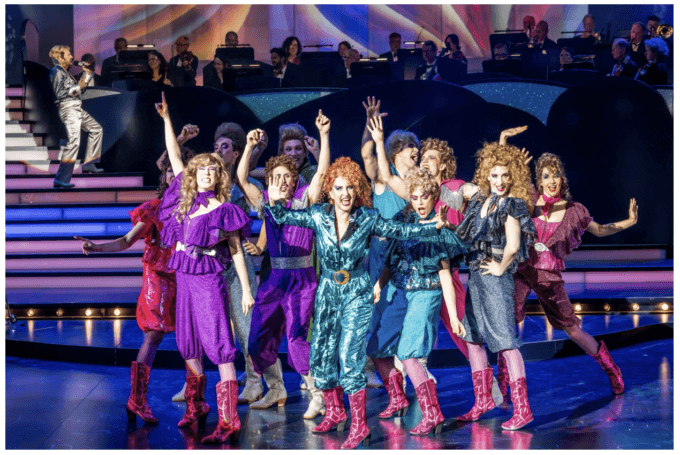
Cast of Mokka-Hits und Milchbar-Träume, Komische Oper Berlin. Photo: Jan Windszus.
The permanent home of Berlin’s Komische Oper—one of the few formerly socialist institutions not just to have survived German reunification, but to have flourished since 1990—stands in the middle of Berlin, a couple of blocks east of the Brandenburg Gate. Built in the late 19th century in neo-baroque style, the theater was badly damaged by bombs during World War II but quickly made usable again for the company so it could start operations there in 1947.
The theatre has been renovated in various ways and to varying degrees over the years, including an extensive transformation of the spacious modernist foyer between 1986 and 1989, that is, in the last years of the German Democratic Republic.
The latest, farthest-reaching renovation is now underway and won’t be completed by next season; small-scale concerts and other events (though no full-scale operas) are planned for the autumn, while construction continues. The final price tag for the renewal approaches half a billion Euros, a sum that has raised many eyebrows and more than a few hackles in a country that perceives itself to be politically adrift, economically beleaguered and facing reforms of, and cuts to, the social welfare system. “Bread, not operatic circuses!” shout some.
With construction on its own theater underway, the Comic Opera has been resourcefully pursuing its ever engaging, often usefully inflammatory, and never unimaginative productions of classic and new operas, as well as other forms of sung drama, at various venues—from a cavernous hangar at the old Nazi airport (used by the American occupiers after the war), to the trusty Schiller Theater from the 1950s in the tony district of Charlottenburg in the heart of West Berlin. The Schiller is not far from the glittering avenue of the Kurfürstendamm, with its luxury goods arrayed behind streak-free windows, shopping-bagged hordes parading along the wide sidewalks, and late-model Bavarian muscle cars strutting down the thoroughfare.
It was to this capitalist purgatory masquerading as consumer paradise that thousands of East Berliners streamed on the night of November 9th, 1989, when the border encircling West Berlin was peremptorily opened up and the Wall fell—not yet literally, but its nearly three-decade-long imprisoning function had crumbled, and with it the GDR.
The founding of the Komische Oper predated the establishment of the German Democratic Republic by two years and its thriving health in the new, post-socialist regime makes the Schiller Theater an interesting stage for the ebullient and affecting musical revue, Mokka-Hits und Milchbar-Träume (i.e., “Milk Bar Dreams”) whose run of performances closes out the current season in the first week of July. This musical’s title derives from the famous ice cream bar built in the early 1960s, just after the Berlin Wall went up, in the Karl-Marx-Allee amongst the showpieces of Stalinist architecture along the grandest boulevard of East Berlin.
Mokka-Hits was imaginatively yet rigorously conceived by the historically astute and dramatically minded theater director Axel Ranisch along with the composer, arranger, conductor, and the Comic Opera’s resident musical genius Adam Benwzi—an American émigré who moved to divided Berlin in 1984 and is also now professor of musical theater the city’s University of the Arts. Their show brilliantly condenses the four-decade history of the GDR into a two-hour anthology of hits that were enjoyed by normal citizens, interleaving these songs with jokes and improvised asides, contextualizing but never pedantic commentary, and poems that pack an emotional wallop and remain as timely as they were during the most heated years of the Cold War.
The rising out of ruins of the Workers’ and Farmers’ State, the early socialist dreams soon dashed by disappointment, and the ultimate dissolution of the short-lived nation and its absorption into the “West”—this arc was traced by two dozen songs carefully culled by Benzwi and Ranisch from the catalog of the official East Berlin cabaret, the Distel-Programm (Thistle Program) and the blockbuster live television variety show, Ein Kessel Buntes (A Colorful Kettle) that was broadcast six times a year from 1972, making it a few seasons into Reunification.
The body of potential material to be drawn on for such an ingenious and challenging project is immense. But the musical’s final distillation, drunk in by a captivated and fully involved Schiller Theater audience, was intoxicating—even more so on an evening when temperatures reached 100 degrees Fahrenheit. Mokka-Hitsis the latest in a series of kindred productions reliant on Benzwi’s illuminating engagement with neglected repertories of the second half of the 20th century, as in his reanimation of music from New York’s Catskills Borscht Belt in Barrie Kosky’s All-Singing, All-Dancing Yiddish Revue brought to the Comic’s stage in 2022.
Among Benzwi’s many skills is the ability to play to the strengths of the excellent and adaptable Komische Oper ensemble. Individual cast members played many roles, wore many different outfits and wigs, and spoke and sang with different diction and regional accents, though most in the local Berlinish. A rough-and-tumble post-war working woman reappeared as a psychedelic rock prima donna, and later, the dispirited wife left behind after a mournful love song sung with a husband about to skive off to the West.
Ascend in a thought-experimental observation balloon and look down from a thousand feet above the Brandenburg Gate, and the differences between cultural products made on either side of the Wall begin to seem far less marked: this was one of the uplifting lessons of Mokka-Hits and proof, that the powerful seek rivalry more resolutely than do the meek. The Schiller Theater’s hulking rectangular facade, the gold mullions of its curving glass gallery behind which loom a row of columns take on a politburo pomp. The rumba craze that sidled over from Cuba in colorful costumes and kinetic choreography (by Christoph Tölle) moved to the beat of a joyful zeitgeist neither capitalist nor communist.
The rise of global vacation culture was hymned in the exuberant “Tourismus.” The song’s excited patter anticipating holiday escape was run through a second time in English translation that hilariously rendered the singable “ismus” of the German as the unsingable “ism”—a clever and seemingly harmless dig at the free world’s supposed freedom of movement. Where does one go when Cold War borders close? Maybe nearby Prague—or the beach for the sun and swimsuits of “Im Sommer 61” (the same summer that the Wall went up). Bolshevik Beach Blanket Bingo could be sung and danced in sexy swimsuits beyond the Iron Curtain.
The Colorful Kettle also brought world music home to roost in East Berlin with Spanish exoticisms, Italian seductions, and Czech pride. Space-suit Disco arrived camouflaged as an indigenous invention—though everyone knows and knew that the Wall could keep almost everyone in but couldn’t keep musical trends out.
To my right, a couple laughed with real joy when stars they instantly recognized from decades ago came magically back to prime-of-life form on the Schiller stage. These East Berliners of the present delighted at these impersonations of the original performers’ physical and vocal mannerisms. Like many others in the audience, the couple sang along with some of the hits.
As a late-coming foreigner, I could not share this connection with, and feelings for, this history, so recent, yet seemingly so far away. But I understood—felt—that Mokka Hits was not just winning entertainment, but also a medley of healing nostalgia, long-overdue affirmation, perhaps even reconciliation.
The paradoxical unity-in-division between East and West energized the closing “Wir Sind Wir” (We are us) as the post-socialist future dawned. The GDR ended not with a bang but a whimper. The reporter who’d appeared at the start of the show before a note had been sung returned to the lip of the darkened stage and spoke into the microphone of his portable recorder: it had all gone by so quickly.
So, it is with societies and states—and riveting, redemptive evenings in the musical theater.