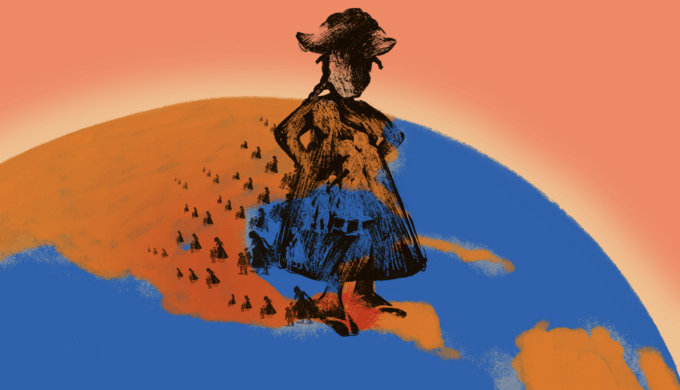
Graphic by Paola Bilancieri.
In 1992, while on a United Nations mission to assess the health conditions of refugees and displaced communities in Central America, I travelled to Quetzaltenango, a highland city at the heart of Guatemala’s Mayan culture. It was there, on the steps of the town’s historic cathedral, that I learned an unexpected lesson.
An elderly Mayan woman, dressed in traditional clothing, was kneeling in prayer when I instinctively raised my camera. Before I could take the photograph, she turned to me and said, “One dollar!” I hesitated. But she was right. I was about to benefit from her image without her consent or compensation—an echo of the exploitation her people had endured for centuries, beginning with the Spanish conquest.
For Guatemala’s Indigenous majority, dignity and equity have surfaced only in fleeting moments. One such moment came in 1951, with the democratic election of President Jacobo Arbenz. At the time, 2% of the population owned 70% of the land. Arbenz sought to change that imbalance through sweeping agrarian reform, transferring uncultivated land from large estates to the rural poor. Roughly half a million mostly Indigenous peasants stood to benefit. His government expanded suffrage and established a minimum wage.
But Arbenz’s reforms threatened powerful interests—none more so than the United Fruit Company (UFC), which controlled 220,000 hectares of land, only a fraction of which was under cultivation. UFC responded with an aggressive lobbying campaign in Washington, where it had influential allies: Secretary of State John Foster Dulles and his brother, CIA Director Allen Dulles, both with ties to the company.
In 1953, the Eisenhower administration authorised Operation PBSuccess, a covert plan to overthrow Arbenz. The CIA backed Colonel Carlos Castillo Armas, whose revolt relied more on psychological warfare than military strength. Lacking support from Guatemala’s own armed forces, Arbenz resigned on 27 June 1954. His fall marked the collapse of one of Central America’s most promising democratic experiments.
What followed were decades of authoritarian rule, corruption and systematic violence—particularly against Indigenous communities. These abuses fuelled the massive migration flows that continue today.
The consequences of U.S. intervention reverberated for generations. In a 1977 address at the University of Notre Dame, President Jimmy Carter acknowledged that U.S. foreign policy had long been distorted by what he called “an inordinate fear of communism,” which led Washington to support repressive regimes in Central America as long as they aligned with U.S. interests. Guatemala was one of the clearest examples.
A civil war that began in 1960 lasted 36 years, ending in 1996. More than 200,000 people—mostly Mayan—were killed. An estimated 100,000 women were raped. Over 1.5 million people were displaced, and entire communities saw their infrastructure and crops destroyed. Few perpetrators of these crimes against humanity were ever held accountable.
On 10 March 1999, during a public meeting with Guatemalan civil society, President Bill Clinton issued an unprecedented apology for the U.S. role in supporting military forces responsible for widespread atrocities. “Support for military forces and intelligence units which engaged in violence and widespread repression was wrong,” he said. “The United States must not repeat that mistake.” His statement followed Guatemala’s Historical Clarification Commission, which concluded that the U.S. bore significant responsibility for human rights violations during the conflict.
Yet the apology, significant as it was, fell short. It offered no reparations and did not fundamentally alter U.S. policy in the region. And Guatemala was not the only country affected. Washington backed the Somoza dictatorship in Nicaragua and supported military governments in El Salvador and Honduras—regimes that carried out gross human rights violations whose consequences I witnessed during several public health missions.
The roots of today’s migration crisis run deeper still. From the 16th century onward, Spanish colonialism created extreme land inequality, with a small landowning elite and a large Indigenous underclass. Central American economies revolved around mono‑crop exports that enriched elites while impoverishing rural majorities, leaving societies vulnerable to global price shocks.
Throughout the 19th and 20th centuries, strongman rule, military dominance and weak democratic institutions shaped the region’s political landscape. During the Cold War, U.S. support for anti‑communist dictatorships, counterinsurgency funding and the suppression of reformist movements intensified conflicts and deepened social fractures.
From the 1960s to the 1990s, civil wars in Guatemala, El Salvador and Nicaragua shared common roots: land inequality, political exclusion and state repression. U.S. involvement escalated violence and contributed to mass displacement. Later, neoliberal restructuring in the 1980s and 1990s privatised essential services, undermined rural livelihoods and weakened social safety nets. U.S. deportations during this period transplanted gangs such as MS‑13 and Barrio 18 into fragile postwar societies, fuelling cycles of violence that continue to drive migration.
Given this legacy, it should not surprise us that tens of thousands of Central Americans continue to flee their countries in search of safety and opportunity. The United States is not responsible for all the region’s problems, but it cannot ignore the role it played in shaping them. It has a moral obligation to treat migrants humanely and to help repair the conditions that contributed to their displacement.
The woman in Quetzaltenango was asking for a dollar. Central America is asking for something far more consequential: recognition, accountability and a commitment to a future in which its people are not forced to leave their homes to survive.