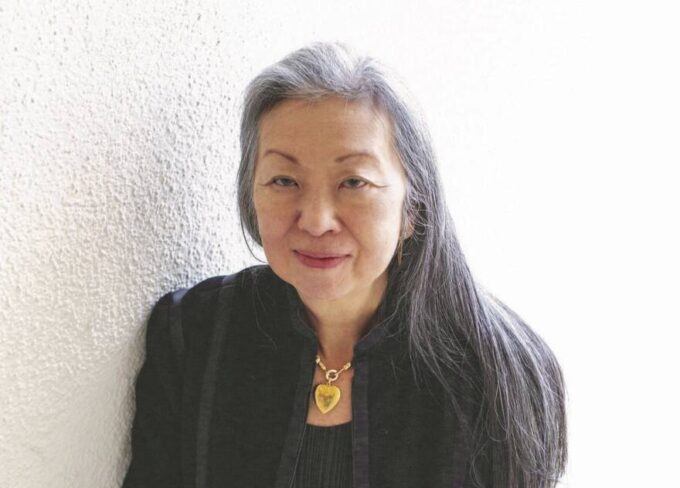
Fae Myenne Ng.
Fae Myenne Ng doesn’t want to forget the officially lost periods in the
history of our country. Many people don’t know that the Chinese Exclusion Act (1882-1943) was “the first significant law restricting immigration into the United States,” according to the National Archives. And with the Chinese Confession Program (1956-1966), these bloodless bans effectively prevented procreation of four generations of Chinese Americans. Fae Myenne Ng knows and does not forget.
Born in San Francisco in 1956, she was among the first wave of post-Chinese Exclusion births, a child of the Confession era. She grew up in San Francisco’s pre-commercialized Chinatown, well before it became a glitzy ghetto. Her world, among men including her father who feared deportation, was contained in Chinatown’s back alleys and sweatshops. These experiences give this celebrated author much to say to younger generations of Chinese in America and to the rest of us children and grandchildren of immigrants.
Ng sees herself as a preservationist when the trend is toward assimilation, reminding us of the need to search out the neglected heritage of old stories contained in the lives of our ancestors. For me, her books also speak to this time, when government actions of forcible immigrant detention, removal, and family separation are once again being normalized. Perhaps they can provide some kind of solace and wisdom to other readers, through understanding that the current upheavals of these times are not unique challenges. We have had to face such injustices and terrors before.
Ng’s calls her first book, Bone (1993), an “Exclusion novel,” as it is centered on one San Francisco Chinatown family’s experiences resulting from the Exclusion Act of 1882, which basically remained in effect until completely repealed by the Immigration and Nationality Act of 1965 (aka Hart-Cellers Act). In her Literary Hub essay, “All Stories Float Ashore,” she writes
Dad… taught me that the told story was dangerous. Silence is an act of protection….“But…I write the books that Exclusion Men kept secret in their center. I tell the muted stories before they mutate. I believe our literature hasn’t caught up with this truth—Exclusion created a new genre—the lie in America.
Ng calls her second book, Steer Toward Rock (2008), a “Confession novel” as it chronicles how ramifications of the Chinese Confession program, which offered “paper sons” the possibility of naturalization if they signed an affidavit “agreeing to be amenable to deportation,” profoundly alters the lives of another Chinatown family. She says,
The [Confession] program sent distrust like a plague through family and community so I learned that a true American must feel free to tell—not confess—one’s story.
Her 2023 memoir, Orphan Bachelors: On Being a Confession Baby, Chinatown Daughter, Baa-Bai Sister, Caretaker of Exotics, Literary Balloo Peddler, and Grand Historian of a Doomed American Family, was inspired by the true-life characters from Ng’s own San Francisco based family and community, especially the last generation of Chinese male immigrants who entered the United States as “paper sons.” Named “orphan bachelors” by Ng’s merchant seaman father, Ng writes:
In 1940, he memorized a Book of Lies and posed as the son of a legal American citizen to circumvent the Chinese Exclusion Law (1882-1943). In 1966, he admitted those lies when he entered the Chinese Confession Program (1956-1966). In exchange, he was given the possibility of naturalization only if he signed an affidavit agreeing to be amenable to deportation.
In a recent conversation with Fae Myenne Ng, we discussed how her life as the child of immigrants intersects with her writing. And surprisingly, it came to reflect how reading her books opened up memories gleaned from my family’s history, told and untold, about their immigrant beginnings in Pittsburgh, Pennsylvania, especially the tragedies surrounding the life of my maternal grandmother who died long before I was born. Our conversation heightened my awareness of the ways our lives and the arts are intertwined, a power recognized even by those who may be publicly disparaging of the arts, unwilling to fund it as fearful of allowing artists freedom of expression, or anyone else for that matter. While working on this piece I observed documentation of demonstrations staged in front of a Detention facility in Los Angeles, where protestors of immigrant roundups clashed with alarmingly equipped, costumed and masked Homeland Security, ICE and National Guard troops; heard American Congresspeople casually invoke a classic form of Japanese theater, “Kabuki,” as a derogatory adjective; and media wonks describe the present administration’s decision to bomb Iranian nuclear sites as “performance art.” On Abby Phillips’ June 25th CNN NewsNight show, one panelist even went so far as to proclaim a new variation on their standard “both sides do it” justification, arguing there are “performative artists on both sides.” Our following conversation considers how the present time and our histories coincide in this moment.
Carla Blank: In your memoir, Orphan Bachelors, you write: “I have borrowed from life to make the story come alive on the page. ‘Borrowing’ is a word my father used to cajole understanding.” I find that so interesting because the art world uses that word, “borrowed,” and they invoke it interchangeably with “appropriation,” or “found,” or sometimes “reinvented.” And I was wondering if you were conscious of and thinking about that doubleness, because I think it’s what contributes, in part, to why your writing is so inventive and resonant.
Fae Myenne Ng: My parents didn’t speak English. They’re dead now so I have no one to speak my dialect with. But those linguistic relationships are still the core of my creative process. Even as I lose more of my Chinese from isolation, I’m emotionally rich in a way that I may never be in English. I highlight certain words to establish a linguistic emphasis – this is English but with a different register. It’s as if I were putting my foot down on the alphabet. Perhaps it’s a way for me to pause and communicate what I’m searching for in Chinese. Maybe even beyond the Chinese word. Perhaps I’m hoping for an ancient sound. But it’s only an image that I am trying to suggest and when I settle on an English word, it’s usually a verb, because verbs have action and activeness, an animation of language that exists between meaning and translation; they carry an inference of feeling, which borrows the imagistic power of Chinese. How to recreate a semblance of that into English? That’s why I highlight certain words.
I love that you noted “borrowing.” It’s the perfect example. I hear the three elongated syllables to create a Chinese tone of longing, hoping, and probably despairing.
Carla Blank: Borrowing also resonates in how this concept of language has relevance to abstractions, which contain a history of human creativity. Because evidence of abstraction goes back as far as we have found remnants of humans’ lives. For instance, geometric shapes are pure abstractions that have been present throughout time. In the Americas they appear in architecture, pottery shards, petroglyphs, and passed through the generations as found in designs for bead and quill work, blankets and other fabric arts.
Fae Myenne Ng: Fabric arts, yes! I grew up in the sweatshops and textiles was my first love. ‘Borrowing’ happens in the fashion world especially. So, let’s talk about the abstractions in language. On the last two pages of Orphan Bachelors, I wanted the echo of possibility to reverberate and follow the reader out of the story. My goal as a writer was to bring two English words close together but also keep them distinctly apart, so as to suggest a fluidity between the possibilities of meanings. In not translating, I created a duality, a double stream of linguistic fluidity. My use of the Chinese word ‘pei you’ is an example. My father often used this term that was of his generation, a pre-communist term or more likely an ancient word that had been kept alive in rural communities. ‘Pei you’ wasn’t a word I learned in Chinese school, it was a word I had to deduce the meaning of through his pained confessions of all that had not come to fruition. I dance on the closest English equivalent, “perhaps,” to bring ‘possibility’ into focus. It’s a word of gesture, an elegance of consideration that does not exist in capitalism. Chinese is potent and precise in that way and I would like to bring it into English, not by translation but by distillation of feeling, working with the image to find the word.
I write what I understand of his Chinese, “As a child, I understood it as his way of inviting possibility.” Then I accent my understanding back into English, highlighting the word ‘perhaps’ “Perhaps, my father already knew that Mah had told me a story and that by sidestepping that acknowledgement, he freed me.”
I write ‘pei yu’ only once because English doesn’t register tone and it would be very disturbing for a mono English reader to keep reading “pei you” and internally hear: “pay you.” These are echoes of love and hope alongside the hopelessness and regret.
Bone moves backward in time. Rock stands still in the time of devastating betrayals during McCarthyism. Orphan Bachelors circles in time, moving back and forth, fluid in one feeling: sorrow. Our lives were horrible in China and so we made it to America, carrying hope and dreams and it becomes a nightmare of more horrors. That’s how I structure my understanding of time in my writing: there’s no time. It’s all the time. It’s every time. Everyone’s alive. Everyone’s dead. Everyone cares. Everyone doesn’t.
Carla Blank: Meanings may be lost in time—for instance I remember a conversation with Ojibwe poet and writer Heid E. Erdrich at a conference in Flagstaff, Arizona, where ancient petroglyphs can be found etched into the mountains’ rocks. She proposed that the prevalence of small hand outlines and stick figure drawings could have resulted from a pastime that ancestral Puebloan mothers used to amuse their children while on walks, rather than some esoteric practice. Nevertheless, their images continue to resonate over time.
Fae Myenne Ng: Agree about the continuity in our artistic history which is conservation, preservation, and excavation. When I think of Chinese American time, when I consider our history in this country, I think of it as an emerging of timelessness. In Bone, the family is at unrest because the ancestor’s bones are roaming in America and not resting in China. Orphan Bachelors addresses the fact that for 61 years, Exclusion prevented the procreation of the Chinese American family. Four generations of the unborn are ghosts that will forever haunt us. We who follow have a living debt.
Carla Blank: Maybe that has to do with part of my experience as a reader of your work, as I feel I only understand some of what you’re saying, which I think is fine. Because you’ve done a masterful job, packing layers of information into every sentence, giving readers plenty to absorb. It’s like when I was directing Pakistani Americans in Wajahat Ali’s play, The Domestic Crusaders, and it included Urdu. The actors asked, “Should we translate?” I answered, “I think it’s good to have secrets. Not everything should be be/can be translated. We outsiders should be reminded we can’t know everything.”
Fae Myenne Ng: I agree. In this country, our inheritance is: stories and secrets and lies. There must be respect for the mystery of all we cannot and are not privileged to know. Immigrants hold borrowed time and they hold the true stories of this country. We, as their progeny are their artistic proof. For us to survive in this country is only our first debt.
Carla Blank: Your books called up my own family’s history because I’m a second-generation grandchild of four Russian Jewish immigrants. Almost everything about their lives remains secret to me. So when you talk about a “gene of secrecy,” that is also quite profound in my family’s life. For instance, I have arthritis, and genetically, I understand it appeared in the family from way back. Because one story I remember hearing was that my maternal great grandmother remained in Russia, cared for by her youngest daughter, because she was so crippled by arthritis she couldn’t travel to America. Except my sisters don’t remember hearing that story. However, you know much more than I, probably because you’re first generation. That’s another thing. I always get mixed up about–naming generations–who’s second generation, third generation.
Fae Myenne Ng: I call my parents immigrants, and I give them that full glory. I am the first generation to be born here. Immigrants are our heroes. They got here. They survived and they procreated. The first generation owes dearly and each succeeding generation owes differently.
Carla Blank: I also think of my grandparents as the immigrants. My parents are first generation, and I’m in the second generation. Your family history mirrors something in my history. Because three of my grandparents died long before I was born, they became known to me through a few stories and one studio photograph of each couple. Particularly I know my maternal grandmother died in a mental institution. Although I don’t know what drove her into manic depression, I understood that once a brother moved to Los Angeles for health reasons, she felt isolated by being a Yiddish speaker without the closest member of her family to talk to. Her husband, my grandfather who was alive when I was a child, didn’t talk much. But you could feel the darkness.
Fae Myenne Ng: That’s really hard, the lack of stories, the silencing of them. Our challenge is to release them. Your Grandmother’s isolation story is tragic – her connection (and lost mind) when she had no one to speak Yiddish to –will this story be unburied by you in your new book? How do we sustain our minds when we lose our original language? History is lost when we lose language.
Carla Blank: Perhaps you are giving me a reason to add another aspect of my history to include in my memoir, which presently is focused on my journey as an artist, as well as others who are not related to me. In a quote from Orphan Bachelors, you reflect on your father: “As a child, I believed his stories. As a writer, I write his lies.” And then you also write about your mother: “Perhaps writing was a way to hold her, [my Mah’s] marital bitterness in mind and at bay; writing became my mourning.”
Fae Myenne Ng: Yes. I was glad I was attentive enough to get that down.
Carla Blank: That reminds me to double-check if the language in the documents in Steer Toward Rock is taken from actual documents?
Fae Myenne Ng: Yes. They were from my father’s FBI file – and his interrogation file from Angel Island. They existed as his only written truths in the government file; my books are an act to write his truth into history.
Carla Blank: So Orphan Bachelors was fifteen years in the making?
Fae Myenne Ng: All my books took about fifteen years. Distilling my father’s lies gave me permission or the confidence to write his truth. He lived and died with these lies that came from the consequences of many historical, cultural, sociological conditions. They became an integral part of this complete and complex person. And so this is my inheritance. One doesn’t have to forgive; one must perhaps understand. My sister says, “Nobody listened to them except you.”
Carla Blank: And you listened to the orphan bachelors too. So that was just your nature?
Fae Myenne Ng: My father taught me how to listen. Was it my position in birth, as the first child? I heard the first tellings. My mother was a teacher in China and she taught me this distinction: Story is fact, told without conditions; a secret is selfish, told as a manipulation of story. I ask my students to consider that lies are the wonder and the terror of the new American story.
Carla Blank: A passage in Bone illustrates that your style has a knack for detail:“Leon was a collector too. Stacks of takeout containers, a pile of aluminum tins….His nightstand was a red restaurant stool cluttered with towers of Styrofoam cups, stacks of restaurant napkins, and a cup of assorted fast-food straws.” Then the details continue, finishing with: “On the windowsill were bunches of lotus leaves and coils of dried noodles. There were several tin cans: one held balls of knotted red string, another brimmed with tangles of rubber bands. The third was ashy with incense punks. Beyond these tins, I could see Coit Tower.”
Fae Myenne Ng: That was an image from my grandmother’s kitchen table. Her table was a collage of collections that spoke of her needs and fears. And then to zoom out to see Coit Tower. Coit Tower is our vision of hope. The Golden Gate was the symbol for the immigrants coming in. Coit Tower is the symbol for those of us born here.
Carla Blank: Got to use Coit Tower. It has WPA murals.
Fae Myenne Ng: Exactly. I love the old couple walking hand in hand. That’s the Exclusion marriage.
Carla Blank: So here’s another quote from Bone: “It took me a minute to catch up with him. I relaxed, remembering that Leon did not like fanfare and ceremony.” Would this also reflect your writing style? Sentences that lack ornament and ceremony, short, direct, not long winded.
Fae Myenne Ng: I want to honor working-class language. This is the world I grew up in. Where’s time? You have to go sew something or cook something. Say what you need to say and then shut up. An orphan bachelor, Mr. Louie, said to young-chatty me: “Little Sister, I’m old. Say it simply. I’m old.”
Carla Blank: Have you ever written something that you would call a poem? Because your writing, your language has that depth of resonance, the possibility of multiple meanings that energizes the language of poets. You did say you were writing poetry in Chinese school. Is that your first memory of writing?
Fae Myenne Ng: Yes. I wrote my first stories in Chinese when I was in the Chinese school. My favorite subject was poetry, we learned them by rote memorialization, taught by scholars who left feudal China to become laborers in America. They were elegant men, poets who carved their laments on the barracks of Angel Island. They trained my ability to remember everything, they trained my ear. I learned to love the compression in Chinese, its powerful economy is what I hope to bring into English.
Carla Blank: But then you stopped writing in Chinese?
Fae Myenne Ng: My life in English became larger and I realized that I would never have a living history in Chinese. Here’s a recent linguistic treasure
– I was getting chives and lotus root at a Chinese grocery, and I heard the cashier talking to another customer. In three words, a world:
Kuer (the genderless pronoun)
Fan (sleep)
Jau (ran away)
Death is revealed in three words: it’s a choice, an escape. This is the compression and precision that I want to capture into English. My father’s death was reported in the same way – as if death was worthy of the chase, that in dying, we run to our next existence. As I paid for my groceries, I asked the cashier something in Chinese and she ignored me, as she always does, which amuses me. She knew I was a linguistic fly.
Carla Blank: In still another quote from Bone: “My job is about being the bridge between the classroom teacher and the parents. Teachers target the kids, and I make home visits….” At the end of this paragraph you say, “This job sounds great on paper, but sometimes when I’m face to face with the parent, I get this creepy feeling that I’m doing a bit of a missionary number.” So does the narrator of the novel feel that the American curriculum calls for assimilation into a dominant Anglo culture? Is that why she feels like a missionary?
Fae Myenne Ng: Orphan Bachelors had many more teaching scenes. Almost half the book was teaching at CAL. But my editor said the students are too interesting; they steal the show. My students inspired me to find a way to talk about duty and desire, to try and tease them away from the Confucianism that controlled their grandparents, the dogma of the Cultural Revolution that controlled their parents. To NOT defer to leaders, to the missionaries, the father, which is our cultural gene. We follow well. I teach my students to break the rules, to NOT stay in their own lane. At CAL, I get my students to consider what they want. Desire before duty. Don’t become part of America’s economic artillery, don’t be the modern coolie.
Carla Blank: “Missionary” infers a demand to change.
Fae Myenne Ng: And subservience. I think of Cameron House and the Christian influence in Chinatown. All the Chinese schools were Christian, and they tried to control us with God. Unfortunately, rote works. I can still recite the Lord’s prayer in Cantonese.
Carla Blank: You write about a phase of Chinese American history, the immigrant experience, that modern, assimilated writer shun. Not only Americanized Asian American writers, but Jewish and Italian American writers such as Gay Talese who got a backlash when he said that Italian Americans have no literary tradition. For example in this passage in Bone: “I shifted from one foot to the other. Great. I thought so Leon is hanging with Chinatown drift-abouts. Spitters. Sitters. Flea men in the Square. Mah calls Jimmy Lowe the Mo-yeah-do-Bak. (Mr. Have-Nothing-to-Do). Most of the old guys have nothing to do.” So do you get a backlash from assimilated writers who are embarrassed by someone bringing up the old stories?
Fae Myenne Ng:. “Let them talk,” Mom always said. “Let them perform their own opera and descend their own stage.”
Carla Blank: Are some Chinese, like Blacks, unassimilable?
Fae Myenne Ng: Probably. At least my father and his cohorts were. My parents were hardcore immigrants who kicked butt; they were fearless. Teaching has shown me that the new generation has learned to keep their heads down, maybe that’s the new survival mode. Except for the artists. Artistic purpose and practice is one way to maintain and honor our hardcore beginnings.
Carla Blank: In Bone you write: “I use my ‘This isn’t China’ defense. I remind them ‘We’re in America.’ But some parents take this to heart and raise their voices. ‘We’re Chinese first, always.’ I can’t win an argument in Chinese, and I’ve learned from experience to stop the argument right there, before I lose all my authority.” Is that one reason that you continue to portray the old-world odors that Americanized writers wish to abandon? For instance, in a Bone passage you write: “A bitter ginseng odor and a honeysuckle balminess greeted me. Younger, more Americanized mothers complained that the baby clothes have absorbed these old-world odors.”
Fae Myenne Ng: This is a language that I can feel in my bones, even if I don’t have anyone to speak it with. The unending sorrow of these men and women who gave everything and died with nothing needs documentation. It’s not that I have unique ability, it’s that I’m a willing witness and I don’t manufacture the truth. My job is to make it current, give it a vitality and a meaning, so that the orphan bachelors’ tenacity lives on.
Carla Blank: Perhaps that’s why your writing is very fresh, very unique. You once wrote: “Every English word was like a curse. I’m over that now, I think.” For instance, in the midst of your living histories, I noticed ongoing motifs of cars and airplanes. And I’m wondering if this is one way you evoke or ground the reader in the contemporary world.
Fae Myenne Ng: So, the immigrants sailed here, and their children drive, fly, run, swim. My parents ran from the invading Japanese Imperial Army, the fleeing Nationalists, the approaching Communists –escaping is on our genes. We love running away.
Carla Blank: Were your parents proud of you being a writer?
Fae Myenne Ng: My parents couldn’t read my books in English and when translated, the simplified Chinese was so frustrating they gave up. My mother’s niece had the most stunning response with no awareness of her own racial self-hatred. In a backhanded compliment disguised as awe, she said to my mother: “But you don’t speak English – how can you raise a daughter who can write a book?” My mother told her, “Do you suppose, just because I don’t want to speak English, I would raise an idiot daughter?”
Carla Blank: About the last third of Orphan Bachelors I had the feeling, like all of a sudden, it got lighter. Because the beginning was so heavy. And even though your parents are dying and your brother is dying during this time in the book, it just somehow felt like it opened up.
Fae Myenne Ng: Only a dancer would understand that balance, thank you. The balance – the light and the weighty –the reach and the contraction. I learned that from the orphan bachelors, to suffer deeply, but then get free.
Carla Blank: So among themselves, hanging out together, it sounds like the orphan bachelors shared a lot of jokes, that the camaraderie was very strong, and helpful for each other’s survival.
Fae Myenne Ng: They taught me to work with intensity and release, that to absorb the pain takes a certain ability and to release the pain takes a certain courage.
Carla Blank: Well my mother, in her late 80s, wrote a memoir. And using the form of a family tree she included the histories of relatives who arrived in the United States. Similar to your understanding of your parents, while writing her memoir, she had a change of heart about how she thought of her father, which was a great gift. She said she now could understand why he chose to do the things he did once his wife began to disappear into illness. And even though it was difficult for my mother at the time, he was trying to help his wife, while having to raise their children. Unfortunately, my mother was wounded by the absence of her mother. But fortunately, my mother somehow saved two mementos from her mother that she passed on to us four granddaughters: her mother’s large, silver-plated tablespoons and, according to our birth order, either a five-or ten-dollar gold coin that my grandmother had stored under a mattress, which my mother set into necklaces for us. I carefully treasure that tablespoon, saving it to stir the ingredients for cakes or pies in honor of my own family’s special occasions. The gold necklace remains in a bank safety deposit box.
Fae Myenne Ng: Perfection! And two generations on, you’re giving the story life here in our conversation, and perhaps by writing a book to house her memories, to relocate her from the institution she languished in. This is a beautiful testament.
Carla Blank: Since we all have histories, I think the way you write helps readers, because certainly for me, it stirred up buried thoughts about my history and how it has influenced the way I live my life, and the artwork I choose to do. You leave a lot of space around the words to ponder. Thank you Fae, for your radiant writing and our conversation.
Fae Myenne Ng: This was extraordinary. I appreciate your reading and love all that you share about your own art. We had, in orphan bachelor fashion, a simpatico 傾偈, park-bench talk, or as my father would say – we boiled telephone congee, or, in our left coast lingo – it was a good time shooting the Californian breeze.
Fae Myenne Ng’s most recent publication, Orphan Bachelors, A Memoir, has received many honors including a 2024 American Book Award, the California Book Awards Gold Medal Winner for Nonfiction, the 2024 William Saroyan International Prize for Writing in Nonfiction, Booklist Editors’ Choice, and the Chinese American Librarians Association Best Book Award. It has been chosen as California’s 2025 Great Reads from Great Places selection for Adult Readers and will be honored at the National Book Festival at the Library of Congress. She is working on the third installment in her trilogy of novels, Donatella, Getting Away With It.