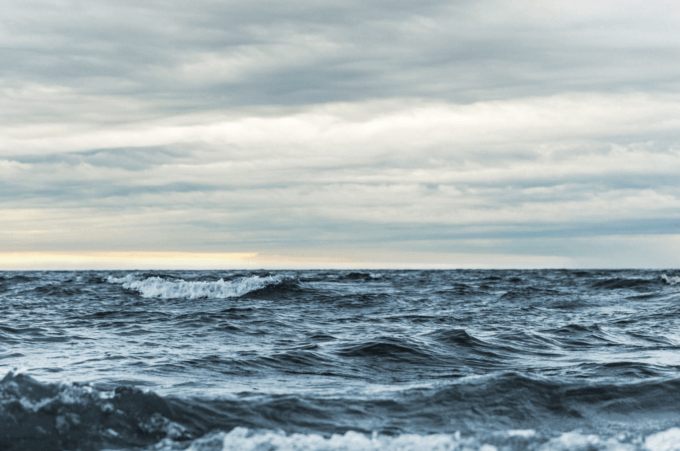
Photograph Source: Ant Rozetsky
The oceans are not the same as years ago. They’ve changed a lot. For example, Oceanic Hypoxic Dead Zones, meaning low or depleted oxygen zones, have increased by more than 300%, up from 150 recorded sites in 2000 to over 500 in 2026.
“The science is clear – climate change is transforming the oceans.” (Blue Whales Are Going Silent. Scientists Warn It’s a Cry for Help, d/d August 25, 2025, Earth.org)
According to Scripps Institution of Oceanography, oceans have absorbed 90% of Earth’s excess heat since 1970, saving humanity from itself. If not for the oceans, that amount of heat would cook people alive. Scripps references a jarring study: “The heat energy absorbed by the ocean’s upper 2,000 meters (6,500 feet) between 1955 and 2010 would have warmed Earth’s atmosphere +36°C (64.8°F) rather than the current +1.5°C above preindustrial.” That’s lethal!
“Marine biologists tracking current trends note a terrifying parallel to Earth’s past. Studies analyzing the Permian-Triassic mass extinction event (which wiped out 96% of marine species 252 million years ago) confirmed that the primary driver was metabolic intolerance to warming, oxygen-depleted waters—the exact conditions human-driven climate change is forcing upon modern oceans.” (Scientists Finally Solved the Mystery of Earth’s Greatest Mass Extinction, ScienceDaily, July 12, 2026)
Blue Whales Crying for Help
So, what about blue whales “crying for help” as mentioned by Earth.org? Indeed, there are projects underway to help. Aside from right-wing nut cases that reject climate change, like the U.S. federal government, the world, especially China, is as busy as bees installing renewables in a panic mode to fight a climate system that is lashing back at its originators. Consequently, CO2 emissions have moderated, but they are still increasing, and every fraction heats the planet more.
Knowledgeable people who are not afraid to speak out believe time is short, maybe too short, for something constructive, assuming it’s not already too late. There are some scientists who believe it is too late. But, come on, nobody wants to believe it’s too late or admit to it. Still, some do. The only sure-fire way to salvation is removal of CO2 that’s already there. But the technology to accomplish this is weak/inadequate.
Meanwhile, in line with the Permian-Triassic: “Marine heatwaves are becoming more frequent, longer lasting, and hotter. Their average duration has tripled since the 1940s, with some events spiking ocean temperatures by up to 5°C, according to an April study (ed.-which is the temperature that marine life cannot survive, killing 30,000 fish off the coast of Australia) These extremes ripple through the entire food web, from plankton to predators… If whales that can travel thousands of kilometers still can’t find food to eat, it’s a sign of large-scale disruption,” Ibid.
Regarding offshore water temperatures during the Australian dead fish incident of 2025, ABC.net.au/news: “Sea surface temperatures are about 4 to 5 degrees Celsius above the long-term average in the north coast bioregion and 2–3C more in the Gascoyne bioregion.”
Suffocation
Every 1°C temperature increase of warming water holds 2% less dissolved oxygen. A spike of 5°C is devastating because cold-blooded marine metabolism speeds up with rising temperatures, meaning more oxygen is required to survive at the very time when less is available. This results in hypoxic dead zones. According to the UN, “hypoxic (or dead) zones, where oxygen levels are so low that most marine life cannot survive, now span 4.5 million km²,” equivalent in size to all Southeast Asia.
Gray Whales Starving
“There’s been a “complete decline [and] a collapse of reproduction,’ says Steven Swartz, co-director and senior scientist at the Gray Whale Research in Mexico Program. The whale corpses now washing up on the West Coast hold clues as to why: Many of them were emaciated, so much so that one scientist described them as ‘a bag of bones.” (Gray Whales are Washing up Dead on the West Coast. The Reason is Alarming, Scientific American, Sept. 9, 2026)
One-hundred-eighty-seven (187) gray whales found dead this year on the West Coast from Mexico to Alaska. Until very recently, the gray whale was a model of revival, the population had bounced back from near extinction. By 2016 the whales numbered 27,000, but as of 2025 that number had plummeted to 13,000. The behemoths can grow to 49 feet long and 90,000 pounds, which is equivalent to half a dozen elephants.
The gray whale population is subject to increases/decreases in a rhythmic pattern over decades, at times up close to 30,000 subsequently dropping as low as 13,000, then back up to 18,000, but according to marine scientists, trending down in a troubling way. After years of studying corpses, it has become increasingly clear that climate change’s changing environment is the dastardly devil at work.
Seemingly, erratic climate change has taken control over planetary species, whether to live or to die.
For example, the gray whale diet depends upon Arctic sea ice and the algae that grows beneath it. As algae die and drop to the seafloor, crustaceans feast and grow, ultimately serving rich meals for gray whales. But climate change has melted Arctic sea ice much earlier in the season than ever before, and faster than ever, disrupting the food chain for gray whales.
A study in ICES Journal of Marine Science d/d November 2025, What Gray Whales are Telling us About Ecosystem Change in the Pacific Arctic by JD Stewart, el al, examined decades of gray whale deaths and the biomass of Arctic crustaceans, finding the health of both gray whales and crustaceans ebb and flow in precise synchrony.
No Bouncing Back
The situation has deteriorated, it’s totally different than years past with ups and downs, according to Joshua Stewart, co-author of the above-mentioned study, an assistant professor at Oregon State University’s Marine Mammal Institute: “We’re not seeing signs of the population quickly bouncing back like we did previously,’ Stewart says. Essentially, the ecosystem can no longer support as many gray whales as it once did. As a result, the whales are starving,” Ibid.
Moreover, and worse yet, new births are severely impacted. It’s estimated that there were 85 calves born in 2025 versus 1,600 in 2014. “The challenge with this case is that the lever we have to pull is slowing or reversing climate change,’ Stewart says. ‘It’s something we know we need to do, but we haven’t done it,” Ibid.
Crisis at Foundation of the Food Web (Singularly Important)
“In the icy embrace of Antarctica, an unseen tragedy is unfolding, and only a handful of voices are brave enough to acknowledge its chilling reality. At the heart of this looming disaster lies a tiny yet vital creature: the Antarctic krill. These shrimp-like crustaceans are not just a feast for whales, seals, penguins, and seabirds; they are the linchpin of the entire Antarctic food web, the very essence of life that nourishes the largest animals on our planet. Yet, dark clouds gather over the Southern Ocean as industrial trawlers descend with rapacious greed, stripping the sea bare. They are vacuuming up krill by the hundreds of thousands of tonnes each year, transforming these critical beings into feed for farmed salmon and supplements for human consumption.” (Operation Krill Wars, Captain Paul Watson Foundation)
Also: Krill Defender Arrested by Moscow.
KRON4 News, San Francisco, September 10, 2026: “The California coastline is experiencing two serious wildlife emergencies at the same time, with sea lions dying from toxins produced by algae blooms, and sea birds starving from lack of fish, according to marine wildlife rescuers.”
Santa Cruz –Native Animal Rescue (NAR): We are seeing “an alarming influx of weak and emaciated Murres coming ashore,” Ibid. Murres are pelagic seabirds that hang-out in the open ocean. They are exceptional divers. Exhausted weakened birds found on the shoreline means their prey has become less accessible. They are starving.
World Weather Attribution.org: “Extremely high SSTs (sea surface temperatures) and marine heatwaves have disastrous consequences for marine ecosystems, leading to mass mortality events of habitat forming species such as corals, sponges and macroalgae. The loss of such foundational species impacts the structure and function of the entire ecosystem. Mass mortality events caused by extreme heat can thus lead to mass mortality events further down the food chain for invertebrates, fish, seabirds and marine mammals.” This appears to be happening.
According to LA Times d/d Oct. 3, 2025: Marine Mammals are Dying in Record Numbers Along the California Coast.
According to the Australian Marine Conservation Society: “The mass fish kill along Western Australia’s Pilbara coast caused by a marine heatwave demonstrates how real and devastating the impacts of climate change can be, more than 30,000 fish have washed up dead on Gnoorea Beach… It’s obvious that opening yet more oil and gas projects is the height of irresponsibility when we are witnessing mass fish kills, bleached corals and cascading impacts across coastal communities.”
In Southeast Asia a detailed study published in mid-2026 revealed a long-term upward trend in whale and dolphin deaths in Thai waters, particularly in the Upper Gulf of Thailand. The research linked these deaths to extreme environmental changes.
Hungarian Aquafarm Hit by Heat
This past summer several hundred tons of fish died at one of Hungary’s largest fish farm complexes. The owner informed Euronews that because of the recent extreme heat in Europe the shallow water warmed quickly causing 300 to 350 tons of fish to die.
Heatwave Destroys Korean Aquafarm
According to Tech Times d/d Aug. 10, 2026: “A marine heatwave in Pohang, South Korea has now killed 810,000 farmed fish across 27 aquaculture facilities — three times the toll reported in earlier coverage — and the tools the Korean government has deployed to stop the bleeding cannot do the one thing that would actually save the remaining fish: lower the water temperature.”
Yet civilization has been counting on aquafarms to supplement, if not replace, the enormous loss of ocean marine life, “with a 2026 study in Nature Ecology & Evolution revealing that fish levels can drop by up to 19.8% in a single year from chronic heating, while global waters rapidly run out of oxygen.” (Scripps Institution of Oceanography).
Payback
According to Forbes (“the Capitalist Tool”) d/d July 9, 2026, Why A Record-Hot Ocean Is Supercharging The El Niño Effect: “The sea has been paying our debts quietly. Now it is calling them in. For decades the ocean soaked up the heat we could not see and asked for nothing back. That was never a gift. It was a delay.”
“The record warmth in the sea this summer is that delay running out. It is coming back as a strengthening El Niño, as heavier autumn rains and deeper droughts, as bleached reefs, shifting fish, and a heat record more likely to fall next year than this one. We cannot cool the ocean by looking away. And we cannot ask it to carry any more than it already does… The ocean has bought us time. What we do now decides whether that time was wasted,” Ibid.
What to do?
Will the UN Climate Conference of the Parties (COP 31) of 193 countries with 30,000-40,000 attendees from November 9 to November 20, 2026, in Antalya, Türkiye effectively tackle the intractable problem of human-generated CO2 emissions by eliminating the voluntary nature of NDCs to cut CO2 emissions by adopting enforcement mechanisms with teeth, or will it allow failure to continue?
When is it too late hovers as a dark, looming shadow.