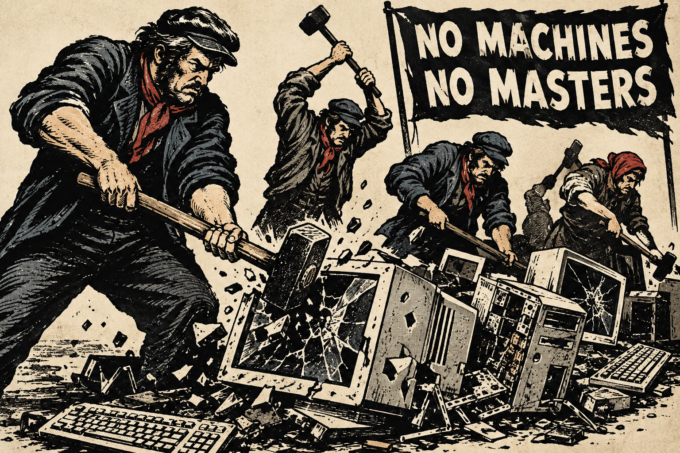
What ChatGPT produced when asked to generate an image of Luddites smashing AI.
Great hullabaloo just now about the dangers of AI. Furious or futile?
The Wall Street Journal’s top columnist filled a long op-ed on Sunday with all the warnings recently issued from those within the AI world about how the machines now—and this means while you’re reading this—have the capacity to organize among themselves for their own ends, and some believe that this includes doing away with humans as unnecessary or interfering. Calls for government regulation or industry self-restrictions are sounded everywhere.
One interesting voice was heard this August. Bill Gates, the billionaire co-founder of Microsoft, came out with an essay warning that artificial intelligence is bringing us to “an era [that] will be one of the most turbulent times in human history” with “no plan” for the upheaval it will cause on jobs, manufacturing, cyberattacks, chatbot addiction, “critical thinking,” and much else. Ultimately, AI “will be able to function on its own without a human checking on it, and companies will have every incentive to let it.” Something must be done.
Now this is interesting because Gates was one of the people directly responsible for the revolution that paved the way for this AI revolution: the internet/computer interface that has completely changed the world we live in over the last 30 years. And as it happens, I was one of the many voices raised at that time warning about an era that would be one of the most turbulent times in human history, with no idea how to slow or control it and its impact on jobs, manufacturing, critical thinking and everything else. Something, I said, picking up a sledgehammer and smashing computers on stage and on television from coast to coast, must be done.
Well, that revolution happened without much of anyone paying attention to the voices of the Neo-Luddite movement. It did not simply wipe out jobs and change the economy—it changed our very lives, and with an unprecedented rapidity—years, not decades. From 1986 to 2007, the world’s capacity to store information increased by 25 per cent, to exchange information by 30 per cent, and to compute information by 61 per cent. The sheer volume of data was huge and doubled every two years. And everything went from slow to instant–not just mail but bank transactions, medical visits, meetings, friendships, transactions of all kinds.
Our lives changed from analog to digital, and so the very way we confront and deal with information, and thoughts and memories had to be readjusted. The technology world exploded—computers everywhere as microchips became smaller and more powerful, phones (cell, mobile, smart), fiber optics, satellites, social media, cyberspace, cybercrime, every aspect of life—economy, government, society—was not only touched but changed. From treating technology as part of a human world, we became humans in a technological world.
And in the deepest sense we moved from a world where technology offered and explored reality to one where technology disguises reality so effectively that it is hard to know what is true—really true–from what is put out there as true. Information once came from trusted sources whose general projection of the truth we could rely on—books with editors, newspapers with reporters, encyclopedias with experts—to attractive, nearly addictive, digital sources like social media, “influencers,” politicians, podcasts, websites, networks, even news media, with immediate and vast impact but no commitment to or apparent interest in the truth. If you’re worried about “critical thinking,” Mr. Gates, this is where it all began to come apart. Your revolution.
Will there be any change this time? Is there something that makes this revolution controllable? Regulatable? Selectively beneficial?
Not as I understand the lessons about technology that Gates’s upheaval caused us:
+It is not self-referential. It does not know what effects it will have on the world, and it has no way of knowing even if it cared, because it is not under control by anyone or anything.
+It is everywhere. It is nowhere.
+ It has a momentum of its own, based on what it can do, and therefore will do. Its practitioners spend every moment trying to expand (and make money from) exactly that, so it comes up with new machines, new fields, new processes, and new combinations all the time. Some work, some don’t, but the technology expands just the same.
+ It is never neutral. It always will reflect the values, goals, priorities, and ethics of the society that created it and the economic and political elites controlling it. In a capitalist world, it will reflect the basic necessary, essential, compulsion toward growth–growth at all costs.
And I see no way to stop it.