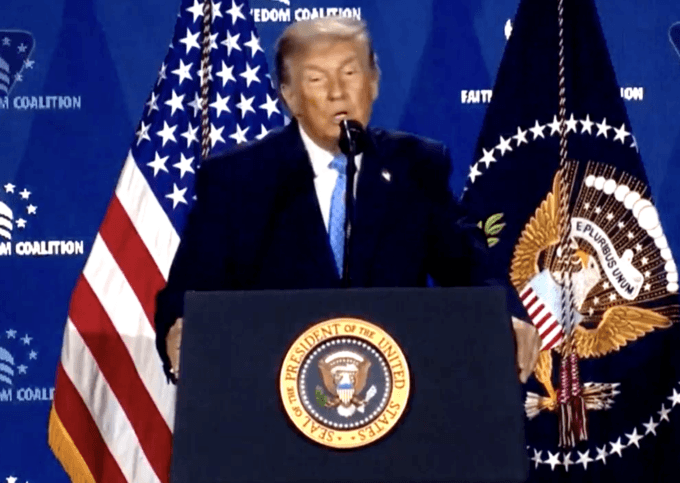
Trump speaking at the Faith and Freedom Coalition. Screengrab from video posted to X.
Watching Trump behave like a maniacal wrecking ball every day, one can be forgiven for wondering why Democratic presidents always appear so comparatively docile. Obama uses the utmost finesse to barely pass the (wretched and corporate-subsidizing) Affordable Care Act? Trump backdoor defunds it with some executive orders. Biden spends much of his term unsuccessfully attempting to implement a small bit of student debt relief? Trump wipes out the entire Department of Education with a wave of his hand. Why, then, are Republican presidents seemingly so much more effective at doing what they want? A common temptation is to conclude that this is primarily a matter of leadership, and that if our side could just get an ideologically committed street brawler in the White House we would finally get some meaningful improvement around here.
William Howell and Richard Moe’s Trajectory of Power: The Rise of the Strongman Presidency provides a different answer to the question. Examining the development of the modern presidency and the different ways that it constrains Republicans and Democrats, Howell and Moe make two major points. The first is well-known and largely uncontroversial. The executive branch has gotten massively stronger in the modern era. The only ones who still deny this only do so by focusing on one specific arena of presidential power: the president’s diminished effectiveness in lawmaking. While it’s true that, particularly within a polarized and closely divided Congress, it’s become harder for presidents to get laws passed due to countless veto points and interest group capture (Trump 1.0 couldn’t even get a Republican Congress to fund his wall or repeal Obamacare), the larger story is that the presidency has amassed dramatically more power in nearly every other capacity, particularly trade, foreign relations, and the ever-expanding realm of so-called national security. As Howell and Moe show, this expansion has been achieved largely through the president’s increased control of the federal bureaucracy, enabling presidents to both expand their reach and act unilaterally, increasingly ignoring Congress altogether.
Notably, the executive’s expanded power has been a largely bipartisan affair. Faced with the growing crises produced by an increasingly sophisticated industrial global economy, the national government, and specifically the executive branch, began to expand in size and scope at the turn of the century during the Progressive Era, and then most notably during the New Deal and the Great Society. More recently, Nixon expanded the president’s control over the bureaucracy by bringing oversight and decision-making into the Executive Office of the President via his Domestic Council while also expanding the Office of Management and Budget, a “super department with enormous authority over all of the activities of the federal government” that Trump is using to wreak havoc today. Clinton, notably, used Nixon’s Domestic Council as the model for his own National Economic Council, which no president, irrespective of their politics, has disbanded since.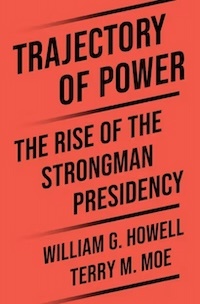
This expansion of executive breadth and scope was not merely a power grab. As often as not, Congress, particularly during crises such as the Depression, dodged its collective action problems by forfeiting its power to an executive designed for decisive and quick action. And when presidents did attempt to jettison their power it tended to end badly for them. Attempting to depoliticize presidential appointments, Carter reduced the power of the White House personnel office before realizing that in disconnecting his presidency from the bureaucracy, instead of centralizing it under his command, he had “’given away the store’” and undercut his own ability to govern, a mistake he would work to undo later in his term. In the story of the president’s expanding power, Carter’s experience is the exception proving the rule that the presidency either follows the logic of expansion or atrophies.
Howell and Moe’s second major point is only slightly less obvious than the first. Namely, Republican presidents since the New Deal have been committed to destroying the liberal administrative state. While Eisenhower assumed that the administrative state and its plethora of progressive programs could be rolled back only by Congress, Nixon saw that due to its tremendous entrenchment it could only be eliminated via unilateral action at the presidential level. Republican presidents since Nixon, and particularly since Reagan, have then paradoxically sought to expand presidential power precisely in order to destroy the administrative state. Because “changing an institutional status quo almost always requires much more power than protecting it,” Democratic presidents have in this regard largely stood pat while Reagan, George H.W. Bush, George W. Bush, and Trump have created what has now turned into a supercharged, lawless, and authoritarian “strongman presidency.”
Such a presidency, however, is not only defined by the negative power to destroy. Instead, Republican presidents have invoked the rationale of unitary executive theory to also expand the president’s affirmative power in, among other areas, foreign policy and over the Department of Defense, the NSA, and the State Department. The conservative courts, as anyone reading the news knows, have invoked the pseudo-historical ideology of originalism to justify their acquiescence to Republican executive power, while the Christian Right and a virulently reactionary media conveniently emerged to further advance the project.
To use the language of the book, modern presidential power has, in short, followed a general “symmetrical” expansion benefiting both Democratic and Republican presidents but has simultaneously followed an “asymmetrical” expansion that has solely empowered Republican presidents, and the GOP more broadly, at Democrats’ expense. The result has been a Republican presidency that is qualitatively different from Democratic ones, which is why the former presidents, regardless of their personal idiosyncrasies, all appear to be nihilistic psychopaths while the latter come off as pathetic duds. To be more generous, Republicans are playing a very different game, one whose logical endgame is the elimination of all opposition.
Howell and Moe’s account is particularly useful in showing that, beneath his freakish narcissism and volatility, Trump is remarkably conditioned by the presidencies of his predecessors as well as a predictable institutional trajectory. Indeed, if you didn’t know that Arthur Schlesinger had died in 2007, you might guess that his description of the George W. Bush Administration’s conduct as “’the most dramatic, sustained, and radical challenge to the rule of law in American history’” was referring to the Trump years.
The authors additionally provide some helpful reminders that the type of partisan sabotage, shutdowns, and gerrymandering we’ve been seeing of late transcend Trump and were all part and parcel of the Gingrich Revolution of the 1990s. One can argue that, beyond Bush v. Gore (a precursor to January 6th and the principle that the GOP no longer honors election outcomes), one decisive “wheels have come off” moment was the impeachment of Clinton, a desperate and bad faith measure emerging from the fact that, while he was an abysmal president, he had been deemed illegitimate merely because he had power while the Republicans did not. While Obama was not stupid enough to get into trouble for committing adultery or perjury, he was nevertheless also delegitimized by the right (for being “foreign born”). Meanwhile, Trump has broken every rule in the book to no effect while rapidly building upon the authoritarianism of Bush, and, for the same reason that a rock thrown off a hill falls down, future Republican presidents will very likely be even more authoritarian than Trump.
There is, however, a counter to Howell and Moe’s argument that GOP presidential rabidness and Democratic timidity are attributable primarily to the GOP’s opposition to the liberal administrative state. After all, Trump has shifted, at least rhetorically, the GOP’s traditional stance on Social Security (which Clinton and Obama both flirted with weakening) and has modified the party’s position on a number of other policies, showing that there is nothing predetermined in GOP presidents’ opposition to the administrative state (Republican governors have certainly embraced Obamacare in addition to other forms of federal support for liberal programs). And are we to conclude that if Trump were merely on good terms with the administrative state he would not be trying to steal elections and persecute his enemies?
What might be more useful here than the question of ideology, which is far more susceptible to historic flux, is the simpler question of economics. Within the context of worldwide capitalist crisis, the GOP can afford to be vigorous and coherent in pursuing its policies since its unrestrained support of capitalism is in line with the domestic and global system’s demand for unending accumulation. The GOP does not typically have to reconcile any serious contradictions between its rhetoric and positions and the demands of governance. They have the structural winds at their back. By contrast, the Democrats are in a bind that has badly tightened since the 1970s, the dawn of the postwar global slump and neoliberalism. Unlike the GOP, the Democrats continually walk into headwinds when their rhetoric and positions on labor, the environment, and trade confront the realities of cutthroat global competition and the demands of the state. It follows that, in office, one party would be unified, purposeful, and aggressive while the other would be internally divided, mealy mouthed, and incoherent.
These interpretations, of course, are not mutually exclusive. In either event, it’s useful to be reminded of the importance of structure, without which our discussions of Democratic leadership (which somehow always fails) and strategy (which is somehow always stupid) aren’t destined to get far.