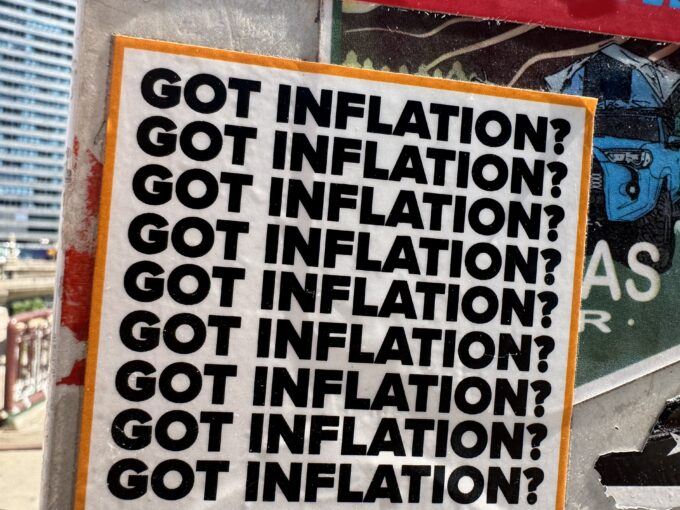
Photograph by Nathaniel St. Clair
As much as I’m not inclined to come to the aid of Trump lackey and newly crowned Fed Chair Kevin Warsh, I feel a need to be consistent even in the age of Trump crazy. The latest reports on inflation are not good news for those hoping for a quick return to the Fed’s 2.0 percent inflation target, but I still don’t think they warrant interest rate hikes.
For those who somehow missed it, year-over-year inflation was 3.4 percent in August. The core rate was 2.4 percent. (The auto insurance component fell 5.1 percent year-over-year. If it had been flat, both rates would have been roughly 0.2 percentage points higher.) While these inflation rates are not panic material, they are definitely higher than the Fed’s 2.0 percent target.
More importantly, there is no evidence that they are headed downward. Back in 2024, before the election, year-over-year inflation was 2.4 percent and was generally expected to fall to 2.0 percent in 2025, or very close to it. Insofar as hitting 2.0 percent inflation was seen as the Fed’s job, it looked like it could take a bow. It certainly looked like it was free to lower interest rates in response to labor market weakness.
Then Trump got elected, and inflation jumped — first in anticipation of tariffs, as consumers and businesses stocked up starting right after the election, and then in response to the actual tariffs. Inflation likely would have leveled off and again headed downward, but then Trump started the war in Iran, sending oil prices soaring. With little prospect of the war ending any time soon, it doesn’t look like there will be much relief on the oil price front.
This is where the test of the Fed’s credibility comes into play. Inflation has been above the Fed’s 2 percent target for more than five years. It has no near-term prospect of getting back there, so the argument goes, it must raise rates.
This is basically a story of “things are bad, do something.” I doubt anyone believes that a quarter-point rate hike, or even a larger one, will do much to bring down inflation any time soon. It presumably means somewhat less housing demand and construction, as well as some hit to private investment, as well as state and local government projects. This will at best have a modest impact on inflation, although it will weaken the economy.
On the other hand, there is no real prospect of inflation getting out of control if the Fed holds. As I and others have noted, wage growth is slowing. The year-over-year rate of wage growth was just 3.1 percent in August. The annualized rate, comparing the average for the last three months (June-August) with the prior three (March-May), is just a 2.7 percent annual rate. This is down from a rate of over 4.0 percent through most of 2023 and 2024.
It is very hard to tell a story of inflation accelerating when wage growth is just over 3.0 percent and falling. We have seen an extraordinary shift from wage income to profits, but is the expectation that this shift will just continue indefinitely? If wage-profit shares just stabilize, even the trend 1.5 percent rate of productivity growth should have inflation under 2.0 percent. If we see anything like the productivity boom the AI enthusiasts and the stock market are anticipating, with 3.0 percent wage growth, inflation should be well under 2.0 percent.
So, what does the Fed have to worry about? There is certainly the risk that Trump will do another big round of tariff increases, perhaps to try to pay for his $5K election dividend or because he’s angry at more of our allies. He may also start some new war, putting further upward pressure on prices. But a Fed rate hike won’t help on these matters.
In fairness, there is a real risk that long-term rates will rise more in response to the Fed holding than the Fed raising, out of misplaced fears of inflation. But in terms of actual inflation risks, it’s hard to see the story, at least in areas where the Fed has some control.
Again, I don’t like throwing in my lot with Team Trump on this one, but I have often proclaimed my loyalty to arithmetic and will continue to do so. The case for accelerating inflation does not add up.