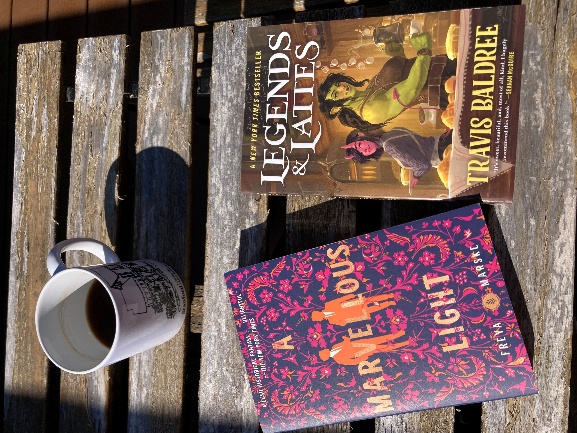
Author photo of two queer romance novels next to coffee
“He still had his fingers crooked around Robin’s…”
“Tandri’s hand found Viv’s and gripped it tight…”
Tantalizing erotic and sensual lines such as these come from queer romance novels. Lesbian ciswomen like Viv, an ogre in Legends & Lattes by Travis Baldree, or gay cismen, like Robin Blyth in A Marvelous Light by Freya Marske are composites of qualities making up complex characters, rather than one-dimensional, failed Bechdel tests or queer-coded, Disney villains. What I have been drawn to is how contemporary queer romance novels, broadly construed, carry a continuum of political imaginaries. It as if when reading across them you can center the reform or revolution debate as possibilities within manufactured worlds of conflict around homophobia, sexism, and class exploitation.
Through these novels, paired with book clubs and short form videos, a community is built to participate and share in an imaginary world to fantasize about justice, while providing an outlet for desire. The main demographic for these books tend to be more liberal in terms of politics, quite possibly even socialist. Rather than separating the public and private spheres of love, agape and eros intertwine to create a path for love through political struggle. In Minnesota during the ICE occupation, I imagine many Queer rebels read these books and participated in literary communities, then coordinated and participated in the resistance against police state tactics. Administration officials even impugned their character as “deranged leftists” for daring to impede the federal government’s inhuman treatment of their neighbors. In an era of rising fascism, I wonder about the role of literature in shaping a preparatory worldview to struggle for justice against authoritarianism. Reality catches up to become a representation of what has been built in the world of fantasy, creating a moment to actualize the literary universe.
Don Quijote is instructive about the way in which our literary world can drive forward our material one. Don Quijote is not mad, at least not in the sense people often ascribe to those who exist in a radically distinct relationship to reality. The stories he read were real for him. As time went on, people around him participated in making them real, even inventing adventures for Quijote. Fantasy and reality become mingled, and in that mingling provide an outlet for the performance of a self created through literary encounters. This is what the French psychoanalyst Felix Guattari meant by the cinema of the mind. It becomes filled with all kinds of images and scenes that aid in filling in for uncertainty and shaping how we interact with the world. We come to embody this literary world because having stable meanings about the way the world works can provide comfort, reduce anxiety, and build community. The right cinema of the mind gives us the capacity to think of what Ghassan Hage calls “being other than what we are”. We are not beholden to meaning by instinct or genetics, there are an untold number of ways that we can believe, value, and symbolize our experience of the world.
There are numerous instances across queer romance of how dreaming of radically different worlds is based on a clear conception of justice. In the book Faebound by Saara El-Arifi, the Fae with magic subjugate the Fae without magic, known as Lightless, which becomes a flashpoint for reform by the second book, Cursebound. The understanding of the inherent injustice to the hierarchical sorting of populations into more or less deserving is a pervasive motif in the genre. This book is also about how different beings, Fae, Elves, and Humans, battle due to difference, and the necessity of unity across difference to break free from prisons of their own making.
Even more, there is the ongoing theme of solidarity within these books, whereby the protagonist and their group of friends and frenemies band together. This latent politics of friendship in bringing about justice and social change separates these queer romantic novels from their more traditional counterparts. In certain of these novels, there is the explicit people shorn of prejudice fighting for the equality of all. These books then represent the Kierkegaardian love of the stranger as a prerequisite for the emancipatory political act. All are worthy of dignity by dent of existing, and the denial of this essential fact is an affront to the moral order.
This is clearly on display in Camp Damascus by Chuck Tingle. The female protagonist, Rose, has been tethered to a demon that punishes erotic and sensual thoughts of her lover. Together with her girlfriend and another gay man also tethered to a demon, they aim to destroy the site of their torture, a Christian conversion camp. They seek salvation through emancipation of all Queers who’ve had this curse placed upon them. The culmination is a demonstration of divine justice, in which the truly wicked are punished, those who act against Jesus’ command for universal love.
Even more than these themes of difference and solidarity is the way they demonstrate a range of political stances. A novel like A Pinch of Pepper and Salt by Kosoko Jackson with its protagonist Xavier returning to his small town in Maine to fall in love with the chef Logan is more Hallmark than Communist Manifesto. What politics do exist in it are muted or carried forward by having a Black protagonist in an interracial, gay relationship. A systemic battle seems worlds away, literally. Yet, it is still a political book, centering the individual and their striving, ultimately rejecting the demand for climbing the meritocratic ladder to instead inhabit the rural idyll. In its rejection of the demand to compete and be stars it uplifts our substantive relationships as key to our humanity.
The novella Futbolista by Jonny Garza Villa centers a cultural politics about queerphobia in the Mexican and Mexican-American community, but in a form that eschews any reference to the State. Here sweet male embraces by a soccer star, Gabi, become an avenue for shifting ideas about what it means to love men as a Mexican-American, cisman without requiring a social movement. The aim is to challenge through the use of traditionally masculine symbols, like sport, the idea of who a cisman can be and who they can love. In this, the personal and familial as sites of acceptance/rejection are crucial, extending outward as a demand for change through modern cultural forms, namely the idea of the influencer.
The overtly political romance novel, Red, White, and Royal Blue by Casey McQuiston, wraps itself in a more West Wing-style vibe of institutional reform. Here, a son of a President and a male member of the British Royal Family fall in love and become a flashpoint of how homophobia is leveraged by reactionary political actors to pursue their agendas. Rather than invisibilize themselves, direct confrontation showcases a call for the pluralist, progressive coalition as a necessary condition for a just political agenda. This politics of recognition is vibrant in all of these books, but redistribution can be crowded out by more elitist, merit-based narratives. Partly this follows from the heroic group whose special gifts make possible the emancipatory journey. Yet, the wine moms of Minnesota have shown that the hero they are waiting for is themselves each time they chased down an agent of the state kidnapping someone off the street. Kind of a cliché, but you are all the heroes you’ve been looking for, and books should be reflections of that quintessentially important truth.
Even when these queer romances push at the radical limits of the political imaginary, there is a way that romantasy returns itself to heteronormativity and hierarchy. In part, mass appeal may require some limit within the world as it is now. Push too far beyond, and the books could become unintelligible and too avant garde or niche. One way to push beyond the current formulas is to think of a more boundless desire. The protagonist and their lover tend to end in monogamy, eschewing polyamorous forms of love. These books are not devoid of these more hedonistic revelries. In Faebound, celebrations end with orgies. Yet, Dean Spade is correct in that the current order of things often constrains us to a love that fits within the idea of a bourgeois nuclear family. In part, this is from an idea of eros as singular, the one true love. In opposition to this notion is love as a becoming, one whose ending does not represent catastrophe or animosity. Rather, partners can change with time. And, why not think of an orgy as a truly egalitarian act, with all present being equal participants in climax.
Even more, while there is some emphasis on resource concentration as a form of power, there is often little critical thinking about the cooperative ownership of the means of production. The new order shall be egalitarian, but discussion of what that tangibly will mean for the division of labor is unsaid. A Power Unbound, the protagonist, Alan Ross, is clearly opposed to the aristocratic order of Victorian England. Yet, Alan falls for Lord Hawthorn who loves the clandestine smut Alan writes and supports the social democratic reforms of the past. There is no upending of class exploitation, merely its amelioration.
Regardless of my criticism that seeks to push the limits of the possible in this genre, I remain a devoted fan. Queer romance represents the promise of a left-wing literary vessel, one that can root itself in visions of liberation that celebrate difference, solidarity, and justice. Such strong creative endeavors should be taken seriously. Ideas exist and they impact the world we live in, especially in thinking about the distribution of benefits and harms from the decisions we make. They are the kindling of our desire to act, the counterhegemonic backdrop to our solidarity. We can make them better by representing socialist utopias enacting democracy and cooperative ownership over the means of production with a dash of kink to get the reader off on liberation.