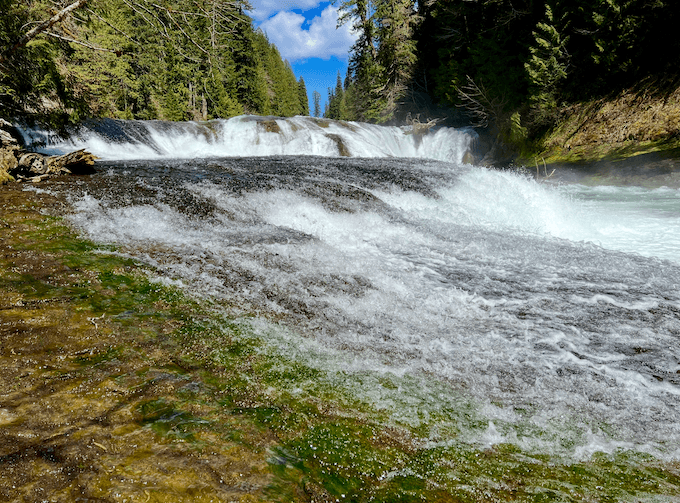
Upper Lewis River, Gifford Pinchot National Forest, Washington Cascades. Photo: Jeffrey St. Clair.
The Trump administration has proposed rescinding the 2001 Roadless Area Conservation Rule on roughly 44.7 million acres of national forest land. The stated rationale emphasizes “local control,” wildfire response, forest health, timber production, and management flexibility. But the proposal deserves to be judged against what the Roadless Rule actually does—and against conditions in the West today.
The existing rule is not a prohibition on management. It restricts new road construction, road reconstruction and most timber harvest in inventoried roadless areas, but contains specific exceptions for public health and safety, existing rights, certain mineral leases, road realignment needed to prevent resource damage, and other circumstances. It also allows generally small-diameter tree cutting where needed to improve threatened or endangered species habitat or to restore ecosystem structure, including reducing the risk of uncharacteristic wildfire. Prescribed fire, livestock grazing, trail construction and maintenance, motorized use on designated routes, hunting, fishing and other recreation can also occur under the existing rule.
That distinction is important because the administration’s proposed rule is not merely an adjustment to allow urgently needed fire management. The proposal analyzed as Alternative 2 in the Forest Service’s 2026 Draft Environmental Impact Statement would rescind the national rule altogether, eliminate its nationwide road and timber prohibitions and remove the federal inventoried-roadless-area designation from the affected lands. Management would instead depend primarily upon individual Forest Plans, project decisions and other applicable laws.
The administration’s own DEIS acknowledges the tradeoff. It concludes that rescission would increase opportunities for roads and timber harvest, but could also increase sedimentation, reduce water quality, fragment habitat, harm threatened and endangered species, diminish primitive recreation and scenery, affect Tribal resources and increase the Forest Service’s road-maintenance burden.
Those consequences deserve particular scrutiny because one of the most valuable products of America’s national forests is not timber. It is water.
The West is already running short of water
The timing of the proposed repeal could hardly be more consequential.
The Colorado River Basin has now endured what the Bureau of Reclamation describes as 26 years of unprecedented drought. Following the record-low 2025–2026 snowpack, combined storage in Lake Powell and Lake Mead fell below any level observed since before Lake Powell began filling in 1963. Both reservoirs reached record-low elevations in August 2026. (USBureau of Reclamation)
On August 21, the Department of the Interior adopted new operating guidelines requiring reductions of 1.25 million acre-feet of Lower Basin Colorado River deliveries in each of 2027 and 2028. Under the Lower Basin states’ proposed sharing arrangement, Arizona would lose 760,000 acre-feet annually, California 440,000 and Nevada 50,000. The states are also expected to conserve at least another 700,000 acre-feet over the two-year period. (USBureau of Reclamation)
These are no longer hypothetical projections about climate change decades in the future. They are reductions being imposed now on water used by cities, farms and communities throughout the Southwest.
The problem is not confined to the Lower Colorado River Basin.
In Montana this summer, low streamflows and high water temperatures caused state wildlife managers to restrict fishing on 24 rivers, including portions of the Madison, Big Hole, Gallatin, Clark Fork, Bitterroot, Blackfoot and other celebrated trout waters. Some areas were completely closed to protect bull trout and westslope cutthroat trout seeking refuge in cooler tributaries. Montana Fish, Wildlife and Parks was also requiring junior water users in several basins to curtail withdrawals to protect instream flows. (Montana Free Press)
In Wyoming, drought has affected agriculture directly. A Meeteetse rancher told the Cody Enterprise in June that a ranch normally irrigated into August or September might have only another 25 days of irrigation water. At the time, 16 Wyoming counties were experiencing extreme drought. (Wyoming Public Media) Wyoming Game and Fish has likewise reduced or eliminated fish stocking in some reservoirs because the Laramie region is experiencing some of its driest conditions in three decades. (Wyoming Public Media)
Water scarcity therefore affects cities, agriculture, fisheries, recreation and wildlife simultaneously. In that setting, protecting the watersheds that produce relatively clean water should become more important, not less.
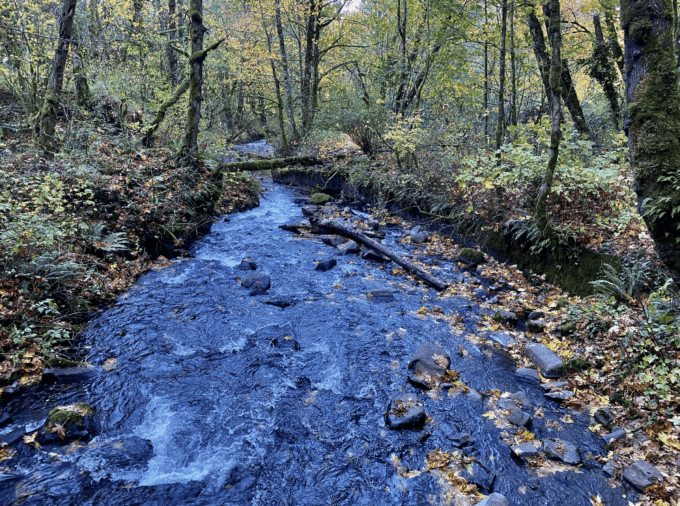
Roaring River, Mt. Hood National Forest, Oregon Cascades. Photo: Jeffrey St. Clair.
How much municipal watershed lies within roadless areas?
To understand what is at stake, I compared the Forest Service’s National Inventory of National Forest System Municipal Supply Watersheds with Forest Service inventoried roadless areas.
The municipal-watershed inventory identifies NFS HUC-12 watersheds recognized as municipal supply watersheds because they overlap source-water protection areas or have other local, state or federal designations identifying their importance to municipal supplies.
The overlap is substantial.
Among western states directly subject to the proposed national rescission, significant areas of protection will be lost.
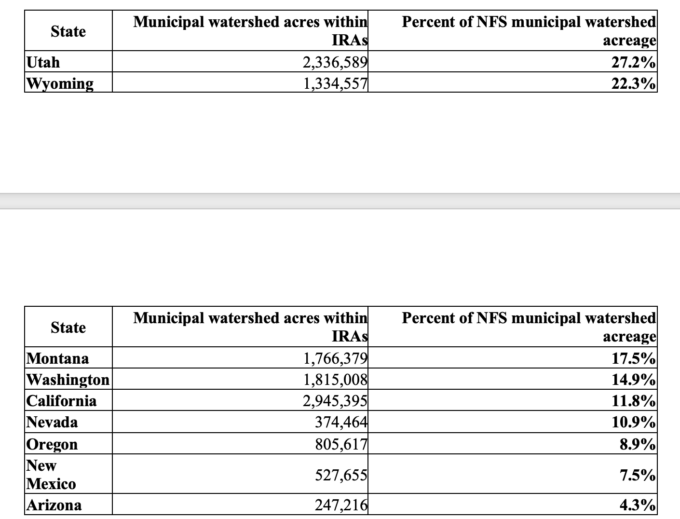
The acreage calculations come from intersecting the Forest Service municipal-watershed and roadless-area datasets; the percentages compare that overlap with total NFS municipal-watershed acreage in each state.
The numbers are particularly striking in Utah and Wyoming. More than one-quarter of Utah’s identified NFS municipal watershed acreage and more than one-fifth of Wyoming’s presently overlap inventoried roadless areas.
Colorado and Idaho require separate treatment. Both have state-specific Roadless Rules that the proposed national repeal expressly leaves in place. They therefore would not lose roadless regulation under this particular action. But neither state should treat that exemption as a reason for complacency. Their state rules divide roadless lands among management categories with differing degrees of protection, making decisions within those frameworks especially important where municipal watersheds are involved. In an increasingly water-limited West, both states should use those protections to their fullest extent.
Roads are not benign watershed features
Why does roadless status matter to water?
The answer was central to the original Roadless Rule. The 2000 FEIS recognized that roads and timber harvest can increase erosion and sediment delivery, compact soils, alter runoff, destabilize slopes, affect stream channels and degrade aquatic habitat. It also recognized that temporary roads can produce many of the same effects as permanent roads and may create repeated disturbance when constructed and removed over time.
The 2026 DEIS does not seriously dispute those relationships. It acknowledges that increased road construction and timber harvest under rescission could produce soil erosion and compaction, lower soil productivity, increase runoff and landslide potential and reduce water quality. Its answer is that Forest Plans, best management practices and project design can mitigate these effects.
That is a fundamentally different management philosophy.
The 2001 Rule largely avoids creation of new impacts in the remaining roadless landscape while allowing defined exceptions. The proposed rule would allow more disturbance and rely primarily on subsequent project review and mitigation.
That change comes despite a road system the Forest Service already cannot afford to maintain. The 2026 DEIS estimates that maintaining the existing National Forest road network in good condition would require roughly $1.6 billion annually, while the agency received about $270 million in 2023. It reports a $6.9 billion deferred-maintenance backlog for passenger-car roads alone, excluding many lower-standard roads.
Building additional roads into watersheds therefore creates not merely an initial disturbance but a long-term financial and ecological obligation.
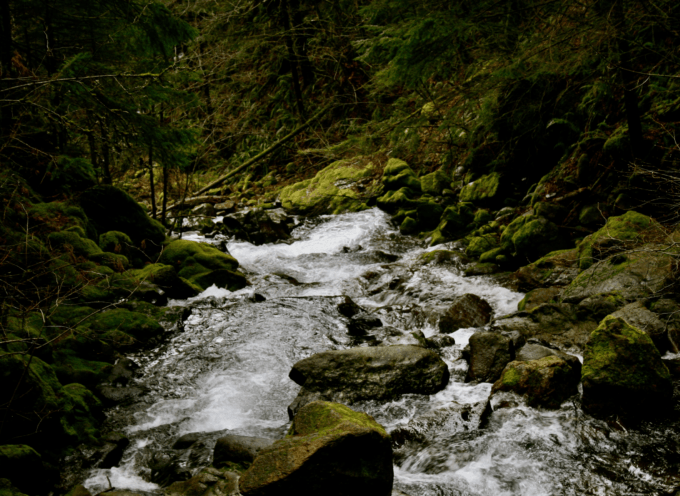
Hot Springs Fork, Collawash River, Mt. Hood National Forest. Photo: Jeffrey St. Clair.
The wildfire argument cuts both ways
Wildfire is perhaps the administration’s most persuasive-sounding justification for rescission: roads can provide access for mechanical treatment and firefighting.
But the existing Roadless Rule already permits fire suppression, prescribed burning and qualifying vegetation treatment intended to reduce uncharacteristic wildfire effects. The question is therefore not whether fire can be managed in roadless areas. It can.
The more important question is whether additional roads themselves reduce net wildfire risk.
The Forest Service’s own DEIS acknowledges that wildfire ignition frequency and density are presently lower in roadless areas and Wilderness than elsewhere on National Forest lands, and that increased road access could increase human-caused ignitions because people start fires disproportionately near roads.
Independent research supports that concern. Balch and colleagues analyzed more than 1.5 million government wildfire records and found that human-caused fires represented 84 percent of wildfires between 1992 and 2012 and accounted for approximately 44 percent of area burned. Human ignitions also extended the effective fire season by several months. The researchers found that patterns in fire activity were strongly associated with human influences including road density, population and land development.
The Forest Service made the same point even more concretely in March 2026. An agency analysis of 26 years of fire starts on four Southern California national forests found that nearly two-thirds of human-caused fires occurred along roadsides. The agency is consequently participating in an ignition-reduction program specifically focused on roads.
Roads can sometimes aid suppression. They also put ignition sources into landscapes that previously had fewer of them. A rational wildfire policy must account for both sides of that equation.
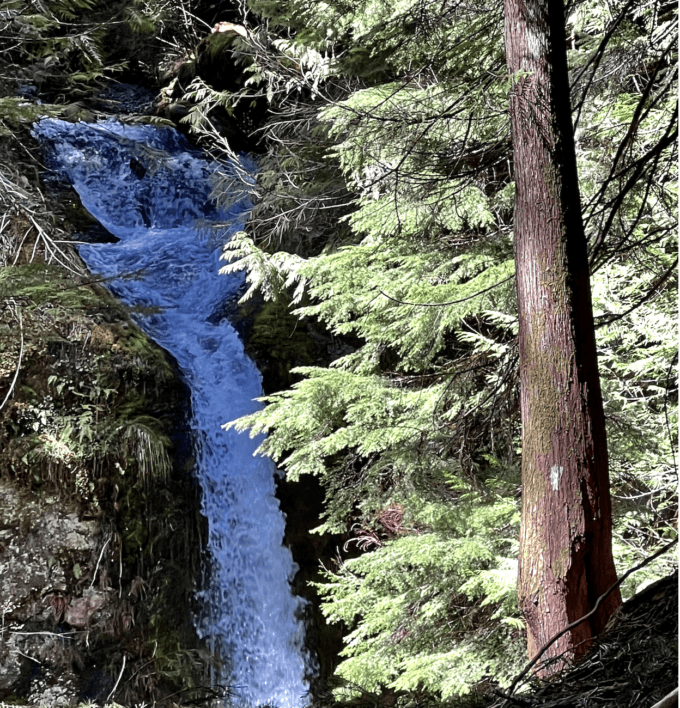
Upper Siouxon Creek Roadless Area, Gifford Pinchot National Forest, Washington Cascades. Photo: Jeffrey St. Clair.
Roadless areas also provide security habitat
Water is not the only public resource protected by retaining large areas without additional roads.
The 2000 Roadless Rule was based in part on the value of large, relatively intact landscapes for wildlife habitat and connectivity. The 2026 DEIS again acknowledges that roads and timber harvest may increase fragmentation, edge effects and human disturbance and finds biodiversity impacts likely to be least under the existing Roadless Rule. Its preliminary biological analysis concluded that rescission may affect and is likely to adversely affect 327 ESA-listed species and 71 critical habitats.
Roads do much more than occupy the width of a roadbed. They bring traffic, noise, recreation, hunting access, invasive plants and repeated human presence into landscapes where many species depend upon security and connectivity.
That matters because much of the National Forest landscape is already roaded. The remaining roadless lands are valuable partly because they retain a characteristic that is increasingly scarce: relative freedom from motorized access and development.
What problem does wholesale repeal actually solve?
The Forest Service’s 2026 DEIS repeatedly describes the proposal as a way to increase “flexibility.”
That description may be accurate, but flexibility is not itself a resource benefit.
The existing rule already permits responses to imminent threats to life and property, existing legal rights, prescribed fire, qualifying ecosystem restoration and wildfire treatments. Rescission goes much further. It removes the national conservation presumption and turns decisions about roads and timber harvest largely back to individual Forest Plans and projects.
The administration has not shown that protection of municipal watersheds, wildlife habitat and undeveloped recreation requires such a sweeping change.
Indeed, its own environmental analysis acknowledges that rescission would increase the probability of many of the effects the 2001 Rule was designed to prevent.
This is particularly difficult to justify in the West of 2026.
Lake Powell and Lake Mead are at historic lows. Colorado River users face mandatory reductions. Wyoming ranchers are running short of irrigation water. Montana’s rivers are becoming too warm and too low for trout during summer. Communities across the region are being forced to learn how to live with less water.
Against that backdrop, millions of acres of Forest Service municipal-supply watershed remain within inventoried roadless areas.
Those lands are not simply undeveloped timber inventories waiting to be made accessible. They are part of the West’s water infrastructure.
Unlike a pipeline, reservoir or treatment plant, an intact watershed requires relatively little construction. Its value lies precisely in what has not yet been built across it.
The prudent response to increasing water scarcity is therefore not to remove one of the few national safeguards protecting these watersheds. It is to recognize that keeping some of the West’s remaining headwaters roadless may be among the least expensive and most durable investments we can make in future water security.