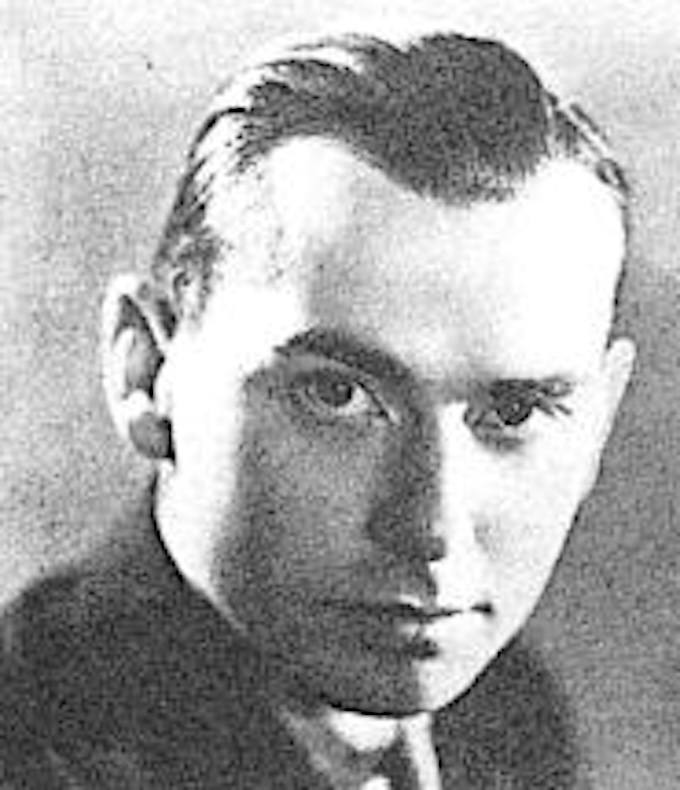
Christopher Caudwell, circa 1936.
Ninety years ago, in December 1936, at the age of 29, Christopher St. John Sprigg, a London-born member beginning in 1935 of the British Communist Party, volunteered to fight against Fascism in Spain. Two months later, he died in action while firing a machine gun to cover the retreat of comrades in the International Brigade. His body was never recovered. His death in Spain ought not to have surprised members of the Brigade or their friends and family members in England, the USA and elsewhere.
In Studies in a Dying Culture, probably his best book, which was published under the name Christopher Caudwell, he tackled some of the biggest names in British literature such as H. G. Wells, a futurist and the author of The Time Machine and The War of the Worlds, and D. H. Lawrence, the author of Sons and Lovers and Lady Chatterley’s Lover. In a series of critical essays, Caudwell illuminated the contradictions inherent in their work in much the same way that Lenin exhumed the contradictions inherent in the novels of Tolstoy. Caudwell showed that he wasn’t an appendage to the book and publishing industries.
Though he was an intellectual who wrote poetry, detective fiction, and aeronautics textbooks, St. John Sprigg/ Christopher Caudwell was also a doer with skin in the game. “Have we the courage to realize forcibly our views?” he asked rhetorically in Studies and added, “What guarantee have we of their truth?” His answer: “the only real guarantee is action.” He added, “man cannot live without acting. Even to cease to act, is a form of acting.” That’s an example of the dialectical thinking that informs his writing.
St. John Sprigg talked the talk and walked the walk, from England’s “fair and pleasant land,” as William Blake called it, to the battlefields in Spain. Two years after he died in combat, Bodley Head published under his pen name, Christopher Caudwell, a collection of his essays titled Studies in a Dying Culture that went on to be widely read and to influence several generations of Marxists and lefty intellectuals and writers such as E. P. Thompson, the author best known for The Making of The English Working Class, plus Raymond Williams, the author of Culture and Society and Saul Yurick, the American novelist whose tour de force The Warriors was turned into a popular Hollywood film when Hollywood still made decent films.
Thompson and Williams were also critical and even dismissive of Caudwell. Thompson pointed out that his “utopian vision of Soviet Communism leaves a dusty taste in our mouths today, and inevitably this must date some part of his writing.” In the wake of the revelations about Stalin, that perspective was to be expected. But Thompson also argued that Caudwell’s writings “represent the most heroic effort of any British Marxist.”
As a young budding Marxist, I read him for the first time in the late 1950s about a decade after Bodley Head published in 1949 Caudwell’s Further Studies in a Dying Culture, and not long before Monthly Review Press reprinted in 1971 the two “Dying Culture” books under the title Culture as Politics, edited by David Margolies, then a professor emeritus of English at the University of London.
My own first book, The Mythology of Imperialism (1971), along with my thinking and my in-your-face, no-holds-barred writing style—“Bombard the Critics” is the title for Chapter 1 — was influenced by Caudwell’s prose, and by a shared reading of history and by the example of his “activist“ life. No, I didn’t go into exile to protest the war in Vietnam, and I didn’t join the Communist Party, but I joined SDS, went into the streets and demonstrated against the bombing of Vietnam, against segregation and against the anti-student, anti-Black and anti-women stance of patriarchal academics and academia.
In a Foreword written in 1933 to the first of the two dying culture books, the German theoretical physicist, Max Planck, wrote, “We are living in a very singular moment of history.” He added, “It is a moment of crisis.” (St. John Sprigg also wrote about physics, so Planck wasn’t an odd choice to write the Foreword.) The early 1930s, with the rise of fascism, the visible fissures in the capitalist system and a world war on the horizon, was certainly a singular moment of crisis. Of course, capitalism has been in crisis again and again ever since the 1930s. It was in crisis in the early 1970s during the war in Vietnam and with rebellion at home and on campuses and in ghettos and it’s in crisis today. You don’t have to be a Marxist to see that or say that.
The culture of capitalism, if it can be said to have a genuine culture, is once again dying a slow but steady death, which makes Caudwell a contemporary, not a figure who belongs to the past. Empires, from the Roman to the British and the American, decline and fall slowly, as historians tell us. They may revive briefly and have last gasps but they go down, sometimes with “a bang” and sometimes with “a whimper,” to borrow the words from T.S. Eliot’s poem “The Hollow Men,” which begins “We are the hollow men” and that reaches a crescendo with the line, “This is the way the world ends” that’s repeated three times.
I recently reread Caudwell’s Studies in a Dying Culture and found it relevant, and still nourishing food for thought today, two years shy of its initial publication in 1938, half a century ago. The author’s prescience is remarkable. His essays on D. H. Lawrence, H. G. Wells, T. E. Lawrence, Sigmund Freud and on topics such as love, liberty, pacifism and violence resonate loudly and clearly. After all, the works of Lawrence and Wells are still with the reading public. Freud and Freudianism continue to exert an influence on the world of therapy and psychology and “bourgeois violence” as Caudwell calls it, goes on rearing its head and its weapons of mass destruction, inflicting pain and suffering, death and destruction on the world and its inhabitants. (What he called “bourgeois violence” might today be called “state violence.” Caudwell was obsessed with the bourgeoisie.)
E. P. Thompson wrote that “Caudwell defies the usual stereotypes of the literary Left of the Thirties” and “does not belong to the ambience of Left Review, the Left Book Clubs or Unity Theatre; and he had avoided public school and university altogether.” If he was a Marxist, he was also a maverick Marxist. In some ways, the writers whose work he chose to analyze was predictable, especially D. H. Lawrence and H. G. Wells, but he broke with Marxist tradition when he looked at the life and the work of T. E. Lawrence, known as “Lawrence of Arabia,” a British army officer, a diplomat and an archeologist who “went native” and aided and abetted the struggle of the Arabs in Sinai and Palestine against the Ottoman Empire during WWI. Caudwell was mostly but not entirely Eurocentric; he saw far beyond the English Channel.
Caudwell argued that T. E. Lawrence “betrayed” the Arabs and their cause and “brought into Arabia the very evil he had fled. Soon his desert Arabs would have money, businesses, investments, loudspeakers, and regular employment.” Caudwell added that Lawrence “was not aware of the omnipotent destructive power of the present over the past.“
Even more insightfully, he noted that “the archetype of the hero, even as he alters the world, seems unaware of what he is doing,” and that he “seems to act with a kind of blind intuition.” Shades of Christopher Nolan’s Odyssey that boasts a hero motivated by intuition and might be said to be an example of the hollowness of contemporary mass culture that recycles old memes albeit with some shifts to pander to current values.
Caudwell’s deviance from much of the Marxist thinking of his own day is apparent in his essay on “liberty,” in which he writes, “I agree with this basic assumption of Freudian therapy, that man always obtains more freedom, more self-determination, by a widening of consciousness or, in other words, by an increase of knowledge.” A Freudian Marxist, he was also an admirer of Lenin, a critic of President Franklin Delano Roosevelt and the New Deal, which he called a “State run by Samurai, a giant ultra-Imperialistic democratic world-state as the result of an open conspiracy.” That sounds like Orwell’s world of Big Brother.
Caudwell was also perhaps an embryonic Maoist. Writing a decade before Mao and the Chinese Communist Party came to power, he extolled the “Red Army, an army of heroes” that performed “exploits believed impossible, not aided by bourgeois gold.” Surely, he was thinking of the Long March, though he doesn’t mention it per se. He was also guilty of mythologizing the Red Army.
In our day and age in which democratic socialists have taken center stage in the political area, Caudwell’s worship of Lenin and his endorsement of the “dictatorship of the proletariat” might be viewed as a violation of the basic tenets of humanism and an insult to the memory of Eugene V. Debs, Mother Jones, and the anarchists and Republicans who fought and died fighting fascism and Stalinism in Spain. But to his credit, Caudwell didn’t want a permanent dictatorship of the proletariat. He looked forward to a “classless State” when humans would not oppress one another. The main emphasis in Studies in a Dying Culture is not on Lenin and the dictatorship of the proletariat but on the author’s fierce opposition to fascism and fascists who he explained burned books, crushed cultures and opened the gates to “a flood of barbarism and horror.”
No less horrific and barbarous now than it was in 1937, the year Caudwell died fighting fascism on a hilltop soon to be stormed by Franco’s forces. In Studies, he laid the groundwork for contemporaries who would dissect the dying culture of Trump and the Trumpers who would use any means necessary to bury the arts, the literature and the music that has rejuvenated American life ever since the world crisis of the 1930s. Hail hail the innovative work of Nelson Algren, Martha Graham, Langston Hughes, Toni Morrison, Orson Welles and many others who have fused creativity to political action and political action to creativity and liberated minds, bodies and souls.