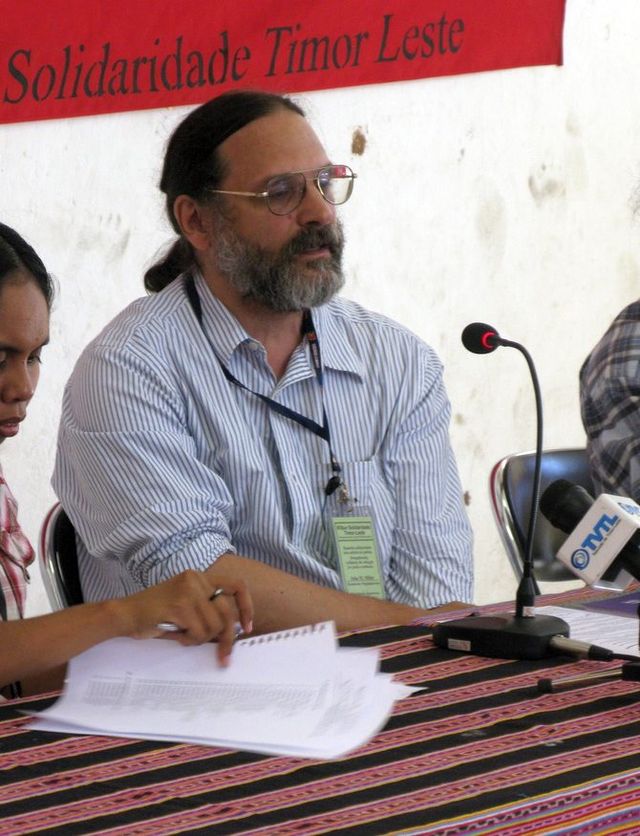
John in Timor-Leste. Credit: East Timor and Indonesia Action Network.
Unexpectedly on April 28th of this year, John M. Miller, lifelong anti-militarism activist, died at his apartment in East Harlem of heart disease. He was 70 years old. John was a dear friend, a comrade, and a beloved family member. He was also one of those most effective activists I’ve known, and by far one of the most humble and modest. I’ll miss him for my remaining years, as will so many others.
John is perhaps best known as co-founder of the East Timor and Indonesia Action Network (ETAN) – earlier known as the East Timor Action Network, but renamed in recognition of a wider mission after Timor-Leste gained independence – which played a critical role in mobilizing activists in support of the Timorese self-determination struggle following the bloody Santa Cruz massacre in 1991.
But John’s contributions to social justice struggles went far beyond ETAN.
While working at a long-gone book shop in Washington, D.C. in the late 1970s, John became involved in anti-nuclear struggles with the Potomac Alliance, coordinating their newsletter until 1981. In 1979 he helped organize the May 6 Coalition, which saw tens of thousands march on the Capitol in the wake of the Three Mile Island nuclear nightmare in Pennsylvania. For years, he served on the steering committee of National Mobilization for Survival (better known as ‘Mobe’) and worked as a staff member there, as well as editor of their journal, Mobilization.
In the early 1980s, John became a staff member for WIN Magazine, the journal published by the War Resisters League (WRL), an organization that became John’s political home until he passed. He also published frequently in The Guardian, along with many other outlets, about environmental justice and militarism.
John saw the need for U.S. activists to focus attention on solidarity work with struggles in Asia, and for years he served as co-coordinator with the Campaign Against U.S. Military Bases in the Philippines and the Philippine Bases Network. He also put himself on the frontlines many times over decades. In a recent interview, Charlie Scheiner, co-founder of ETAN, recalled to me,
In 1986, in the Philippines, activists organized demonstrations and marches that led to the overthrow of Ferdinand Marcos, who had been the U.S.-supported dictator for decades (and whose son is now president of the Philippines, unfortunately). John and I were both involved with that, and we went there. At a march in downtown Manila, the leaders asked us to be in the front because they thought the police would be less likely to attack if there were white people, particularly Americans, visible there. So we did that.
In spring 1988, John formed the Foreign Bases Project, a mostly one-person operation that produced important research and through which he organized against U.S. military bases around the world. Scheiner recalled,
[He] started the Foreign Bases Project. We had something in the New York area called the Campaign Against U.S. Bases in the Philippines, and a large part of that was encouraged by Walden Bello, who at that time was a grad student at Princeton. […] There was another network focused on U.S. bases in South Korea, and John tied it all together to say this is a global problem, there are U.S. military bases in many parts of the world, and they have bad impacts on the local population and also on the global political climate.
Locally, here in New York City, John did layout for the Met Council on Housing’s newspaper Tenant/Inquilino. He was also a very familiar face at various demonstrations and anti-militarism events.
I met John in my teenage years when I first attended an ETAN meeting at 339 Lafayette in Manhattan, known for decades as the Peace Pentagon. That building, which is sorely missed, served to introduce and connect many people into struggles on the radical left. On one weekend, in the 1990s, a person could attend workshops organized by the Atlantic Anarchist Circle in the same room that served as the space for ETAN meetings later in the week. One could feel the generations of dedicated activists who had organized from that building when you were there. John fit in perfectly in that space.
Along with Scheiner and a deeply committed network of activists like Lynn Fredrickson, Pam Sexton, and so many others, John pushed East Timor (Timor-Leste) onto the docket of the larger left, and into the policy briefings of politicians through powerful lobby days, protests, and writings. They built direct relationships with Timorese activists, organized speaking tours and any number of local events, year over year. Their wins included restrictions on U.S. military aid to Indonesia, and a significant change in public awareness of Indonesia’s 1975 invasion, its subsequent occupation, and the persistence of the Timorese struggle for freedom.
John never forgot to remind anyone who would listen that it was U.S. military and diplomatic aid that made Indonesia’s brutal occupation of East Timor possible in 1975, and it was a responsibility of those in the U.S. to hold their government to account for their government’s continued support, for decades, of dictator Suharto.
An important opening for the possibility of Timorese self-determination developed in 1998, as student struggles toppled the Suharto dictatorship and Timorese activists, with the support of a remarkable international solidarity movement, caused pressure that pushed the hand of Suharto’s successor, B.J. Habibie, on what had been long been known as “the Timor question.”
An independence referendum, overseen by the United Nations, was called. ETAN played an important role in mobilizing monitors. In the period leading up to the referendum, the U.S. government was aware that Indonesia was creating paramilitary forces to pressure and terrorize the population against voting for independence. On August 30, 1999, in an incredible testament to their bravery and the deep roots of the struggle for self-determination, the Timorese voted overwhelmingly for independence.
In response, Jakarta directed the destruction of East Timor – Indonesian-backed militias burned the majority of infrastructure, displacing hundreds of thousands, and murdered some 1,500 people.
International monitors, many who came from longtime solidarity involvements, were faced with the decision of staying or going, and the question of how the Indonesian-backed militias could be brought to heel.
Upon exiting Timor-Leste, John and other ETAN folks worked hard to force the U.S. to cut its military aid. Their work succeeded in a temporary cessation of military aid by the Clinton administration, which became a critical factor in ending that horrifying period of Indonesia’s mass retribution against the Timorese for voting to govern themselves.
John would write about that experience and how it changed his perspective in WRL’s magazine. I attempted to talk about the experience with him at various points, but he never opened up much about it, and I suspect difficulties from that experience stayed with him for the rest of his life.
Over the next couple of decades, John continued to work diligently for accountability of U.S. officials – like Henry Kissinger – and many others responsible for supporting Indonesia’s actions in Timor-Leste throughout Indonesia’s brutal occupation. One of my favorite memories of working with John is when we organized a small demonstration at the Indonesian consulate in Manhattan, after Suharto died in 2008, calling attention to the fact that he passed without experiencing any consequences for his actions against the Timorese, or any others. John also worked closely in support of West Papuan struggles for self-determination and continued his “worker-bee” efforts with the War Resisters League.
When John M. Miller, the activist, died an outpouring of international appreciation for his lifelong commitment sprang forward.
After he died, many of us who knew John first and foremost in the activist context got to learn more about how fiercely loving and loved John was with and by his family. His funeral was held at a Jewish cemetery on Eastern Long Island where his family shared beautiful memories of him, alongside the incredible sadness that comes from his loss, both before and after the service. His niece Alana noted,
[I]n our family he will be remembered for always showing up with a New York Times, a large Iced-Tea with Lemon NO SUGAR, and his backpack. His nieces and nephews knew him for his kindness and generosity; giving even when he did not have much. Let’s be honest, he never met a museum gift shop that he did not stop in. Leading to the most random gifts you’ve ever received- for example he gave my cousins a bag of DVDs he collected around Manhattan. His presence amongst our family was quiet, but mighty.
His younger brother, Eddie, recalled: “John was born to be a big brother, exceedingly patient, never raising his voice, and only occasionally becoming mildly annoyed by those of us doing the annoying.” Carrie-Ann, his sister, beautifully said:
He was more than my brother – he was my partner in adventure, and we were each other’s guardian angel. I think I said “where is Johnny” more than any other phrase. I idolized him, and he inspired me to do good in the world. Amidst the joyous chaos of family life, he’d sit calmly with his New York Times, observing, listening, and offering sage advice when needed. He was brilliant, kind, compassionate, thoughtful and always there. John always put others first. He was a great listener. His presence will be deeply missed, but his memory will continue as others continue the work. He led quietly, did whatever had to be done and felt passionately about equal justice for all.
For a number of years from 2014, John lived in the apartment below my wife and I in a small building in East Harlem. When we went away, he fed our cat Emma (“the creature” he called her), and I was lucky enough to see him several times each week. His apartment was always a mess, but he didn’t hesitate to invite people in to stay on his couch or take on an ETAN task. On the wall next to his apartment front door was a small solidarity poster. His home and his work for justice were always one in the same.
John was a towering figure in my life – a friend, a mentor, a commanding editor (we once got into a fight when he dryly responded that my first take at a press release was “better than a blank page”), a neighbor. His loss has left a big hole for me, and for many others. But in the months since he’s passed, I have had the opportunity to learn so much more about him, and to meet so many others who knew and loved him, and that is a gift.
A group of people from the East Timor and Indonesia Action Network and War Resisters League has put together a Global Memorial for John that will happen this Friday evening (August 28th) virtually. You are more than welcome to join. If you’d like to attend, please register here.