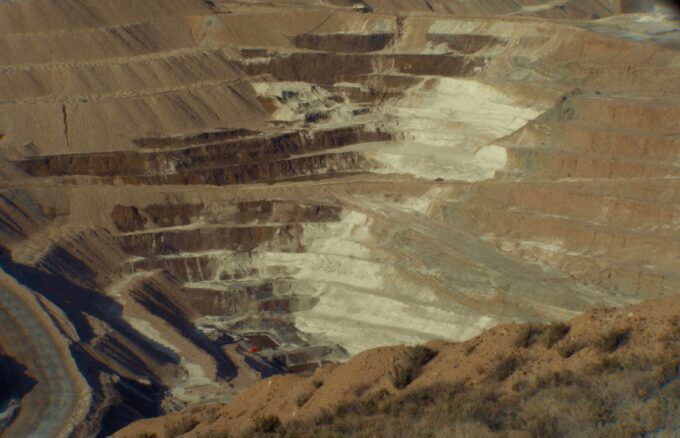
Rio Tinto’s Borax Mine, in Boron, California. Photo by Colby Groves.
It’s dry, hot, and windy. The dust is swirling. My buddy Colby and I are in the heart of the blazing Mojave to visit California’s most expansive open-pit mine. Owned and operated by the Australian mining goliath Rio Tinto, the pit, which produces a mineral called borate, is uncomfortably large, stretching two miles long, 1¾ miles wide, and 755 feet deep. According to the Rio Tinto guide that let us through the gates (of hell?), the mine produces about half of the world’s borax supply, a borate-derived compound with many uses.
From our perch above the mine, we watch excavators fill large dump trucks, which are winding their way up dirt roads, spewing clouds of diesel exhaust as they navigate huge piles of dirt. It’s a slow, meticulous operation that digs out 1 million tons of refined borate each year. Rio Tinto has been seeking to offload its $2 billion California boron assets but has yet to find a buyer.
The US has classified borax as a critical mineral because it’s important not only for everyday items like food and laundry detergent but also for military applications and clean energy tech, such as wind turbines, solar panels, and electric vehicle batteries. So, you could say this open-pit mine is vital to both the US war machine as well as the green energy transition. 
If that sounds like an oxymoron, welcome to capitalism, pal.
There are many such metals and other elements vital to the transition away from fossil fuels. Lithium-ion batteries, of course, dominate. Cobalt, nickel, aluminum, graphite, and more are required to building out green energy infrastructure and renewables. Copper is crucial because it’s an excellent conductor of electricity. It’s in everything. EVs, transmission lines, solar panels, you name it. The booming market for these metals, bolstered by the AI craze, means one thing: more mining is in our future, much of it in the name of battling climate change.
The amount of materials needed to sustain an electrified future at the world’s continued pace of economic growth is as remarkable as it is troubling. By one estimate, at least 384 new mines will be needed by 2035. This means we’ll see more open-pit mines, and lots of them. New copper deposits, for example, will need to be tapped. The International Energy Forum puts the top number of new copper mines at 194 by 2050. Many of these operations are set to be built in areas of biological importance. It’s also estimated that in the US, 79% of lithium reserves, 97% of nickel, and 89% of copper are within 35 miles of Native American reservations.
It’s not just green tech that needs new mines. Data centers require not only a lot of energy and water but also a heap of critical minerals. A conventional data center requires 15,000 tons of copper. A hyperscale AI data center, on the other hand, needs far more, upward of 50,000 tons (100 million pounds) of copper. The World Economic Forum believes the world will need over 4.3 million tons of copper for data centers and their power infrastructure by 2035.
As I explore in great detail in Bad Energy, the transition away from fossil fuels, as it’s now headed, means a hell of a lot more extraction, which in turn means even more environmental damage. I think it’s worth reckoning with these various impacts and contemplating whether we can save the climate (if that’s even the goal) by pillaging what remains of the planet’s resources.
Many mainstream environmentalists (and certainly policy wonks) downplay the need to couple the energy transition with something just as important: reducing consumption in wealthy societies, especially among the billionaire class. Some argue that humans aren’t capable of consuming less and rarely address the market-based economy’s reliance on endless growth. Doing so, of course, would require a more sophisticated analysis of what we are up against.
Take Bill McKibben, who, in his seminal 1989 book The End of Nature, argued that society cannot survive a culture driven by capitalist consumption and that technology alone will never save us. I still believe the book’s thesis, but a more risk-averse McKibben has since altered his perspective, not on the need to end the use of fossil fuels, but on the belief that swapping these climate-warming energy sources for renewables will do the trick. I don’t share Bill’s optimism.
As long as the market demands perpetual expansion and finite resources are consumed, humans and the Earth remain in serious trouble. There’s no silver bullet for the mess we’re in, and we’ll never save the planet, let alone humanity, until we reckon with the forces behind its destruction, starting with the crooks on Wall Street.
+++
In other enviro news, global ocean temperatures in June broke records, and fears are growing that we’re in “uncharted territory,” prompting Pacific fisheries to scramble.
New research shows how forever chemicals move through the Great Lakes and into people.
After years of opposition, a 900-mile oil pipeline is set to be completed in East Africa, but a last-ditch effort is underway to keep the oil from flowing.
In France, millions of chickens died as summer temps soared, following a similar event in the Pacific Northwest in 2021, when unprecedented heat killed hundreds of thousands.
I just got a text from my brother in Billings, Montana, where a heat wave is about to hit. The high on Sunday is predicted to reach 109 degrees. This will beat the record high of 105, which was set in 2002. My hometown of Billings has only reached 108 once in its history, a record also set back in 2002. Much of Idaho, Montana, Wyoming, and North Dakota is in for extreme heat this weekend.
+++
On to the good news this week. Salmon in Northern California appear to be rewilding, and California has returned 136 acres of rugged Mendocino coastline to Native tribes.
Stay cool wherever this finds you, and I’ll see you next week.
View this post on Instagram