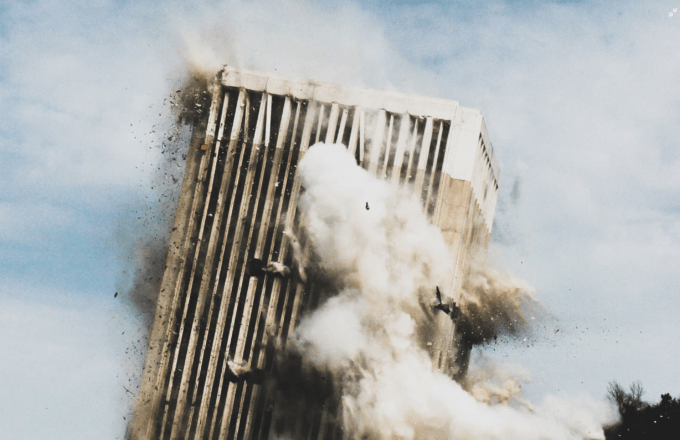
Photo by Micah Williams
Many of us have anticipated a great breakdown of global systems coming at some point. Too many exponential curves pointing upwards inevitably having to peak and begin tumbling down. Too many interlocking complex systems vulnerable to failure cascading from a single point.
Now we are asking – Is this it? Is the closure of most traffic on the Hormuz Strait due to the Iran War the trigger that sets off broad systemic collapse? Loss of a significant share of global oil and gas supplies, as well as fertilizer made with fossil fuels and their byproducts, argues to be just that kind of trigger. So far, dipping into reserves as well as financial manipulations have kept oil prices under control. But summer is predicted to be the time tanks will near bottom to cause a dramatic upward surge.
The knock-on effects to financial markets with their multiple blown-up bubbles are imponderable. In terms of fertilizer shortages, we will not see the effects until harvests many months away, but they are sure to be substantial. In the global south, food and energy shortages could topple governments. In the north, they will put increased stress on most people at a time they are already carrying a heavy load. The prospect of a Depression-level downturn is given serious credibility.
Whether or not these events will proximate in a catastrophic collapse, they are sure to add to what is already a time of great disruption. That is, I believe, what characterizes our time more than any other description. Disruption is coming at us from multiple directions.
Politically, tensions are escalating among nations. Hybrid wars and proxy wars proliferate even as the weapons of war become more sophisticated and deadly. Within nations divisions widen among populations to the point that makes it difficult to impossible to cope with mounting challenges.
Economically, wealth is concentrating in the top percentages of the population, reaching previously unimaginable extremes towards the pinnacle. The poster, of course, is Elon Musk becoming the world’s first trillionaire. This is as economic conditions for most are stagnant or declining. The distorted wealth curve is distorting politics, as the ultra-rich increasingly buy the process and the media that informs it.
The rise of AI is supercharging economic concentration and uncertainty. We don’t know who will have jobs in 10 years, and wonder how AI will increasingly concentrate wealth and power in the hands of an already bloated oligarchy. It is a fact of history that those in control of powerful technologies come to dominate society, whether it was hardened brass armor and weapons in the bronze age, or information technology in the current era. Mass layoffs in the tech sector already signal increased power and wealth for corporate owners.
Overarching these disruptions is the greatest of all, and the one that seems most ignored. Humanity is disrupting the ecological roots of its existence, stressing all natural systems. Rivers are drying out. Oceans are acidifying while being overfished. Corals are dying of ocean heating. Rainforests are retreating. Forests all over the world are burning. Heat waves, droughts and storms are reaching record levels. Species are vanishing at great extinction levels. All while the atmospheric load of heat-trapping pollution is only growing. As I have often noted here, we have crossed most planetary boundaries that ensure our species and others a safe operating space.
Heading this way for decades
We have been on this track for a long time. Many believe we crossed over to ecological overshoot sometime in the early 1980s. In 1988, the world passed atmospheric carbon dioxide concentrations of 350 parts per million, the threshold for any reasonable level of climate stability. Now they are around 432 ppm and growing at record rates. Meanwhile, since the 1950s, all sorts of exponential curves have been ascending nearly vertically – energy and material use, population, pollution.
So in one sense, disruption is the ocean in which us fishes have swum all our lives. For decades, the more far-seeing and sensitive among us have seen it. Ecological visionaries have been warning us about the condition of the planet since the 1960s and 70s, predicting we would hit the limits this century. Those aware of the world-ending power of our weapons have been urging us to create a peace economy for at least as long. Our political morass of increased control by the wealthy and special interests has been critically reviewed for decades. But the prophets have been ignored and cast aside while business as usual has plowed on.
All the time, while progress has clearly been made in some areas, the overall trends have been growing worse. Are we reaching a culminating point, where our ecological, economic and political crises converge to a monumental disruption of systems that shatters our assumptions of normal life? That makes the disruptions we faced during the pandemic seem like easy times? The most honest answer is that we don’t know. But the logic is that the complex systems that run our world are vulnerable to disruption, and many trends point that way. If it’s not happening now, odds are increasing that normalcy-destroying disruptions will happen at some point.
It is no accident the immediate threat of disruption is caused by the astoundingly bad leadership of Donald Trump. Bibi Netanyahu tried to make president after president attack Iran. Trump was the first to be so stupid, or so compromised, to do it. Every credible assessment said this would result in closure of the Hormuz Straits with devastating results to the world economy.
But ill-informed and hubristic leadership is the unifying element of all our crises, political, economic and ecological. It comes down to the sociopathy built into major economic and political institutions, acting only in their own interest, not caring for their impact on the greater whole. Whether it’s corporations focused only on “shareholder value” and the bottom line, or nation-states relentlessly pursuing their own power and domination. In such systems, the most sociopathic rise to the top, and those who aren’t are forced to behave that way by institutional imperatives. Silicon Valley even sees disruption as a positive force, ignoring the impact of its technologies on social stability and mental health. The Great Disruption is systemic. To deal with it we have to change systems, and the operating logic of the institutions that make them up.
A great world dream
In coming to the fore, the Great Disruption opens two important doors. First, we all have a normalcy bias. Things as they have been will continue to be as they are. That is, until they’re not. When systems are disrupted, people ask why. They want to know. That is the teachable moment when we can illuminate the systemic roots that have brought us to this place. Many of us possess deep analytical understanding of the issues. When normalcy bias is upset, that is our opening to spread our understanding.
Second, the failure of institutions provides the opportunity to build new ones. A good example is the spread of the social housing movement with the failure of the private market to provide adequate affordable housing. The Hormuz bottleneck demonstrates the unreliability of global supply chains and can spur community-based energy production with solar and wind. Increasing food costs and insecurity open the way toward more localized food production. There are many such examples. When institutions seem to be working, the incentives for change are limited. When they break down, alternatives come to the fore.
With disruptions at global and national level, it is likely the future is going to be a lot more local and bioregional. When complex systems break down, they move to simpler, more decentralized forms. Joseph Tainter, in his classic, The Collapse of Complex Societies, demonstrated this phenomenon in many ancient societies from the Maya to Rome. There comes a point when the energy needed to sustain a complex system produces diminishing returns. So the system must devolve to a level it can be sustained. Many argue that is the backdrop for much of what we are experiencing. It certainly argues for building a future closer to home, less dependent on unreliable global supply chains.
In my view, we have been trending toward massive disruption for a long time. Working on climate as I have for many years, studying the various scenarios, and witnessing the actual intensification of global heating impacts, it has been impossible for me to see a future that is not profoundly disrupted, where human and natural systems are stressed to breaking points. I have known that we and our future generations face troubled prospects. From that, I have drawn a hope.
Years ago, on one of my occasional trips to Washington, D.C. on some climate policy issue or another, I was spending a sunny afternoon at my favorite place in the capital, the Lincoln Memorial. I walked over to the center of the steps to take the view of the Washington Monument over the reflecting pool. I looked down to note I was standing on precisely the spot Martin Luther King Jr. had given his famous “I have a dream” speech there at the 1963 civil rights rally. It had been etched into the surface a few years before.
I leapt from the spot. I did not feel worthy to stand there. A few years later, on another trip, taking a break at the Lincoln, I was sitting off to the side reading about Dr. King in Taylor Branch’s magnificent “America in the King Years” series, about his willingness to sacrifice his life for the greater cause. King knew the assassin’s bullet was hunting him. Somehow, at that point, I finally felt worthy to stand at a that spot.
I walked over. Another sunny day. I looked out over the vista, and was moved to state my own dream. Spontaneously, I said to myself, “I have a dream that out of the greatest crises to ever face humanity, we will find our better angels and come together to create a great world for ourselves and our children.”
Simple as that.
Yet a few years later, I took my daughter to visit my family in Pennsylvania and then to see the sights in D.C. I took her to the Lincoln on a steamy summer night to give her an experience much as my parents had when I was around her age. To see the seemingly living statue lit up, and then to take my daughter out to view the scene, the illuminated white obelisk towering over the scene, the bright Capitol off in the distance. Then, I was again moved to silently repeat my great world dream, my hopes embodied in the 13-year-old standing to my side.
Is it foolish to dream anything like a great world can come out of this mess? Grasping at straws? Yet it is my hope and belief that the crises coming upon us, the great disruptions we face, will bring about a greater understanding of what has caused them and what we need to do to make our way through. That they will rip away the veil of normalcy and illuminate our path. That we will come to see the common good we must pursue if we are to survive.
I believe we will learn from hard experience our interdependence, to move beyond the competitive individualism of consumer societies to re-discover and rebuild community at all levels. We are certainly going to live in a wounded world. That is baked, literally, into the trends. But in coming together as human beings to heal our world, we can also make it a great one. This thought has sustained me through many years confronting our multiple crises and wrong directions taken. We can become better people and make a better world. Let us take from the disruptions of the present and greater disruptions to come the inspiration to do so. Our children’s world depends on it.
This first appeared on Patrick Mazza’s Substack page, The Raven.