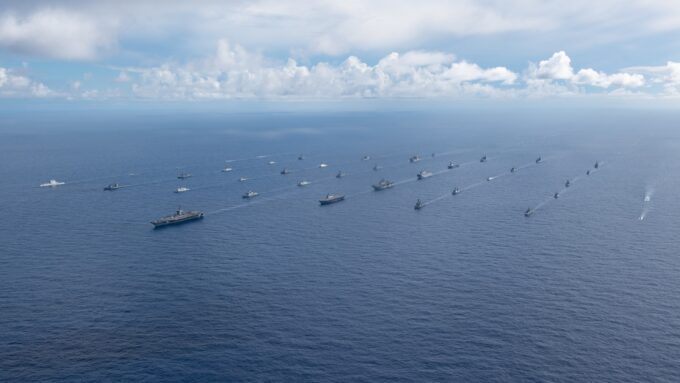
U.S. Navy photo by Mass Communication Specialist 3rd Class Dylan Lavin – Public Domain
The biennial Rim of the Pacific (RIMPAC) war games, the largest naval exercise in the world, is scheduled to take place in the ocean around, the air above, and on the ‘āina of Ka Pae‘aina O Ka Moananui (as Kekuni Blaisdell taught us to call Hawai‘i) from June 24 to July 31, 2026. The U.S. Pacific Fleet announces that “a multinational force of approximately 40 surface ships, 5 submarines, 140 aircraft and more than 25,000 personnel” will descend on Ka Pae‘aina. [1] In light of recent global developments, now, more than ever, we must oppose RIMPAC.
The intent of RIMPAC, as with the entire U.S. military posture in the Asia-Pacific, is to prepare for war against China. In order to encircle China, the U.S. arms and/or maintains military bases in the Philippines, Japan, South Korea, Taiwan, and Australia.
Similarly, the U.S. sought to encircle Iran by placing military personnel and bases in Kuwait, Saudi Arabia, Bahrain, Qatar, and the United Arab Emirates. The U.S. Fifth Fleet was based in Bahrain. Al-Udeid in Qatar was a major USAF base. These Arab monarchies bought U.S. weapons and were led to believe that the U.S. military presence would protect them against Iran. However, on February 28, U.S. and Israel launched a joint assault on Iran, beginning with the war crime of an incendiary missile strike that killed 168 schoolgirls in Minab. After shrapnel from the first Tomahawk missile killed many, surviving girls gathered in the prayer room. The second Tomahawk ignited its unspent fuel, incinerating all. Iran retaliated against the U.S. bases, rendering them inoperable. The monarchies in the Persian Gulf thus discovered that the presence of U.S. bases, far from providing protection, actually made them targets. In light of Iran’s missile and drone capabilities, the vaunted U.S. aircraft carrier battle groups have had to stay hundreds of miles away.
The Philippines, Japan, South Korea, and Taiwan need to recognize that allying militarily with the U.S. makes them targets. If they follow the U.S. into a war against China, China can easily strike its neighbors. The failed U.S.-Israeli war on Iran has demonstrated that in this age of drone and missile warfare, the carrier battle group is of diminished significance. Furthermore, the monarchies in the Persian Gulf discovered that when they ran out of interceptor missiles, the U.S. had no more to re-supply them. In fact, the U.S. moved Terminal High Altitude Area Defense (THAAD) systems from South Korea to West Asia in order to protect Israel. [2] In the event of a shooting war with China, the U.S. military would currently find its weapons stocks running low.
This raises the question of the utility of such interceptor missiles. MIT missile and nuclear weapons expert Theodore Postol maintains that interceptor missiles have been essentially ineffective. [3] Furthermore, he notes that U.S.-Israeli aggression against Iran is likely to push Iran to acquire nuclear weapons.
As a consequence of the U.S.-Israeli assault on Iran, commercial maritime traffic through the Strait of Hormuz has been drastically reduced. The price of petroleum products has markedly risen, and synthetic fertilizer (made using natural gas) has become scarce. Ordinary people worldwide are already feeling the hardship. Gas prices are up, food prices are up. Wages are not up. It makes it hard to keep the kids fed. Without a resolution of the impasse, the global economy is at risk of a recession, if not a depression. The lack of fertilizer will lead to reduced crop yields and potentially famine in the marginalized global South.
In light of this global energy and economic catastrophe, it is misguided to expend fuel and resources on war games. As it is, the U.S. military is the world’s largest consumer of fossil fuels. RIMPAC should be canceled, and the fuel that would be used by warships and warplanes should be put to uses that sustain life.
The recently concluded (April 20 to May 8) Balikatan exercises – mainly between the U.S. military and the Armed Forces of the Philippines (but also involving Japan, Canada, France, and New Zealand) – also simulated combat operations against China. A missile was launched from the civilian Tacloban airport in the Eastern Visayas, meant to simulate the distance of a strike from the Northern Philippines against Chinese forces around Taiwan.
On April 19, the day before Balikatan began, the AFP massacred 19 in Toboso, Negros Occidental and displaced 653 from peasant communities. The 19 killed included combatants and civilians, including two U.S. citizens. Forensic pathologist Dr. Raquel Fortun performed autopsies on a number of the victims and found high velocity rifle bullet entries from the back, countering AFP claims that they were killed in a firefight. [4]
The Negros 19 massacre represents a war crime. It demonstrates the anti-people nature of the transnational military and militarism that plans to manifest as RIMPAC in June. The masters of the universe prefer that the unwanted, unwashed from shithole countries just go away. Or if they won’t go away, we’ll just kill them. (You know, like how we demonstrated in Gaza.)
In Ka Pae‘aina (Hawai‘i), the U.S. military has not cleaned up the toxic sites it has created in the past: Kaho‘olawe, Pu‘uloa (Pearl Harbor), Mākua, Kapūkakī (Red Hill). After years of claiming that the underground Red Hill Bulk Fuel Storage Facility, located 100 feet above O‘ahu’s aquifer was safe, a November 2021 jet fuel spill into the drinking water sickened many.
We are waiting for yet another tech Godot messiah, meanwhile creating more and more desecration, degradation, destruction, and carnivals of distraction in a futile effort to maintain global dominance over all humanity via ceaseless horrific military violence
The disastrous U.S.-Israeli aggression on Iran has demonstrated the limits of the U.S. war machine. To contemplate war against China is folly. We must come together to oppose war, militarism, and wasteful war games. We desire to live in peace. Now, more than ever, we must cancel RIMPAC in 2026 and forever more.
Notes.
1. Commander, U.S. 3rd Fleet Public Affairs. “U.S. Pacific Fleet announces 30th RIMPAC Exercise”
2. McCurry, Justin. Hasty redeployment of US missiles from South Korea to Middle East leaves Seoul rattled. Guardian 11 Mar 2026.
3. Postol, Theodore, with Glenn Diesen. Iran Can Now Build 10-20 Nuclear Weapons – U.S. Must Negotiate. The Greater Eurasia Podcast
4. BAYAN USA. Autopsy of Negros 19 [PRESS RELEASE].