Tehran Diaries: Dispatches from Iran Under Siege. By Raha Nik-Andish. New York: OR Books, 2025, 90pp.
The text of this small volume dates from April, a “yesterday” that seems eternal, because we understand so little of what is happening in Iran in wartime, and what the Iranians themselves are thinking.
The writer, using a pseudonym for obvious reasons, is an art historian and an essayist published in the London Review of Books, among other spots. We hope for his personal security.
We enter at a particularly pregnant moment, elaborated here by a three-page preface by another anonymous writer, comrade or admirer of the author. This small text was composed, as explained, during the longest internet blackout since Gaddafi sliced off service by way of Libya in 2011, when the Hillary Clinton-inspired US coup against Libya was underway. Here we are again, or rather, were when this book was composed.
In an apparently unending irony, as the author writes about the current day, the blackout has eased somewhat, but the Islamic Republic posts messages on Telegram that hardly reach anyone. In a book composed under such difficulties and thus inherently problematic, something possibly decisive can nevertheless be said.
The author struggles to make some sense of things and turns to an intriguing narrative technique. The text moves backward in time, chapter by chapter, through Operation Epic Fury, offering readers an intimate view of where things have been seen and experienced at the ground level. We eventually learn that he has a part-time university teaching job that pays too little to survive, and he also becomes a part-time car-share driver. 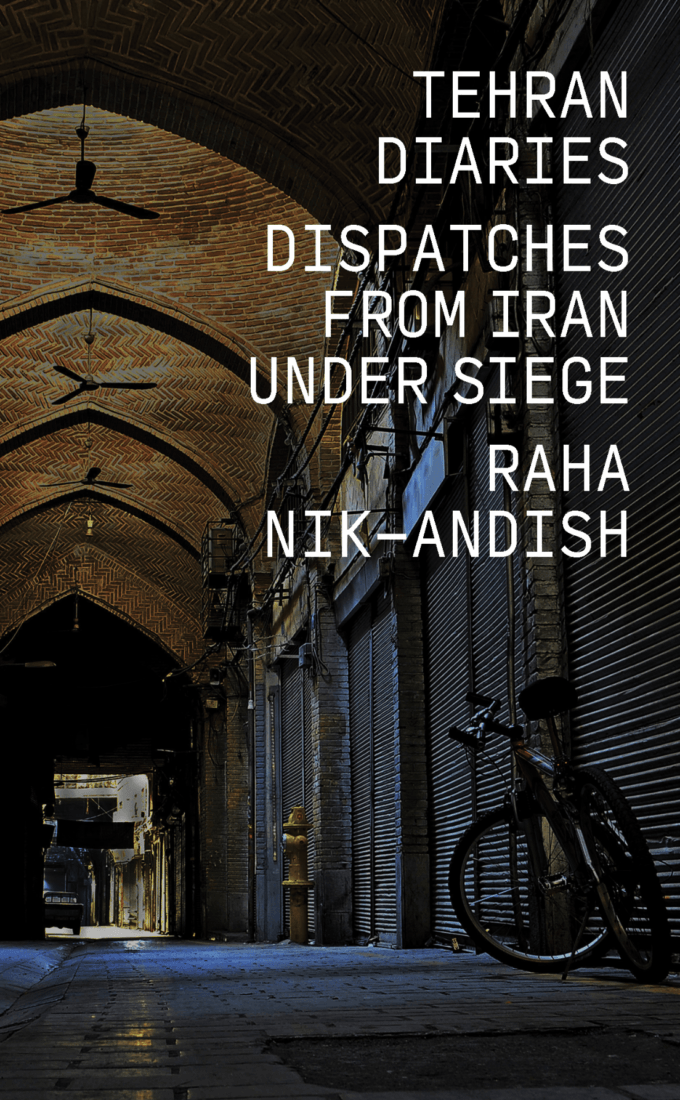
Raha begins with the announcement of the Ayatollah’s assassination by the Americans and Israelis. People come out on their balconies, unbelieving, just to look around. The Basij paramilitaries, below them on the streets, immediately begin to bash anyone who is seen or heard to be celebrating. The following morning, the mosque down the street from his apartment blares patriotic songs intermittently from the Iran-Iraq War and the seventh-century conflict in which the Prophet Muhanmmed’s son was murdered and martyred. The heavy official tone is mocked by a mood of quiet happiness.
The ongoing attack from overhead by Israeli and US planes and missiles dramatizes the military failure of the Iranian government but also the emptiness of the long-standing promises offered by Pahlavi, Junior. Washington and Tel Aviv, broadcasting an imminent but never-to-happen arrival of the ever-future Shah, definitely add to the ambiance.
Two weeks later, families huddle in the apartments while bombs land nearby and smash windows. Oddly, it’s the Persian New Year when special treats come as ritual food, symbolizing the rebirth of life. Voices from the mosque plead ritually for God’s mercy while real-life grown-ups try to reassure children and themselves. Soon, they will go out to try and find food that they can afford to buy.
Will the universities, ostensibly still in mid-semester, continue teaching journalism or the arts? This suddenly seems irrelevant. After Trump’s threats to bomb Iran back to the Stone Age (“where they belong”), Iranians ask themselves: Are we doomed? The author comments, “you can’t imagine the effects of knowing that someone wants to kill you, and that everyone is waiting to die.” (p.13)
No one goes to protests anymore. The early, brutal repression ended that. Not even those who supported the war really want to be bombed, now that bombing is underway and shows no sign of ending. It is fine for the exiles, some of them living high in the Gulf States or Los Angeles, to celebrate the moment and to rationalize death from the air as worth the price for ending the current regime any time now. The State media meanwhile blares that Iran is winning. Then the pay-to-view London satellite channels reopen, and every previous version of the truth disappears. Older viewers experience yet another irony: during the Iran-Iraq War, large apartment buildings had been rare, and friends shared bomb shelters. Now that most in the educated, urban classes are trapped in apartments, only a fortunate minority are lucky enough to have a place in the countryside where they can sit out the worst.
We learn by p.22 that our narrator has seized his first opportunity, on returning from abroad (and probably Britain), to resume teaching. Like everyone else, he is seeking somehow to adjust to a new normal. On campus and off, water is stored, but candles and batteries have already grown scarce. Poignantly, he records that on a street corner outside, below his office window, a young woman sings without accompaniment a now-forbidden old favorite: “Year after year, regret is all we have.”( p.24.) Bystanders do not applaud or even film the singing on their phones. They watch and listen, taking back to their apartments what memories they can.
And then we move further back in time to January of this year. Not so long ago! Middle- and upper-middle-class neighborhoods, never given to political protest, leap over customary boundaries, joining the poorer and more discontented. Various obstacles are quickly created against the certain arrival of security forces. Mostly young people demonstrate with chants. And then the soldiers arrive and begin to fire directly into the crowd. By the next day, the official reports of “rioters” have renamed them “terrorists.”
Our narrator, at first searching for bread on foot, instead goes instead to a cinema, where an Iranian comedy plot has an erstwhile liquor salesman falling in love with the daughter of an important family. Even the audience’s laughter is tinged with sadness and horror. He leaves the theater to continue his travel with Iran’s own popular taxi service, known as Snapp! That he has begun to drive them himself to make a little extra money makes him sympathetic with fellow drivers. They report their woes—the inevitable dangers of driving on streets as the bombing continues—and philosophize stoically about the increasingly grim days that seem certain to come.
The strangest and in some ways, the most dramatic media moment in Tehran is the circulation of a documentary about Iranian actress Taraneh Alidoosti, recalling her arrest during the “Woman, Life, Freedom” protests a few years earlier. BBC Persian is, of course, banned, but people find a way to see the documentary, highlighted by the actress’s declaration that she will never again appear on screen in a headscarf. She articulates a personal pain shared by all.
Back, way back in the early Fall of 2025, by Chapter 5, things may be even stranger. In an urgent effort to attract popular support, government-sponsored public programming includes political art offering a vital message, just a few years old: Iranian women artists, famous and unfamous, are enjoying a new era of freedom, including the expression of modernism in the most prestigious museums in Tehran. Some of the notable art pieces have been stored in the museum’s archives for years and now suddenly appear in public, accompanied by the highest levels of prestige.
Thousands of young, educated, and sophisticated, or perfectly working-class, women visitors approach the entrance and don the head scarves they brought with them. Off go those scarves as soon as they get past the museum doors. Thus a paradox of 2025 and some years earlier. The book does not mention a source of some of the protests to come: the outraged response to a secretly revealed video of a lavish wedding, with the bride-to-be in a revealing dress typical of wealthy family events around the world. Pious and secular can join, lashing out at the privileges enjoyed by the Iranian ruling class.
Official art, above all the famous posters created by the government and viewed worldwide, celebrate ancient rulers and make improbable claims of contemporary triumphs improbable even when US and Israeli aims are apparently defeated. Being Persian, for thoughtful millions of citizens and exiles, encompasses both a rich cultural past and a deeply demoralizing present, an internal exile with children of any social class terrified at every loud noise. They are the fearful generation impending.
We are getting close to the end of Tehran Dispatches, and the author is determined to make this point: on the Iranian campuses of a generation ago, women and men had separate staircases, and women never attended classes with men as they do now, talking freely with each other. Likewise, women were forbidden to ride bicycles, but now they ride them freely through the streets, “the wind in their hair” (p.80) on a normal day. Not even the War changes this social detail.
No normal days now, however. Massive, intense security, aka repression. The air is full of poisonous smoke from bombing. The hospitals are unable to accommodate patients in crisis, including the writer’s father. The situation is hopeless and also class-bound in one more way: when his father dies for lack of adequate care, he is buried, with good fortune, in a family plot—new ones have become unaffordable for those outside the upper classes.
Tehran Diaries closes on this note. A close friend tells the author that his mother needs to have an eye replaced. Luckily, very luckily, the cemetery worker who washes the corpses plucks one that can be purchased—quickly, and naturally, for a fee. This, the reader concludes logically, is either death in life or the reverse It is also Iran today.