Image Wikipedia.
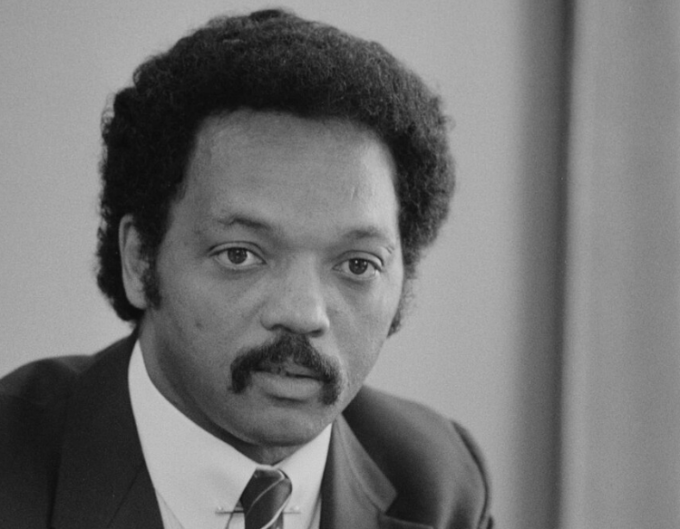
Reverend Jesse Jackson will be remembered for much: His civil rights activism, his presidential campaigns, his early support of the LGBTQ+ community. His campaigns impacts are readily apparent in the Mitten State. Those two presidential campaigns reflected the changing politics of Michigan, issues of race and class, and a battle over the direction of the Democratic Party.
In 1972, segregationist George Wallace won the Michigan Democratic primary. He won due to white backlash against the Civil Rights movement, as well as a sympathy vote due to the recent attempt on his life. Yet in 1988, Jesse Jackson won the Michigan Democratic caucuses. What changed in those 16 years? How did Michiganders go from voting to a man who stood in the schoolhouse door to protest integration to voting for a Black minister who met with Fidel Castro?
The white backlash didn’t go away. In arch-conservative Livingston County—a hotbed of Klan activity—the following sign appeared: “Don’t shoot Jesse Jackson; we don’t need another national holiday.” Nor did Jackson ever win the support of Detroit’s first Black Mayor Coleman Young. Young considered himself a political kingmaker. He derided Jackson’s first campaign as a “merely symbolic” run that couldn’t win; he endorsed ultimate loser Walter Mondale. The second time, Young was all in for Dukakis, who went down in defeat in November.
It was through a cross-racial, populist appeal that Jackson cut through the backlash and did an end run around the state’s traditional political elite. At housing projects, at shuttered factory gates, at union halls Jackson rallied the dispossessed and the disenfranchised. The state’s large Arab-American community came out for Jackson due to his support for Palestinian human rights and opposition to Israeli aggression. James Zogby of the Arab American Institute reported that Jackson called Arab-Americans his “secret weapon, because he was out there getting support from the community, and no one else was.” Contrast with Mondale, whose campaign returned $5,000 donations from Chicago Arab-Americans after smearing them as “anti-Semitic.”
In 1988, Representative Richard Gephardt was thought to be the autoworkers candidate. His “Hyundai ad” promoted protectionist measures against Korean automakers as a way to save American jobs. But it was Jackson’s calls to end economic violence that resonated. “Jackson does something no one else has done,” said Jim Settles, a UAW official from Local 600 in Dearborn. “He gives people hope.”
Jackson could have easily joined in with his own Asian bashing, but didn’t. Instead during both races for the White House, he continually raised the case of Vincent Chin as an example of racial injustice. A Chinese-American, Chin was beaten to death by two white autoworkers at a time of rampant anti-Asian sentiment in Detroit.
To hear corporate executives, union officials, and politicians tell it, all of Detroit’s economic woes had their origins across the Pacific. Japanese car companies were the sole reason for layoffs and plant closures. Then-Chrysler CEO Lee Iaccoca warned of “predatory trade” and “insidious Japanese economic and political power within the United States.” UAW union halls and plant gates bore signs like “300,000 laid-off UAW members don’t like your import. Please park it in Tokyo.” One popular bumper sticker read “Datsun, Toyota, Nissan—REMEMBER PEARL HARBOR!” Some took out their frustrations on Japanese cars with sledgehammers and baseball bats.
Politicians joined in with their own Japan bashing. U.S. Representative John Dingell Jr. blamed the auto industry’s woes on “the little yellow people.” U.S. Senator Carl Levin complained that regarding trade, “we are being shot at, and shot up, by the Japanese.” The UAW, corporate America, and these politicians were all playing with the fires of overt anti-Asian racism, fires that ended up burning Vincent Chin.
Chin was beaten to death in Highland Park by Ronald Ebens, a Chrysler supervisor, and his stepson Michael Netz, a laid-off autoworker in 1982. Before the beating, Ebens reportedly told Chin that “It’s because of you little motherfuckers that we’re out of work” and some witnesses claimed to hear Chin called various anti-Asian racial slurs. The hatred of Japanese cars transformed into hatred of Japanese people transformed into hatred of all Asians. Netz and Ebens even used a baseball bat, similar to those destroying Hondas and Toyotas. Before he died, Chin whispered “It’s not fair.”
Ebens and Netz received a slap on the wrist from Judge Charles Kaufman, also white. The killers “weren’t the kind of men you send to jail…You don’t make the punishment fit the crime; you make the punishment fit the criminal.” Instead of going to prison for murder, both plead guilty to manslaughter and received probation and a $3,780. The life of an Asian-American was apparently very cheap those days in Detroit. Vincent’s mother Lily couldn’t believe it. “What kind of law is this? What kind of justice?” she asked. “This happened because my son is Chinese. If two Chinese killed a white person, they must go to jail…Something is wrong with this country.”
American Citizens for Justice was formed after Kaufman’s ruling to rally Asian-Americans to get justice for Chin. Jesse Jackson supported their efforts and drew a direct connection to the killing of Chin and the history of Black Americans “These attacks on Asian Americans,” he said, “are no different than the atrocities of the Ku Klux Klan against Blacks in the South.” In 1984 he appeared at a rally in San Francisco’s Chinatown with Lilly Chin. In his speech he compared Chin’s killing with the lynching of Emmett Till and called to “redefine America” to be a place for people of all backgrounds and nationalities.
Jackson spoke out against Asian bashing as an economic salve. “Promoting division among the people has never gotten anyone a job—except the worst of our country’ politicians.” He rejected attempts to “blame the mistakes of corporate America on the people of other lands, not leadership that pats corporate America on the head…while [the] American people are told, ‘Blame the Japanese.’” He continued to raise awareness of the Chin case as a horrific example of racial injustice against Asian-Americans, alongside the internment of Japanese Americans during World War II.
Unfortunately, the efforts to charge Ebens and Netz in federal for violating Chin’s civil rights were unsuccessful. Neither spent any time in prison, although both were found liable in unlawful death civil trials. There are is a memorial for Chin in Ferndale and a street in Detroit’s historic Chinatown was renamed for him last year. Chin’s killing is an important reminder of where nativist and xenophobic hunts for scapegoats can lead. Reverend Jackson’s example is also a reminder of the importance of interracial organizing, solidarity, and the true sources of working people’s suffering.