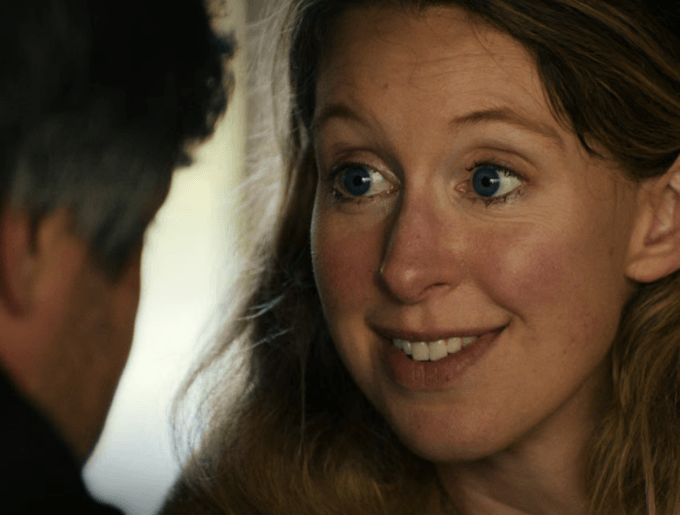
Elizabeth Holmes in You Can See Everything. Photograph: Courtesy of A24.
In these times, postmodernism turns everything into meta-forms or virtual objects, metastasizing throughout the body-politic, liquifying the materiality and sacrality of things and events, to paraphrase Marx’ and Engels’ famous sentence. The Elizabeth Holmes meta-documentary by Nathan Fielder and Lance Oppenheim, bizarrely and preposterously entitled, You Can See Everything, doesn’t escape this tendency.
It unravels its infinite finitude during the tediousness of a three‑hour-long-mini-biopic following Elizabeth’s final weeks she spends with her family before starting to serve an 11-year-sentence in Federal Prison in May 2023. The meta-documentary’s artificial mundanity seems to be the common denominator establishing a continuity between the common man and woman, “Mr. and Mrs. Everybody” i.e., the audience, and those at the top, even if fallen.
The key question of our analysis will try to evaluate is why so many American spectators fell for what is at best a mediocre documentary.
The Gaze
During a short period, Holmes was on “top of the world,” living the American Dream to which many consumers, tired of producing for another or what they think is an ungrateful System, aspire. The majority gets a taste of it, from afar, by proxy, via Stars and Celebrities—their main function. Perhaps wealth is the reward for the social usefulness the stars perform. They provide a role-model, a super-egoic imago, as well as a safety-valve for the frustrations of the masses. This is why the American Dream is but a dream, wishful-thinking—a fantasy which can turn into a nightmare for some.
A few critics have called You Can See Everything “surreal’,” although there is nothing “surreal” in this video-scopic “truth-unveiling.” No eyeball-slicing, no “invagination of the gaze” delivering a new way of looking at things. On the contrary, just the same phallic, introspective gaze tracking its prey. For two long hours (we will see what happens during the third one), Elizabeth is under the gaze of the male filmmaker, obviously self-conscious, trying to play the role of the victim, while avoiding being type-cast as the victimizer. Holmes, a decade ago, was all over the news as the suddenly wealthy businesswoman convicted of financial fraud.[1] Not many female CEOS follow that trajectory. Holmes had more than her 15 minutes of fame, as Andy Warhol would say.
Trying to match the content of Holmes’s words with her facial expressions and with the “content” of her frequently vacuous gaze (as if she were on tranquilizers) Fielder’s camera diegetic works operates like a lie-detector, which is antithetical to a filmmaker’s task. Instead of making Elizabeth’ eyes and mouth the problematic subject of his movie, he makes them the object of the truth of the American dream.
Although certainly well-intentioned and conscientious, Fielder encloses Elizabeth into a field he wants to control, while Oppenheim (whose patronym is missing something, as if begging to be nominalized by the “er suffix” denotating the “doer-action,” as in Oppenheimer, the ultimate doer, subject of another biopic, although much more famous and for good reason) seems to decide the direction the film should take. Both appear to be pathetic at times, caught in their own web of desires and Elizabeth’s manipulation of the situation.
We could first start by saying “who cares about the psychological conundrums, fraudulent shenanigans, financial hooliganism, and cynical criminality of tycoons or would-be tycoons, male or female for that matter?” They are the stuff our sociopolitical reality is made of; neo-liberal, financial capitalists who make the lives of so many difficult, if not unbearable, while rapidly enriching themselves, the top 1%, or wannabe 1%. Why care unless the film proposed for our attention, perusal, or enjoyment, a social dimension, a human transcendence, a descent into the human condition, an artistic vision, etc.? Anything which would help us explain, make sense, appreciate, or stand in awe of our human predicament, like Macbeth’s tortured criminality for instance, or Balzac’s realist novels about great crimes giving birth to great wealth.
Alas, You Can See Everything doesn’t deliver.
Documentation
A documentary is supposed to “document.”
The documentary genre is based on an implied contract between the documentarist (supposed “to document” something—record, verify, authenticate, bear witness, criticize and/or demythologize) and the audience expecting, not so much a distraction as for a fiction film, but to learn something new, to be shown a certain human truth (politics, mores and manners, styles of lives, injustices, hidden agendas, etc.). Documentary audiences want to find out things. The audiences’ suspension of disbelief is not the same for a fiction movie as for a documentary, although both move us but in different ways. This, of course, doesn’t suppress the inevitable gap between a filmmaker’s intention and the audiences’ interpretation, although a good documentarist tries to “control” the interpretative situation by taking this difference into account. S/He tries, for instance, to solidify his/her authorial intention by the filmic diegesis, and by minimizing the unruffled seams inherent to all filming and montage, unless he uses them as poetic license, as in Dziga Vertov ‘s splendid documentary Man with a Movie-Camera (1929). The documentarist plots his/her approach in ways different from those which govern the plot of a fictional, filmic narrative, focusing on credibility, not implausibility. Fantasy is not a documentarist’s friend. Although all good filmmakers know that “truth is structured like a fiction,” as the psychoanalyst Jacques Lacan demonstrated, a documentarist has to take into account the Imaginary of his/her subjects as well as the audience’s, trying to rein it in.
Fielder and Oppenheim fall into the trap of their own fantasy, which implies their subject’s fantasy, opening up the desire of the audience. This comes up several times when the camera focuses on Nance and Elizabeth on the verge of kissing each other. Here conscious and unconscious staging and role-playing take over the documentarist agenda, bordering on the fictional plot. Desire overspills and Elizabeth comes out as a would-be “femme fatale,” reversing roles. Who manipulates whom?
Although there is no actual, genuine “truer” interpretation as such (a cliche of Q&A of many après-film-discussions), which justifies the existence of criticism, the documentarist’s intentions must orient those of the audience, as Claude Lanzman’s difficult and tragic Shoah (1985) shows so well.
Not only because You can See Everything shows us nothing that we don’t already know, but the documentary doesn’t even reflect upon its own way of trying to make us see something, when there is nothing to see anyway. Ironically, Fielder’s film only shows us that there is really nothing to see, there is no ‘there’ there, that shoving a video-camera and a mike into someone’s face does make him/her speak the truth of what happened, or even his/her truth. If there’s a truth to be revealed, it’s the truth of the camera itself, of the way Oppenheim and Fielder set up the whole apparatus, the lie-detecting mise-en-scène, the false camera-vérité. Elizabeth mouths the truth.
You Can See Everything was written by a camera-stylo with an amateurish style.
The Truth
Since many critics have also called on Shakespeare to fathom the depths of Oppenheim/Fielder’ film, we will say that Fielder (who made his directorial debut with this audio-visual melodrama) unwittingly put himself in the situation of a playwright in search of a character (as well as his own ‘character’). He should have read Pirandello’s ‘Meta-theatre’ about the quest for truth, identity, and the fuzziness between reality and illusion, before spending three years on this project of “showing us everything.”
Blending soap-opera, reality shows, cinéma-vérité (whose pitfalls Fielder fell into), with self-apologizing meta‑commentaries, Fielder looks for an elusive truth, which, of course, he cannot find since he seems to have forgotten the basic structuralist teachings of the past, that authenticity and veracity are “facts” hidden by the way they are constructed, represented, delivered, and interpreted by language; that they are made slippery, like the surface of a Klein bottle, a reality aggravated today by the “invagination” of truth into its contrary. Certain historical periods highlight the glassy or elusive character of truth, such as our times dramatically embossed by the Presidency of the populist and “neo-feudal” Donald Trump. Fielder seems to have forgotten La Nouvelle Vague’s cinematic wisdom explained by such aphorisms such as “Ce n’est pas une image juste, c’est juste une image” (“It’s not a righteous image, it’s just an image.”), or “Photography is truth. Cinema is truth twenty-four times a second” as Bruno Foestier facetiously declares in J.L. Godard’s Le Petit Soldat (1963); that is to say, 10,800 seconds in You Can See Everything.
The more the diegesis of the “maxi-mini-biopic” progresses, the more Fielder treads water, visibly increasing his frustration and annoyance, as well as ours, with his subject and topic; Or, captured by his own visual trap, does he play at being the frustrated director, the manipulated manipulator? Or is he actually manipulated by Elizabeth and her partner? Holmes, trying to show herself as a straight-shooter, incapable of duplicity and double-play. In her New York Times profile Elizabeth comments about the actors portraying her in movies and TV shows, like Amanda Seyfried in Hulu’s “The Dropout.” She purportedly denied having said to The New York Times journalist Amy Chozik (2023) “They’re not playing me. They’re playing a character I created.” She insisted that she stated to Chozik “They’re playing a character they created,” meaning that she is more a victim than a manipulating victimizer.
Speak of a narcissism to the third degree! Holmes commenting on the filmic representations made about her story during a documentary trying to capture her whole story.
Perhaps, the curious, narcissist triangle formed by Fielder, Homes, and Seyfried became lost in the labyrinthine interplay between the nexus presentation/ representation/ interpretation, itself caught in the hall of mirrors constituted by the media and the film industry. Obviously, Fielder and Oppenheim failed at mastering the absence/presence/role-playing which pervades “the reality” of even the most “objective” documentary.
Instead of a co-filming a documentary, Oppenheim and Fielder should have co-written a play.
Blood and Dollars
The question he naively seems to ask Elizabeth over and over could be formulated as, “Why did such a sexy, healthy, educated, privileged, white, well-bred, all-American-career-woman, cum-mother-homemaker, became a criminal—a white-collar criminal that is?” In 2014, Forbes recognized Elizabeth Holmes as the world’s youngest self-made female billionaire and ranked her number 110 on the Forbes 400. With her business partner (and lover) Sonny Balwani, she started Theranos in 2004 with $6 million of venture capital. Turning her phobia of being pierced by needles into a money-making motivation, Theranos technology was supposed to rapidly perform blood tests yielding vast amounts of data via the analyses of a few blood droplets pricked from patients’ fingers. While Theranos only sucked droplets of patients’ blood, with the help of Daddy’s friends, reputation, and influence, Holmes’ high-tech venture sucked the blood-money out of many investors. Under the guise of wanting “to democratize healthcare” Elizabeth’s baby-company climbed to the top in 2014 with $400 million venture capital and a net capital worth of $9 billion. By 2018, Theranos collapsed in bankruptcy and infamy. Privileges follow WASP lawbreakers even in prison. They don’t go to a “normal jail” like common criminals. They go to a Federal Prison…, the Holiday Inn of the American carceral system in America.
With such materials (i.e., a blond, American, sweet and vulnerable-looking heroine vying for Daddy’s validation, whose success story in a male/macho financial world, complete and replete with blood-phobia, an unsatiable greed, and a quick ascension collapsing in scandal) imagine what a Michael Moore, an Abderrahmane Sissako, a Pablo Lorrain, a Barbara Koepel, or a Joshua Oppenheimer who interviewed genocidal criminals (making them replay/reenact their monstruous deeds) would have done.
Elizabeth’s thymos was there for the taking and Fielder let it slip away!
Politics
Holmes came from a milieu formatted by the post-Regan Zeitgeist, the Clinton/Bush/Cheney Presidencies which progressively deregulated Capital and opened the gates wide for the rule of a financial capitalism, increasingly disconnected from production and focused on speculation, money manipulation, and Ponzi-like investment-solicitation, pushed all legal and ethical limits. Flirting with disaster, the System periodically require victims. This whole political, economical dimension behind Elizabeth Holmes’ dramatic fall is totally absent from the movie. Fielder could have indicted a whole system via Holmes cum victimizer-cum-sacrificial-lamb. He preferred to sink his teeth into the easy flesh of Elizabeth’s vulnerability. Their psychological copulations gave birth to a sentimentalist soap-opera of some sort.
Neo-capital’s transmutation of greed, speed, and money into pure jouissance formatted Elizabeth’s sense of entrepreneurship.
The Phallic Gaze
Lacking thematic substance and political theoretical levity, Fielder turns in circles, his camera orbiting around Elizabeth in her beach-house, tracking her everywhere (or so it seems), while she is trying to lead a normal family life until she has to leave them for the next 11 years—something dramatic by any human standards.
Is this why the film-soundtrack is marred by an unnecessary, overbearing music, connoting an ominous dread worthy of a thriller, at times drowning the dialogue. Other times, Elizabeth and Fielder seem to speak under their breath, making their exchange of words hard to understand. Who is “murmuring” whom, the way a horse-therapeutically “murmurs” a patient?
Obviously, oblivious of his cinematographic predecessors’ lessons, and the absence/presence of the unconscious (his, hers, the audience’s, and the collective one), Fielder pursues the truth like a porn filmmaker obsessed with extracting the “elusive truth” of “feminine jouissance” via ob-scene close-ups; Fielder’s camera is literally in the face of Elizabeth’s face, her mouth and eyes, ad nauseam…, trying to extract “the truth” out of her. Fielder’s intimate gaze borders on pornographic invasion. The only difference is that porn filmmakers focus on vertical lips, while Fielder focuses on horizontal ones.
At one point, it even seems that Fielder’s penile camera wants to penetrate Elizabeth eyes, like Hitchcock’s camera gaze in Psycho. Here, a feminist critic would be justified to call Fielder/Oppenheim’s camera-eye’s movements a prisoner of the phallic gaze.
But instead of getting to her impossible truth (truth doesn’t rest deep behind the pupil, even if dilated—something Hitch knew, hence his camera-eye’s descent into the spiraling “black hole” of Marion’s eye and into the shower’s “regard”—its drain-hole), Fielder drains us with his repetitively endless visualization of his constant psychological ratiocinations about what Elizabeth did or didn’t do, thought or didn’t think, meant or didn’t mean… Obviously, he has not learnt anything from Kubrick’s Eyes Wide Shut, a film also about “woman’s truth.”
Instead of getting “jouissance féminine” (most often faked by porn-actresses anyway–something even alluded to by the actress Amanda Seyfried playing Elizabeth Holmes), porn-filmmakers generally end up with the male cum-shot, or money-shot. In fact, in many instances the question arises about who will financially profit from Fielder and filmic shots—here the filmmakers reluctantly negotiated a profit-sharing agreement with Billy Evans, Elizabeth’s partner and father of her two children.
In fact, Fielder imprisons Elizabeth in a Sartrean-like scopic purgatory, a huis-clos without rapture or closure since the close-ups trying to cage Elizabeth in do not deliver, as in Dreyer’s Joan of Arc (1929).
Well, nothing comes (out) in Fielder’s film; even when the intrusive camera-eye “surprises” Elizabeth wiping herself on the bathroom commode, or her partner Billy’s’ nakedness in the shower (a shot which would certainly satisfy Donald Trump’s fascination for the male organ); even when the “come-about” shots turn into the Internet-dot.com messages of Elizabeth partner playing at being, speaking, and writing for her, by proxy, on X and other Internet vectors.
The Impotent Gaze
This impotence suffuses and confuses the issue, obviously frustrating Fielder, who literally carries around an enamored fascination for Elizabeth. His own impassive, doe-eyed face is caught between an Inquisition-like demeanor, as if he were “Truth and Justice Incarnate,” and the meek expression of a peevish lover in search of recognition and acknowledgement.
During the 34 days spent by the film-crew at the San Diego’s Del Mar beach house rented by Elizabeth and Billy, a rivalry developed between the two “significant men” of Elizabeth during that short period of Elizabeth’s life, the filmmakers and crew, and Billy, forming a strange neo-tribal family. Both are in awe; both vying for her attention and devotion. Curiously enough, during the last day of Elizabeth’s freedom, her father and mother were present, both silenced, or so it seems, by Billy, while Nathan Fielder timidly alludes to the infamous Enron scandal, for which company Elizabeth’s father was working (Fortune’s “America’s most Innovative Company” for 6 years in a row), and the topic of another documentary, this one brilliant, The Smartest Guys in the Room—2005.
Mr. Christian Rasmus Holmes IV was one of Enron’s C.E.O.s during the heyday of the company. Following the bankruptcy of the fraudulent company (1985-2001), he worked for USAID, which Elon Musk and Marc Rubio destroyed in 2024—destiny can be ironic at times.[2] Perhaps the family history seems to be warped by a destiny à la Grecque, a weaker version of the one which haunted Oedipus.
Of course, Fielder and Oppenheim seemed to have missed the special, tainted father/daughter connection. Elizabeth’s startup high-tech company started on the wrong foot by following Enron’s creative accounting and financial practices: profit fabrication, debt concealment, Ponzi scheme type of financing… Bizarrely, Fielder and Oppenheim didn’t try to establish the connection between capitalism, desire and sex via a female C.E.O., a subject of choice by excellence, who willingly offered herself as a sacrificial victim of some sort, the female victim/victimizer, who survived a sexual assault when a Stanford student, and later became subjected to the reality of patriarchal Capital. In both cases what Lacan would call The Big Other is tainted; at best it is abject, at worst it is obscene—a factuality well demonstrated by the Presidency of Donald Trump.
In Holmes’ case, blood, this stretched-out patriarchal substitute, plays a vital role both as object of sale (“blood–analyzing -machine”) and subject of desire (father’s love/validation).
Curiously enough, Ghislaine Maxwell was transferred in 2025, to Bryan, the same low security Texas Federal Prison where Elizabeth Holmes is serving her sentence. Now both are “purging themselves of their sins.” Ghislaine was also caught in a similar triangulation between Capital, desire, and sex (literally in her case). She also had a problematic relationship with her financially corrupt and morally bankrupt CEO-father (who died in mysterious circumstances). Perhaps there’s the topic, here, of a new film, a fictional one that is.
Obviously, Fielder and Oppenheim missed the train of thought which would have brought them to another dimension, away from their narcissistic preoccupations and those of their two main protagonists.
Transference
While Billy, the “husband,” is (and is playing) the Platonic half of Elizabeth’s Platonic soul, Fielder is insistently trying to force himself into the relationship, coming between them. Obviously, he is in love with his subject and doesn’t seem to be able or willing to escape what psychoanalysts call “transference” or “counter-transference.” In fact, “You Can See Everything” is a documentary which works as if its real subject were an informal study of “transference,” from author to subject, from subject to author, from filmmaker to audience, and audience to filmmaker. Although there is certainly a dimension of Schadenfreude in the audience ‘s interest in Oppenheim/Fielder film, the spectators can only empathize or identify with Elizabeth. They wanted her to succeed–after all doesn’t she incarnate the American Dream? But since she didn’t, or she failed, they want her to “come clean,” to convince them that the climb to the top is still possible, if one obeys the rules.
So goes the ideology.
You Can See Everything is finally about the same repetitive odyssey of the fast climbers racing-to the top of the pyramid, from which, occasionally, a sacrificial victim is tossed down the steep stairs to the crowd below, hungry for a proof that, somehow, Justice is alive and well. The top 1% is well aware that such scapegoating is necessary unless the hoi polio set fire to the whole edifice.
Fielder and Oppenheim could have opened up the field there.
All this documentarizing gives birth to what? Nothing except an excess of the same.
This could explain the uncanny, popular success of a basically mediocre movie. In these times of obscene wealth and “life in the fast lane” of the top 1%, Americans are curious about how some make it to the top, and stay there, while others don’t. They have always been fascinated by the rapid climb to the top and fall from grace of entrepreneurs, especially if she is a heroine-cum-mother-cum-spouse-cum-victim still proclaiming, against all odds and legal decisions, her innocence and ignorance of the wrongdoings, which happened “behind her back,” although she was Theranos’s CEO.
Elizabeth is a fallen Barbie (another movie whose popular success is symptomatic of America’s contemporary unconscious and unconsciousness), a Martha Stewart with big, blue eyes exuding innocence, ingenuity, purity, even a “lost virginity…,” although they are no “Betty Davis’ Eyes.”
This “in your face, face-to-face” documentary unfurls like a long, endless selfie looping upon itself, since it is about the self caught in the mirroring of the same, the repetitious identity-search for an authentic subjectivity, bouncing back and forth from the objective/subjective commodification of Holmes’ face and body by Fielder (the $7 million movie grossed $45 million in three weeks); her billboard-image, licensed by her cunning partner Billy Evans; her deep-faked AI model; and her filmic impersonation by Amanda Seyfried (who looks like her).
Conclusion
Nothing, again, surprising in You Can See Everything’s second part, one of the crucial moments of the film, which, if well managed, could have turned the film around. It is structured around a myse-en-abîme (inner duplication), a baroque device used by artists and writers who want to question and problematize the very act and process of representation (representation within representation). Fielder and Oppenheim drop the ball when they insert into their biopic, Amanda Seyfried from The Dropout, Elizabeth Merriwether’s miniseries made for Hulu, about The Elizabeth Holmes saga. It is directed by Michael Showlater/Francesca Gregorini, and Erica Watson. Amanda Seyfried also stands for Elizabeth in You Can See Everything, during the dramatic reenactments of Fielder’s visit to Elizabeth in Bryan the Federal Prison, since Fielder/Oppenheim could not secure from Bryan’s warden, the filmic authorization for Fielder’s penitential visit. But nothing comes out of the substitution except a feminist interpretation of Elizabeth’s dramatic situation. Amanda infers that Nathan is in love with Elizabeth and that Elizabeth is innocent, more a victim of man’s duplicity, manipulation and greed than her own, willful wrongdoing. According to her, Elizabeth Holmes’ condemnation is fundamentally the result of a male conspiracy joined by her innate vulnerability, compounded by her honest but naïve love of humanity.
May be the “real” Elizabeth Holmes wants to be a Pollyanna. Is it her way to transvestite her own culpability and guilt, or her way of venting her own Sado-Masochism?
At that point, Fielder’s confusion is as confused as the fusion reenactment/enactment.
The final scene depicts Fielder and his crew, as total outsiders, filming through the fence a family picnic of Elizabeth, her children and partner, on the greens of the Federal Prison on July 4th. Then You Can See Everything’s camera-eye irised down to dark. You can now see nothing. The show about a “failed Who’s Who” is over.
Elizabeth will be free in 2034. Because of exemplary conduct, and other influences, she is scheduled to move to a halfway house near Austin in August 2027. In the meantime, Billy took up Elizabeth’s torch by re-working (since 2023) on a new version of a future Theranos’ “high-tech digital analyzer,” with AI’s help this time!
If anything, the film is worth watching to take the pulse and temperature of the American body-politic and its objects of cultural fascination.
And we though that “Good Girls Don’t!”[3]
NOTES
1. Elizabeth Holmes was indicted on June 14, 2018, when a Federal Grand Jury charged her, and Ramesh “Sunny” Balwani, her business partner, with multiple counts of wire-fraud, conspiracy, and multi‑million‑dollar fraudulent schemes related to the finances of the high-tech startup Theranos. They both had separate jury trials. Holmes and Balwani were condemned to 11 and 12 years of Federal imprisonment and ordered to pay $452 million to their victims (patients and doctors). They both defrauded investors of $740 million. Their high-tech startup was valued at $7 million in 2016, instead of the hundreds of million as the two CEOS impressed on their investors. The indictment proved they knowingly misrepresented Theranos’s ability to produce accurate, fast, inexpensive and reliable blood‑test results (only 200 had been conducted in 2016), despite knowing that Theranos’ technology often revealed itself to be inaccurate. Although the tests for analyses such as for calcium, chloride, potassium, bicarbonate, HIV, HbA1c, hCG, and sodium, etc., were unreliable, Holmes and Balwani concealed those technological limitations. They also claimed to use proprietary analyzers when Theranos actually relied on other laboratories. They provided false revenue projections, including claims of $100 million plus revenue in 2014 and $1 billion in 2015, despite knowing actual revenues were negligible. ↑
2. Elizabeth Holmes’ father, Christian R. Holmes IV (heir to Fleischman’s Yeast), worked as vice president of an Enron subsidiary called “Clean Energy Solutions Group.” His role at Enron was significant, especially during the company’s controversial period, and he later held various government positions, such as USAID, which will be destroyed by the “National-Capitalist” ideology of President Trump. Enron was the energy company which infamously collapsed in December 2001. The company declared bankruptcy after defrauding investors. The magnitude of the crimes required the formation of the Enron Task Force made of FBI investigators, the Internal Revenue Service-Criminal Investigation Division, the Securities and Exchange Commission, and prosecutors from the Department of Justice. Enron had to repay more than $164 million to its victims. Twenty-two employees were convicted for their involvement in the corporate scam. ↑
3. A Knack’s Hit-Song—1999. ↑