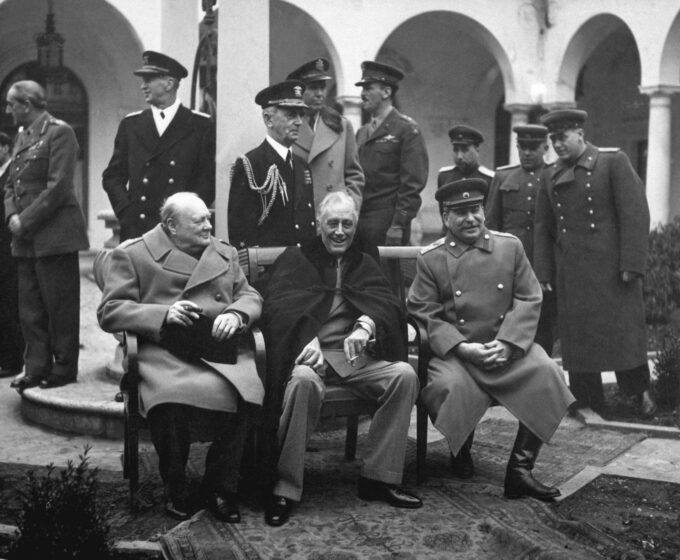
Photograph Source: US government photographer – Public Domain
The Yalta Conference in the last months of World War II was a serious and well-planned summit meeting that brought a politically-weakened Winston Churchill and a physically-weakened Franklin D. Roosevelt to meet with Josef Stalin, who refused to travel beyond Soviet borders in 1945. The conference produced a Soviet commitment to enter the war in Asia against Japan, which Roosevelt desired, and Stalin’s commitment to honor the secret arrangements of the Moscow Conference that negotiated spheres of influence between the West and the Soviet Union in Eastern Europe and the Balkans. The Yalta and Moscow meetings consecrated the Iron Curtain that existed between East and West that lasted until 1991, when the Soviet Union suddenly collapsed.
Whereas Yalta was an eight-day meeting, involving serious substantive discussion, last week’s meeting in China was largely ceremonial and symbolic. It produced little more than a photo opportunity, particularly satisfying for Russian President Vladimir Putin, who looked like a happy cat receiving a large bowl of milk. China’s Xi Jinping seemed to relish his role at the head of the table, solidifying his stance as superior to Putin and equal to Donald Trump.
The fact that no progress was made with regard to Russia’s war with Ukraine or the U.S. war (alongside Israel) with Iran points to the creation of another Iron Curtain, one that exists on the Russian border that will be difficult to disassemble.
Churchill popularized the phrase “Iron Curtain” in his 1946 speech in Fulton, Missouri, when he warned that an “iron curtain” had descended across Europe. The curtain lasted until 1989 when the collapse of the Berlin Wall, the Warsaw Pact, and even the Soviet Union itself created hopes for a “concert in Europe” that would end the Cold War status that had existed for 45 years between the North Atlantic Treaty Organization and the Warsaw Pact.
It does not appear that Presidents Bill Clinton and George W. Bush had any idea that they were helping to create the conditions for a new Cold War and a new Iron Curtain when they ignored previous oral commitments to the Soviets from the White House. President George H.W. Bush and Secretary of State James Baker verbally assured President Mikhail Gorbachev and Foreign Minister Eduard Shevardnadze that the United States would not expand the influence of NATO into East Europe as the price for the Soviet concession to permit the unification of NATO and the entry of a unified Germany into NATO. Baker favored putting the commitments in writing; Bush and his national security adviser, General Brent Scowcroft, blocked that idea.
The betrayal of these earlier commitments ruined the domestic reputations of both Gorbachev and Shevardnadze, and currently serves as the “root cause” of the Russian war with Ukraine, according to Putin and Foreign Minister Lavrov. The original iron curtain separated the Soviet Union and Eastern Europe from the democracies of West Europe, while the new iron curtain separates the Soviet Union from all of the countries (with few exceptions, such as Moldova) of both East and West Europe. Neither Putin nor any likely successor to Putin will be willing to accept such an arrangement without some security guarantees.
There is no chance that the Kremlin will view the new iron curtain as anything other than a genuine threat to Soviet security. The fact that Germany and Poland, historic challenges to Russia, are strengthening their militaries and are increasingly involved in securing Ukraine’s national security will add to Moscow’s apprehensions. Putin and any likely successor will have difficulty raising the resources that will be needed for greater economic growth and productivity.
Putin is not willing to negotiate these issues with the key states of Europe, and there is no indication that anyone on Trump’s mediocre national security team is up to the task or even recognizes the problem. Trump is too busy weakening U.S. ties to Europe and avenging Ukrainian President Zelensky’s unwillingness to support Trump’s false claims regarding Joe and Hunter Biden in the run-up to the 2020 election. In his first term, Trump froze military aid to Zelensky as a result of Zelensky’s refusal to cooperate. In his second term, he is still making life miserable for Zelensky and the entire Ukrainian nation.