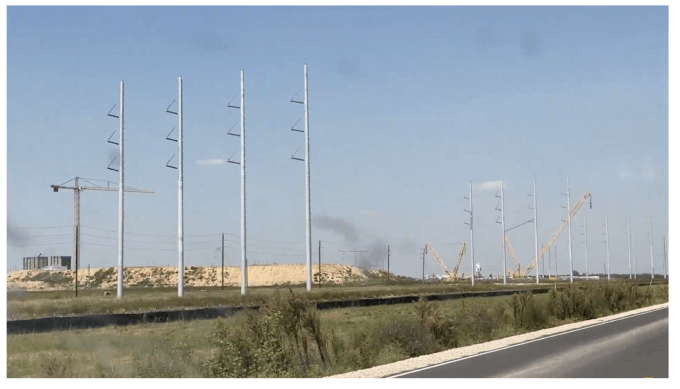
Driving past the Richland Parish data center construction site.
I knew I had to see Meta’s hyperscale data center in Richland Parish for myself. I’d read about the back-room deals, the tax breaks, the ever-expanding list of shell companies involved, and the alleged insider trading surrounding the place, but nothing could have prepared me for the look and feel of the $50 billion construction site in northern Louisiana. Setting the odometer on my rental car as I left the “welcome center” gate, the perimeter measured 17 miles around, and that footprint is already planned to increase. The name, “Hyperion” refers to a Greek god of light, but in rural Holly Ridge, it feels more like Mad Max. Out of flattened, dry earth, a steel forest of cranes spikes up, clouding the horizon. Humongous coils of cable snake across former farmland, and dust from a never-ending parade of rumbling 18-wheelers, dump trucks, RVs and flashy SUVs coats every surface and dries my breath. The ‘big’ in ‘big tech’ never seemed so inadequate. It’s also loud, and heavy, and hot.
Meta (formerly Facebook) began as a platform to connect people to each other, but the tech industry we know today has long ago abandoned any mission to do good. Now business as usual means profits over people and the planet. In Louisiana, that means billionaires over bayous. To power Hyperion, the Louisiana Public Service Commission (LPSC) has already approved three (and is rushing to approve seven more) gas-fired power plants with transmission lines and pipelines that will criss-cross the state. Some say Hyperion, which Meta intends to be its biggest AI training hub, will use seven times the energy of the city of New Orleans and cover an area the size of three or four of New York’s Central Parks. Concerned residents here, as everywhere around the U.S., are doing what they can to prevent disaster(and we at Laura Flanders & Friends are going to be following that story in the year ahead).
Workers in the tech industry have been dealing with disasters for years already. With mass layoffs and super surveillance, workers who came into the industry with high hopes and positive-impact dreams watched from up close as Mad Max destroyed their workplace. Earlier this fall, for City Works, a monthly labor show I host for the City University of New York’s School of Labor and Urban Studies and CUNY TV, I talked with Clarissa Redwine, a former organizer with Kickstarter United, and JS Tan, a former Microsoft engineer, co-authors of “Against Tech Oligarchy: Worker Resistance in the World’s Most Powerful Industry”, and Hannah Pho, a Google engineer and member of the Alphabet Workers Union. The trio told me why they entered the tech industry in the first place, and what’s happened since.
“At the start of the tech industry, where they needed lax regulation, [the tech companies] needed to attract talent that was dedicated to a mission; they needed to build trust with their customers,” said Redwine. “That was no longer needed when they’re the behemoth.”
Tan pointed to Microsoft’s contracts with the Pentagon and ICE: “A lot of tech workers initially wanting to do good in their jobs realized they were inadvertently signed up to build these kinds of projects”. At Google, Pho witnessed a growing “culture of fear and disempowerment”.
Organizing has made a difference. Not long ago, the Alphabet Workers Union struck an agreement with Google to protect the right of employees to speak freely about antitrust lawsuits against the company. Today they’re working on a Google for Jobs Security Campaign to protect workers from being displaced by AI.