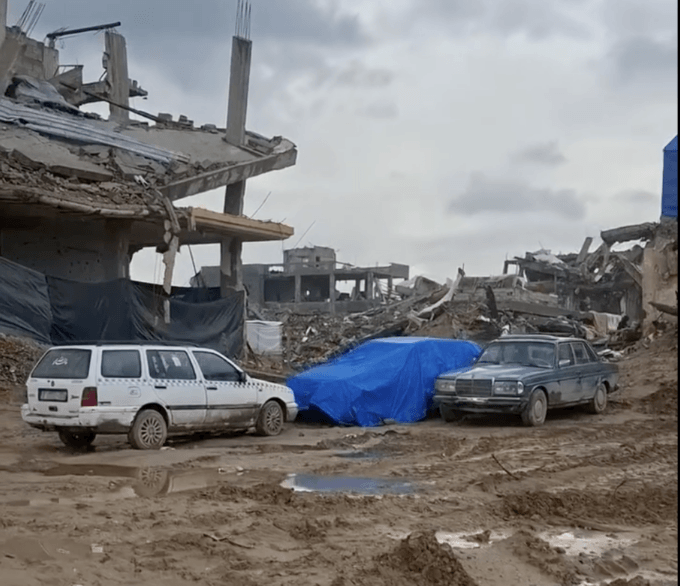
Gaza after the floods. (Screen capture from video posted to X.)
+ On Saturday, Israeli airstrikes killed three Palestinians in Gaza traveling in a van in the Tel al-Hawa area of Gaza City. A statement released by the IDF claimed that the passengers were “terrorists” belonging to Palestinian Islamic Jihad. A piece in Reuters, reprinted in Haaretz, told a different story. According to Reuters, the van was loaded with packaged food bearing the logo of World Kitchen Center, the organization started by celebrity chef Jose Andres that distributes food in central Gaza. The driver of the van used to work for the group. “It was just about to stop to distribute the food and drink to children when it was hit by a missile,” said Abu Zein al-Daya, who witnessed the bombing. In Gaza, history repeats itself every day.
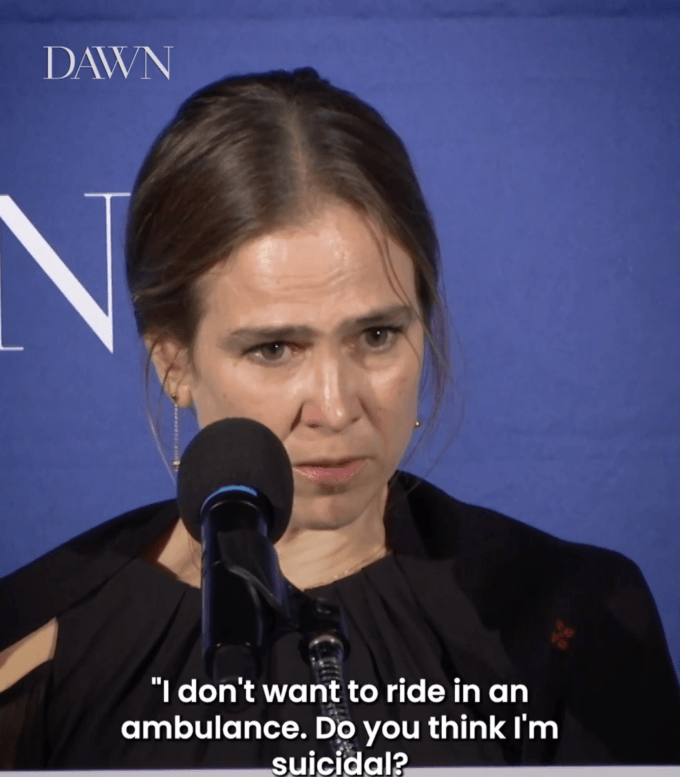
+ Dr. Tanya Haj-Hassan speaking at a DAWN conference on her experiences working as a pediatric ICU doctor in Gaza:
I want to share a few things that children said to me in Gaza.
“Everyone I love is in heaven. I don’t want to be here anymore.”
Another child said to me: “I don’t want to ride in an ambulance. Do you think I’m suicidal? The Israeli army always targets them.” The very vehicle that’s meant to be used for saving lives has become in this child’s mind a death trap.
“Please don’t cut my shirt off.” A child said this to me as we tried to access their wounds at a time when children had been forced to flee with only the clothes on their backs.
Another child clutched my scrubs and said, “Please don’t let them do it, doctor. Please,” as our medical team was trying to reduce bilateral femoral displaced fractures. Both the main long bones of his legs were displaced. That reduction is incredibly painful. You would never do that in any setting without analgesia and sedation. We were running low at the time because analgesia had been blocked from entering the Strip.
“Please tell me the truth. Is my family martyred?”
“Come quickly, doctora, there’s a huge mass casualty. The people are in pieces.”
“If I die, can I be buried in the same grave as my parents?”
And perhaps most painfully, so many children that I met said nothing. They didn’t scream. They didn’t cry. They stared as their whole world collapsed around them at scenes that even an adult emergency doctor would struggle to process.
The so-called ceasefire has become a smokescreen, obscuring attention from Israel’s ongoing targeting of life and everything needed to sustain it. Each time I was in Gaza, I thought it couldn’t get any worse, and it did. When I was last in Gaza earlier this year, Israeli air and drone strikes were still relentless. During the cease, the violent killing of Palestinians continued. But people were also being killed in slower, more insidious ways. Ways we don’t often talk about. In just two weeks, I watched at least four infants die from very treatable congenital heart conditions while awaiting evacuation. They did not simply die from their diseases. They were killed. They were killed by policies that obstructed their access to life-saving care. As one of my colleagues very aptly put it, “This is a crisis of impunity. And impunity doesn’t remain contained. We’ve watched it spread to the West Bank, to southern Lebanon, to Sudan. As each crime is met with impunity, the collection of crimes grows at a frightening rate and radius. When attacks on civilians, medical workers, journalists, and healthcare institutions are not seriously investigated and addressed. When illegal sieges and occupations and apartheid are allowed to continue, entire populations are put at risk, and healthcare workers everywhere, journalists everywhere are at risk with them…We need to talk about the role of the United States; its role in the violent killing, its role in the killing of that thing inside every child–their faith in humanity, and their belief in a just world. We need to talk about the United States’ major role in this crisis of impunity.
+ Save the Children’s annual report says that Palestinian victims of Israeli attacks account for nearly one-third of all violations against children globally. “The scale of harm to children in the occupied Palestinian territory is devastating,” the report said. More than 70% of the total incidents of denying humanitarian aid worldwide, while the killing and maiming of children in the Palestinian territories amounted to almost 40% of the global total.
+ The floods in Gaza have left nearly 500,000 Palestinian children, who were already living in tents, without any shelter.
+ Since October 2023, Israel has arrested more than 2,000 Palestinian children; at least 350 of them are still being held in abysmal conditions that human rights organizations claim amount to torture. The children are fed starvation diets, denied family visits and are routinely withheld medical care.
+ According to a report from Médecins Sans Frontières, around 70% of the cases mental health critics’ doctors treated in the Occupied West Bank from October 2022 through April 2026 resulted from exposure to acts of violence, predominantly from Israeli settler attacks. “People in the West Bank have little choice but to live under relentless settler attacks, institutional violence, and permanent threat,” said Filipe Ribeiro, MSF’s head of mission in Palestine.
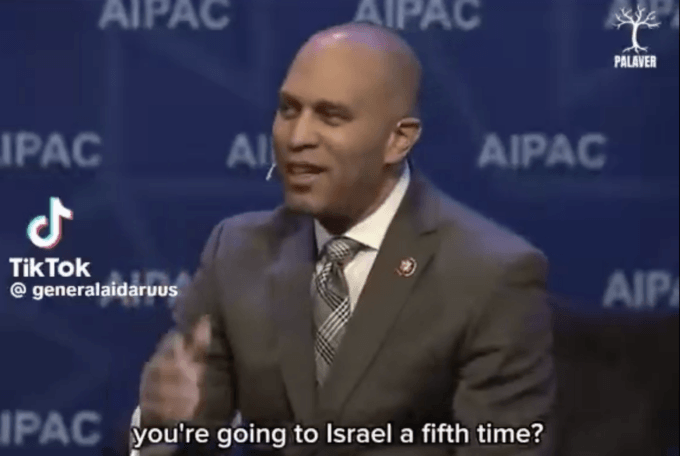
+ Ladies and gentlemen, the new Speaker of the House, Hakeem Jeffries, speaking at an AIPAC conference:
Someone said to me, uh, they said, Hakeem, you’re going to Israel a fifth time? I said, ‘Listen, I’m from New York City, and, and back home, back home in New York City, we consider Jerusalem to be the Sixth Borough. And so, I’m just trying to catch up with my constituents.
+ According to a November 10, 2026 story in the Jerusalem Post, Hakeem Jeffries has made at least eight visits to Israel, including six congressional delegations led by an AIPAC nonprofit affiliate. By contrast, Jeffries has made only five trips to Puerto Rico. There are about a million people of Puerto Rican descent in NYC and roughly the same number of Jews, though very few of them are from Israel.
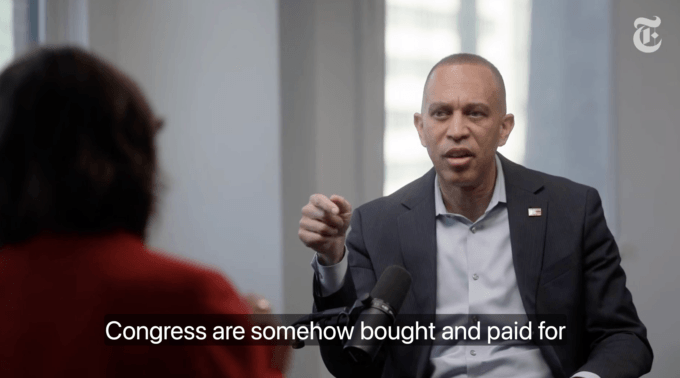
Hakeem Jeffries’ post-House Speaker vote interview with The New York Times was jam-packed with absurdities, none more absurd than his answer when asked about AIPAC funding, where he bristles at the notion that Members of Congress are–brace yourself–bought and paid for…
NYT: A tough issue, AIPAC funding in particular…
Jeffries: But I presume that the reason why it’s become an issue is because people are suggesting that members of Congress are somehow bought and paid for. When I talk to members of Congress, they’re voting their districts, regardless of who they may be raising money from.
NYT: Will you continue to accept support from AIPAC, though?
Jeffries: Well, AIPAC has said they’re no longer, I think they said they’re no longer contributing the $5000 per contribution that they can make under the current law…
NYT: But would you accept money from them?
Jeffries: They’re not giving money in any, uh, point in time in terms of AIPAC as an entity. Now am I going to continue to raise money in the way that I’ve been raising money in small dollar increments, $29 per donation? Yes.
+ AIPAC, and its affiliated PACS, spent $168.5 million in the 2026 elections. Jeffries himself banked $315,000 from pro-Israel groups this current funding cycle.
+ As I reported a couple of weeks ago, AIPAC is now running most of its political money through cut-outs, such as the United Democracy Project.
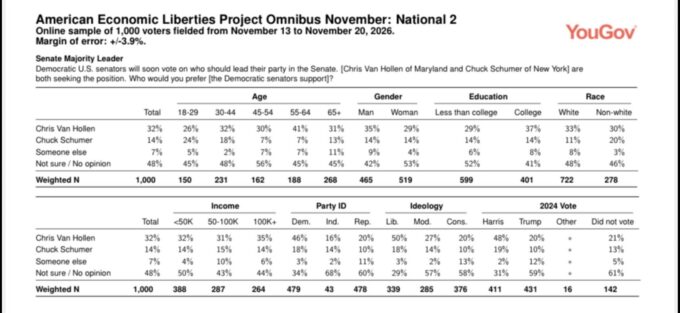
+ Meanwhile, Democrats prefer Chris Van Hollen to Chuck Schumer as Majority Leader in the Senate by a wide margin. Of course, that’s never mattered much, if at all.
+ Apparently, Israel has more representatives in the US Congress than the Knesset, which has 120 seats (19 of which are occupied by the Arab Parties, which none of the Jewish parties–left or right–want (ie, are too racist, in M. Gessen’s apt words) to form a coalition with)…
+ Rabbi Gedalya Axelro, a leader of the militant Chabad-Lubavitch Hasidic movement in Israel, issued a religious ruling (a kind of Jewish fatwa) which legitimizes the assassination of Israeli politicians who cooperate with Arab parties in forming a government, the same kind of “halakhic” ruling that was used to justify the1995 assassination of Yitzhak Rabin, by ultra-nationalist law student Yigal Amir. “I did not commit the act to stop the peace process, because there is no such thing,” Amir claimed. “It is a process of war, and the murder was my obligation according to religious law.”
+ After learning that Israel had used US-made weapons in the airstrikes that killed his colleague, Feroze Sidhwa, who was in New York promoting the new documentary American Doctors, told The Intercept: “That’s not complicity. That’s active participation in the murder of physicians and other healthcare workers.”
+ Trump’s Justice Department sent a wide-ranging subpoena to the American Federation of Teachers seeking information on pro-Palestinian students at the University of Michigan. The Trump administration is trying to build a federal conspiracy case over minor property damage. The subpoena targeted the Graduate Employees Organization at the University of Michigan, which is an affiliate of the teachers’ union.
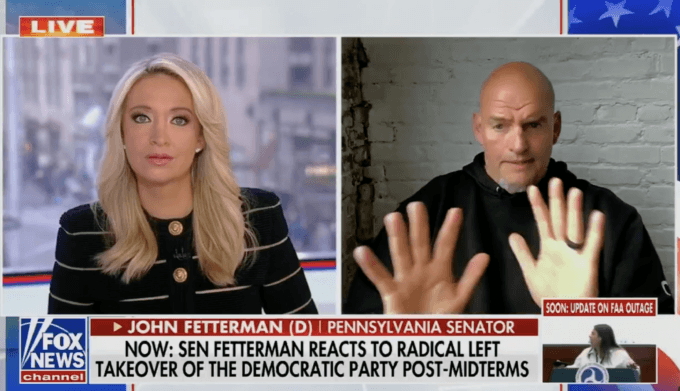
+ John Fetterman back in his native habitat, Fox News, where he announced he might leave the Democratic Party if Chris Van Hollen is chosen as Senate Majority Leader:
I’m frustrated by the gas prices. It’s terrible that Americans have to suffer, but if you want to blame the Trump administration, I continue to blame the Iranians as well. They could find a way forward for peace. It’s a political loser, absolutely, but that’s a country over party. And we need to stand with our special, uh, ally Israel.
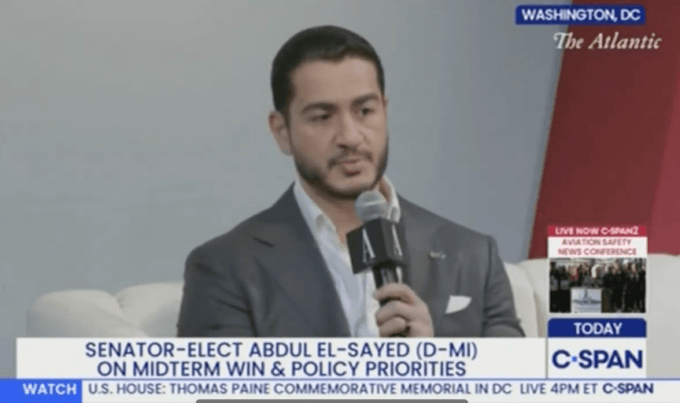
+ Abdul El-Sayed is not Mamdani. He’s his own deal, but just as gifted, confident and plainspoken. In other words, everything Kamala Harris isn’t….
Reporter: What is your response to someone who comes up to you and says, “Well, I find that your critiques of Israel fuel my fears of antisemitism.”
El-Sayed: I’m sorry for your fear. Obviously, I don’t want to do anything that drives your fear. At the end of the day, there’s a difference between safety or lack of safety and comfort. If what I’m saying is making you uncomfortable, you should be uncomfortable with injustice perpetrated on other people. You should be uncomfortable with that.
Addressing the safety question and the discomfort question are two different things, because if it is your sense of your discomfort and/or fear that has to keep me quiet while I watch 70,000 people get killed, their homes annihilated, their hospitals destroyed… and I can’t critique that, then I think what you’re telling me is that their humanity matters less than yours. And I’m not going to be okay with that.
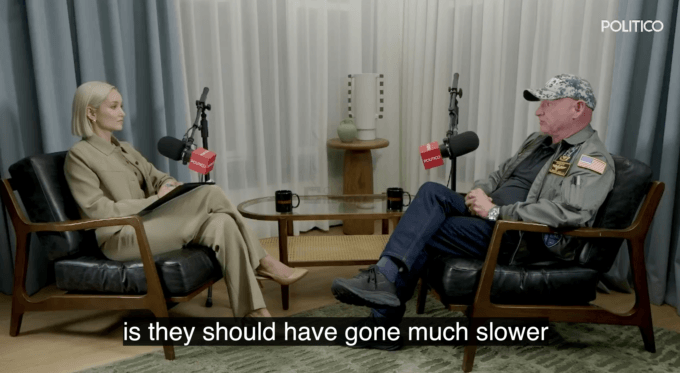
+ From the Plus ça Change newswire: Sen. Mark Kelly, presidential aspirant, on the Democratic reset of the US/Israel relationship, arguing that they should have waged a slower and gentler genocide in Gaza using smarter bombs: “Helping Israel is not only important to the security of Israel, it’s important to our own national security. It’s always appropriate to evaluate the kind of security assistance we provide to countries. This is something we should do on a regular basis, regardless of what the country is. What Israel should have done in Gaza is they should have gone much slower and they have used guided munitions and not a lot of unguided ones.”
+ Here’s the always equivocal MayorPete Bot on the US/Israeli relationship:
The way I come at this is there are three sets of things at stake when we talk about what’s going on in the Middle East and our relationship to Israel and our responsibility to promote the safety of Palestinian and Israeli people. First, before we go abroad, look around at home where there has been an explosion of anti-Semitism, also a disturbing rise in Islamophobia, and much of this, of course, has traveled with activity and interest in what’s going on in the Middle East. And we just have to be full-throated, unequivocal and unambiguous in rejecting any kind of hate, including this anti-Semitism that has become far, far too present in our politics and our culture. In theory, that should have nothing to do with what’s going on in the Middle East because hate is wrong no matter what your politics are, but we’ve seen how these things travel together, so we’ve to be on top of that. There is the right and need for the Palestinian people to have human rights and safety and self-determination.
+ Biden is not the self-reflective type. His memoir is not an apologia for a spectacularly failed president. It’s 480 pages of self-justification. He’s beyond learning any lesson or teaching from his blunders, even when they left more than 100,000 dead abroad and opened the door to a neo-fascist takeover of the country at home. Others are to blame for his downfall: Netanyahu, Pelosi, the press.
His references to the genocide in Gaza do not recognize the mass killing and displacement of 85% of the Strip’s population as a genocide, but merely the cost of doing business. There are no regrets, only blame-shifting and that is largely rhetorical. As we know, his last conversation with Netanyahu was warm and nostalgic. In his book, the Palestinians exist only as stereotypes and caricatures, lacking any distinct personality. For a man known for his sentimentality and tearing up at the slightest provocation, Biden can summon no authentic empathy for the plight of Palestinian children or mothers. They’re all the relatives of Hamas to him.
+ My review of Biden’s memoir in one Ramones lyric: “Drank in all the bars in town to understand your foreign policy.”
+ A few quotes from his self-serving screed will give you a sense of the unrepentant flavor of the text…
“I will never regret standing by Israel in the wake of October 7.”
“Hamas had spent decades embedding themselves in hospitals and schools and neighborhoods, making it impossible to go after them without also killing civilians,” Biden writes. “And that is what happened.”
“I wished I could say there was an easy answer, or a way to fight Hamas with precision and special forces alone,”
“My main goal in going [to Israel after October 7] was to show solidarity as a friend and ally.”
“On campuses, especially, there was a growing school of thought that Israel was a racist ‘occupier’ of Palestinian lands.”
+ In his entire memoir, Biden only mentions one Palestinian by name, Mahmoud Abbas, whom he dismisses as incompetent and uninspired. Meanwhile, according to Arno Rosenfeld of Haaretz, Biden mentions 12 Israelis, almost all of them in glowing terms.
+ The Israeli weapons-maker Tomer is selling the Pentagon $830 million worth of 155-millimeter shells that the US Army calls Explosive Advanced Submunition artillery shells and the rest of us call cluster bombs.
+ Rabbi Gedalya Axelro, a leader of the militant Chabad-Lubavitch Hasidic movement in Israel, issued a religious ruling (a kind of Jewish fatwa) which legitimizes the assassination of Israeli politicians who cooperate with Arab parties in forming a government, the same kind of “halakhic” ruling that was used to justify the1995 assassination of Yitzhak Rabin, by ultra-nationalist law student Yigal Amir. “I did not commit the act to stop the peace process, because there is no such thing,” Amir claimed. “It is a process of war, and the murder was my obligation according to religious law.”
+ After learning that Israel had used US-made weapons in the airstrikes that killed his colleague, Feroze Sidhwa, who was in New York promoting the new documentary American Doctors, told The Intercept: “That’s not complicity. That’s active participation in the murder of physicians and other healthcare workers.”
+ Dr. Hussam Abu Safiya, former director of Kamal Adwan Hospital in Beit Lahia, was arrested by Israeli forces on December 27, 2024. For the past two years, he has been jailed under torturous conditions without charges or trial. He has been held in solitary confinement, deprived of food and sleep, and routinely beaten by guards. His health has deteriorated. This week, an Israeli court extended his detention for another six months, calling the 53-year-old physician “a threat to the security of Israel.”
+ Trump’s Justice Department sent a wide-ranging subpoena to the American Federation of Teachers seeking information on pro-Palestinian students at the University of Michigan. The Trump administration is trying to build a federal conspiracy case over minor property damage. The subpoena targeted the Graduate Employees Organization at the University of Michigan, which is an affiliate of the teachers’ union.
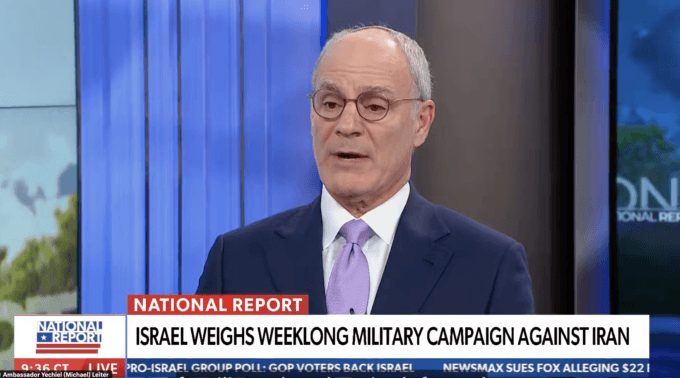
+ In an effort to push Trump into renewed airstrikes on Iran, Roman Gofman, director of the Mossad, flew to Washington and Miami last week to share Israeli intelligence claims about Iran’s development of chemical weapons.
+ Trump apparently took the bait. In an unhinged rant on Fox News, he claimed that Iran was “looking at gases, looking at bio, because we’ve shut them out with the nuclear. Nuclear’s much harder. So they’re looking at the gas and looking at the bio. Biological weapons. Not nice. We’ll see. We’ve got a new year coming. After January 1st, we’ll see what happens. They’ve been nasty. These are nasty people. We didn’t start this war. This war was started 51 years ago. You look at the SS Cole, where 400 of our kids were killed. [Note: 17 sailors were killed in an Al Qaeda, not Iranian, operation.] Our ship. If it did happen [An Iranian attack on DC with a dirty bomb], we wiped them out. I give you my word. ”
+ Israel’s ambassador to the US, Michael Lieiter: “You get American soldiers back to their families here when Iran is defeated.” Thanks for clarifying who’s really calling the shots on US troop deployments in the Middle East, Ambassador.
+ Netanyahu accused the Arab parties of vote fraud, an accusation dismissed by Israeli election officials. But it turns out he’s the one who engaged in an attempt to manipulate the elections, when his aides gave information to Israeli police shortly before Oct. 27 that led to the arrests of Arab party workers on election day. According to Haaretz, Netanyahu’s internal intelligence chief, David Zini, also wiretapped five Arab members of parliament.
+ M. Gessen on Gadi Eisenkot, the “alternative” to Netanyahu:
A former army chief of staff and a former minister in the Netanyahu government, Eisenkot supports Israeli settlements in the West Bank and opposes Palestinian statehood. In 2006, when he was head of the Northern Command, he implemented what he later explained as the Dahiya doctrine, named for a suburb of Beirut that the Israeli military leveled that year, killing some 1,000 civilians. The Dahiya doctrine, according to Eisenkot, calls for responding to assaults with “disproportionate attacks, including against civilian structures and infrastructure” — more or less the definition of a war crime.
+ For the first time, the ICJ has found a state, Myanmar, responsible for genocide. This is an ominous sign for Israel’s pending case, since its defense relied on many of the same legal arguments the court rejected in the case of Myanmar.
+ Haaretz’s Nir Hasson on why Israel should be terrified by the ICJ ruling that Myanmar committed the “crime of crimes,” genocide against the Rohingya:
Even a preliminary reading of the ruling suggests that, by all accounts, Israel’s legal position has been significantly weakened by the judgment against Myanmar.
The similarities between the two cases are numerous. In Myanmar, too, a Muslim minority living in the western part of the country had endured decades of discrimination and exclusion. There, too, the final and most violent phase of the conflict began with a surprise attack by an armed Rohingya group, which seized military bases and police stations. And there, too, a shocked and humiliated army launched a brutal counteroffensive, describing it as an act of self-defense against an extremist Islamic terrorist organization.
The government also claimed that the group was using civilians as human shields. The conflict escalated into mass killings, the widespread destruction of communities and the displacement of hundreds of thousands of people to tent camps.
+ In his latest attack on the ICC, US Secretary of State Marco Rubio threatened that if the court tried to enforce its rulings against Americans, the Trump administration would respond with force. To drive home his boast, Rubio quoted the Roman general Pompey: “Stop quoting laws to men with swords.” Rubio might do well to consider Pompey’s fate…