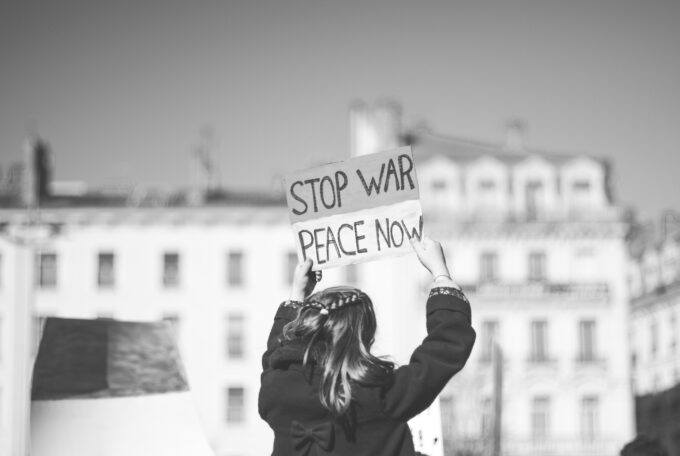
Image by EV.
In the early hours of November 25, an attack on an apartment in Gaza left four people dead. The incident occurred under a “ceasefire” that has been in effect since October 2025, and according to statistics from the Gaza Ministry of Health, more than 1,671 Palestinians have been killed since that time. Simultaneously, a new report published by Amnesty International on the same day recorded the number of women and girls killed in Gaza from October 2023 to October 2026 at over 22,000. These figures are being published while last March, an attack on a school in Minab, Iran, killed approximately 180 children—and the official Western response to it, compared with the tense weeks following any incident in Gaza, came close to silence. This temporal coincidence places back on the table the question that international humanitarian law was written to contain. Are the lives of civilians on the battlefield measured by geographic and political criteria before they are weighed by legal standards?
International humanitarian law has three clear pillars. The principle of distinction obligates parties to a conflict to differentiate between civilians and combatants. The principle of proportionality prohibits an attack whose collateral damage is excessive compared with the direct and concrete military advantage anticipated. The principle of precaution mandates all practicable measures to minimize harm to civilians. These principles do not mean an absolute prohibition of any civilian casualties; but they do not permit the killing of civilians—absent serious examination of necessity, proportionality, and precautionary measures—to become an “inevitable cost of war.” The existence of a legitimate military objective is not the end of legal scrutiny; it is the beginning.
The Libyan experience in 2011 demonstrated just how deeply these rules depend on the identity of those enforcing them. NATO began its aerial operations with a mandate to protect civilians from the forces of Muammar Gaddafi. But subsequent investigations presented a different picture of that mission.
In March 2012, Amnesty International reporteds that 55 identified civilians, including 16 children and 14 women, had been killed in NATO airstrikes in Tripoli, Zliten, Misrata, Sirte, and Brega. The organization emphasized that many of the victims were killed in their own homes, and that there was no evidence of military use of those homes at the time of the attack. NATO not only failed to conduct the necessary investigations, but did not even take action to communicate with survivors and the families of victims.
Human Rights Watch also documented, in May 2012, after examining eight NATO airstrikes, at least 72 civilian deaths including 24 children and 20 women. In seven of the eight locations examined, the organization found no clear evidence of a valid military target. NATO’s response to these findings established a pattern that would be repeated many times thereafter. The alliance declared it was “deeply sorry for any harm that may have been caused as a result of these airstrikes,” but deemed its own authority to investigate in Libya moot after the end of operations on October 31, 2011, and placed responsibility for examination on Libyan authorities. Amnesty International described this response as “tantamount to a refusal to accept responsibility.”
This pattern has been reproduced in the Iranian case as well.
Airwars assessments of the February 28, 2026, attacks indicate that between 8 and 10 civilians were killed in the strike on the Iranian Leader’s residence in Tehran. In the attack on a sports hall and two residential buildings in Lamerd, at least 21 people were killed, including seven children. And in the attack on a school in Minab, more than 150 civilians were killed, the majority of them children. Airwars has documented a total of 272 incidents of harm to civilians over 40 days of war, while internet blackouts and disinformation campaigns have limited the possibility of fully recording casualties and pushed existing estimates toward underrepresenting the true number of victims.
The difference in response to these two cases is not accidental.
When NATO kills civilians in Libya, the official reaction is “regret,” and responsibility for investigation is handed to an institution that is not present on the battlefield. When the same kind of casualties occur in Iran, official narratives speak of “precision weaponry” and “military objectives,” and questions about responsibility are pushed to the margins. This selectivity does not merely erode the credibility of human rights declarations. It undermines the very rule meant to preserve a minimum of human dignity even in the midst of war.
The common response to this critique is to invoke “the other side’s double standard.” But the legal point here is that one party’s conduct does not nullify the other party’s obligations. If a force positions itself in residential areas or operates from among civilians, that action carries its own legal responsibility. However, one party’s violation of that obligation does not eliminate the attacking force’s responsibility to observe distinction, proportionality, and precaution. The rights of civilians are not a privilege that can be confiscated in reaction to an adversary’s behavior. A single standard does not mean identical results in all cases. It means applying the same rules and the same methods of examination to all parties.
Within the American political structure, this selectivity has deeper roots. American citizens’ ballots have effectively become powerless in determining the grand orientations of war and peace. The circulation of elites between the two parties keeps foreign policy on a trajectory distant from the security and economic priorities of the majority of society. In such a structure, foreign warmongering becomes an ordinary matter whose cost falls on the very people who neither play a role in decision-making nor benefit from its outcomes. Soldiers and the lower classes of American society are transformed into instruments for advancing conflicts that serve the security and interests of third-party powers. This exploitation of citizens’ lives and resources is carried out amid media silence and the indifference of political structures, while those same structures build extensive legal and moral mechanisms for every casualty in the adversary’s camp.
The alliance leash is understandable within this same framework. In many cases, Washington acts not on the basis of its own security priorities, but under the influence of alliance constraints that compel it to advance the interests of a particular ally against its own vital interests. The result is that American foreign policy in the Middle East, rather than pursuing an independent strategy, has become a follow-on to the priorities of a regime whose costs are paid not only by the region’s civilians but by American society itself. This structural constraint fundamentally undermines Washington’s capacity to play the role of an impartial mediator or a universal defender of human rights.
The families of victims in Libya and Iran do not need expressions of regret or the publication of statistics. They have the right to know what happened, who was responsible, and whether the law was violated. The realization of this right depends on independent investigations, the publication of results, and accountability where violations are proven. As long as these mechanisms are active for some cases and shuttered for others, the protection of civilians will remain confined to official statements and, on the battlefield, surrendered to military calculations. The life of a child in Tripoli, Tehran, or Gaza is not valued by the political identity of their family. If the rules of war are to have real meaning, no force should be able to demand justice for its own victims while remaining silent before the victims it has itself left behind.