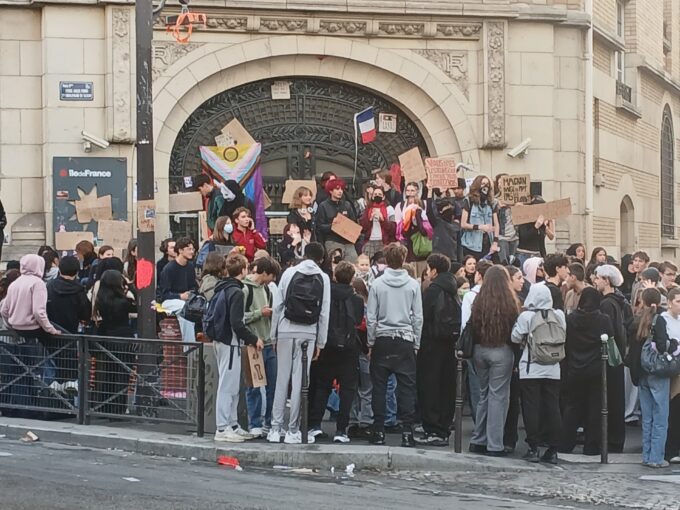
Photograph Source: Guallendra – CC0
“And in fact, before last week, we had not experienced such a joy to be on the street, to joke, to dance, to sing, to tag and to make a riot with the Yellow Vests.”
“Power for no one!”
The recent student upheavals in France evoked the typical bias we expect from mainstream pundits: hapless student protests commandeered by agitators attacking police and looters smashing small shops. The leftist hordes on their blogs in the EU and the US predictably focused on Police brutality and the valiant resistance from the students who continued, for several weekends, to “do it in the road.”
Rightly, the State’s response must be condemned and the surprising insurgence of high school students, mainly from poorer suburban neighborhoods of Paris, les banlieues, needs to be celebrated. But this is not all.
The protest movement started in mid-September at the Saint-Exupéry high school in Créteil, a suburb southeast of Paris. Students blockaded their school to support teachers who were protesting staff shortages.
The shortages are a nationwide problem. According to one study, 9.8 percent of teaching hours in French public secondary schools went untaught in the 2024-2025 school year. *
The educational bureaucracy failed the students. Youth are fed up. You can read it on their cardboard placards that they enthusiastically wave while blockading their schools. Their joyful rebellion manifested a contagion that surprised them and shocked the authorities. For once they expressed their frustration and anger publicly and witnessed with glee that they are not alone harboring their disgust with the fools in government who treat them with contempt.
The fact that clad in full riot gear, militarized agents of the State are battering teenagers is outrageous. Is it any wonder that the so-called Black Bloc has appeared to fight the cops? In desperation the State attempted to close city centers to prevent demonstrations, outraging even more the students and the battalions of citizens who joined them. More smashing, looting and burning of brand-name shops resulted.
The street battle observations by both allies and detractors of the students define the State repression, however we need to dig a bit deeper into the student rebellion to investigate its future political implications.
When interviewed the students commonly report poor building maintenance, lack of substitute teachers, large class sizes, and the Parcoursup, the higher education access platform which doesn’t function properly and limits their choice for college entry.
In sum, they are complaining about the failure of their educational program.
We need to ask though just what is this program and where is it failing? This was a protest based on obvious inequality as witnessed by the solidarity of high school and college students from wealthier schools. The mass media reported that the students from the banlieues saw their chance to succeed, to move to a middle-class lifestyle, hampered by State neglect of their circumstances. The Nation article in April on the banlieues was titled “The Social Ladder is Broken.”**
The students’ recognition of their confinement to a life of scarcity is obvious. The “social ladder” in fact is missing. If the future of employment for the privileged students is dire in France, as it is throughout Europe, where the need is for manual labor, grunt work in the hospitality sector, and in construction, not for more lab technicians, stockbrokers, lawyers, and code writers, how will “better educated” teens from the banlieues find employment?
The takeaway from this student rebellion isn’t that it’s fruitless—a cohort of rebels with a cause, but no future. In fact, if we investigate this rebellion as it is developing, we can see the creation of a new society. The major experience that the students verbalize is their joy in fighting for their futures; they witness for the first time that solidarity gives them the power to change life. How will they be satisfied by returning to their classes? Of course, the roof maybe repaired, the substitute teachers may show up, and the toilets will not overflow, but what about the elan that they experienced “doing it in the road”? Or finally, what if their school has been burned to the ground—the final exclamation mark on their past misery.
More privileged university students have joined the high school students and so have remnants of the rural protests years ago against the high cost of living—the Yellow Vests. Most recently union federations have marched in solidarity with the teachers.
The high school students, unlike the recent recruits to its cause, have the potential for the most significant upheaval of the social and economic relations imposed by the State. Their movement, therefore, seemingly the least willing to accept reforms—as we noted, some schools have been reduced to a pile of ashes—must be recognized as the most dynamic force for revolutionary change. At the same time, precisely due to the students’ ardor they will find it difficult to gain government support.
The question to be addressed: how to build on the overwhelming rapport with their contestation to offer a glimpse of a new society that can contend with the social collapse they have entered—one of daily sacrifice and futility. The movement that the students are articulating went far beyond the media image; not a demand for more resources, it called in effect for a demolition and reinvention of education in general.
The school systems that have been incorporated in modern industrial societies have attained the status of immutability, as if only fools would contest their necessity in a modern society. It might come as a shock to some that the development of education as we have come to know it arose coterminous with the rise of the nation state. The first schools arose in England and Prussia as necessary supports for commercial society: writing to devise contracts and math for accounting purposes. As industrial production began to replace commerce, schools took on the role of providing willing slaves to the new machines.
With the expansion of economic complexity and social division based on the accumulation of wealth the modern school became an institution that combines four social functions: custodial care, social-role selection, indoctrination, and education as usually defined as skills and elementary knowledge.***
In all societies the general task of the educational system, no matter its formal or informal sense, is pivotal for the specific culture. A basic anthropological fact characterizes societies based on how children are integrated into their society. A warrior society will raise their children in a manner opposed to that of a pacific hunter-gatherer society.
In France it is ironic that some of the schools that rebelled were named after Louise Michel a self-professed anarchist who fought on the barricades of the Paris Commune of 1871. She was an avowed feminist and ran a free school that emphasized education of girls. After two months of revolt, the French National Army bloodily suppressed the Communards, killing 20,000 and taking 43,500 as prisoners. Over 1,000 women, Louise Michel amongst them, were imprisoned and Michel was eventually deported, with a thousand other Communards, to a penal colony in New Caledonia.
An amnesty in 1880 allowed her to return to Paris where she reestablished her school and lectured internationally. Michel’s pedagogy was greatly influenced by Paul Robin who developed his theories of an integral education system while teaching French in England after the fall of the Paris Commune. He also returned to France in 1880 to administer a coeducational school of 60 students between eight and fourteen at the Prévost orphanage in Cempuis, a northern French village. He remained there, increasing the student body to nearly 200, until 1894 when local Catholic authorities objected to his methods.
For Robin integral education meant combining intellectual and manual learning, both arts and sciences. Based on utopian Charles Fourier’s concept of the Butterfly passion, he provided the opportunity for students to be free to move between physical, intellectual, and moral tasks, to enhance their creativity. He also wanted early education to be spontaneous, that is transmitting knowledge in a playful manner.
Compared to Robin’s pedagogy, the French system suffocates adolescence, eliminates all true inquiry and adventure. To mention but one contrasting aspect–each summer Robin managed to take his students, orphans all, to the ocean for two weeks.
I suggest that the French students abandon their barricades for a day and enter their schools to study Robin’s pedagogy. And after this study they embark to one of the French villages that is losing its population.
The French National Institute of Statistics and Economic Studies (INSEE) several years ago found that over 20,000 villages had not one café for locals to meet and engage in a social life. Further, many homes have been abandoned and the French government, unlike other EU countries facing rural depopulation, offer few incentives to purchase and rehabilitate forsaken structures.
Imagine a dozen students moving to one of these villages and, with the advice and assistance of the current elderly residents, rehabbing an abandoned house, cultivating a garden, and maybe even re-opening a café. If a teacher went along to act as liaison between the students and the villagers to help direct the projects, they might see it as a welcome break from their former carceral duties. And what if the students finally begin to enjoy themselves?
Notes.