Fitzgerald: Let me tell you about the very rich. They are different from you and me.
Hemingway: Yes, Scott, they have more money.
American attitudes sure have evolved on matters of infidelity and Chinese espionage in the last quarter century. Back in the late 1990s, during one of the periodic Big China Scares, Alexander Cockburn and I were two of the very few defenders of Wen Ho Lee, the Chinese American nuclear scientist working at Los Alamos, who was accused of stealing nuclear secrets for China. He was indicted on 59 counts, denied bail and put into solitary confinement, where he was restrained in shackles much of the time. He was vilified in the press (led by the WSJ, but the NYT and Washington Post soon piled on), slandered by the Clinton Administration and slimed by anti-China bigots in Congress. The charges were bogus. The case soon fell apart. The federal judge who denied Lee bail and threw him in the hole later apologized to him in open court. Lee later filed a civil suit against his persecutors and walked away with a $1.6 million settlement.
Now, twenty-seven years later, consider the reaction to the case of Jensen Huang, the hip, Ramones-style leather-jacket-wearing CEO of one of the world’s largest corporations, who strikes a cyberpunk pose and hangs out with political elites from both parties, whose indulgences his company has cultivated with lavish political contributions, including $105,000 to Abdul El-Sayed. Like Lee, Jensen Huang was born in Taiwan (a distinction lost on many communist-fearing Americans). He arrived in the States at the age of 10 and went to high school in Aloha (that’s pronounced /əˈloʊ.ə/, not /əˈloʊhɑː/, FYI), Oregon, outside of Portland. He was a proud Beaver at Oregon State University and got his master’s at Stanford.
Fresh out of Stanford, the Young Master Huang famously founded Nvidia (originally NVision) in a breakfast booth with two colleagues from Sun Microsystems at a Denny’s Diner in San Jose, well, East San Jose, anyway. Three decades later, Huang was the13th richest person in the world and his company was valued at $6 trillion and rising on the AI wave he helped propel. Then it all came crashing down…for eleven days, anyway.
This time it was the New York Times that ran point in accusing Huang of being a perhaps unsuspecting tool of Chinese intelligence. On October 29, the Times ran the first in a string of stories reporting that Huang had a sexual relationship with Chinese tech executive Alice Huang, who ran Megaspeed, a Singapore-based company that bought Nvidia’s highly prized AI chips. The Times reported that Alice and Kang Wei, whom she often presented as her husband (though perhaps not in Jensen’s presence), had been recruited as a spy by the MSS, China’s Ministry of State Security.
The Trump administration knew about the entanglement between Jensen and Alice, as well as her suspected ties to China’s MSS, long before the NYT. Trump was informed at least twice, but brushed off both warnings and invited Jensen Huang on a trip to Beijing in May 2026. Commerce Secretary Howard Lutnick was also in the loop, but still approved the sale of more than 800,000 advanced Nvidia AI chips to China and left Alice’s company, Megaspeed, off the Department’s export restriction list. Coincidentally (or not), Lutnick’s former firm, Cantor Fitzgerald, now run by his sons, held 3.5 million shares of Nvidia stock on the day Lutnick joined the Trump administration, shares that swelled in value by more than $170 million over the next six months. Cantor Fitzgerald began shedding shares after Lutnick learned of Huang’s ties to Alice and had “only” a million shares left on the day Huang resigned, a week after the NYT story broke, and its stock value plunged by more than 30 points.
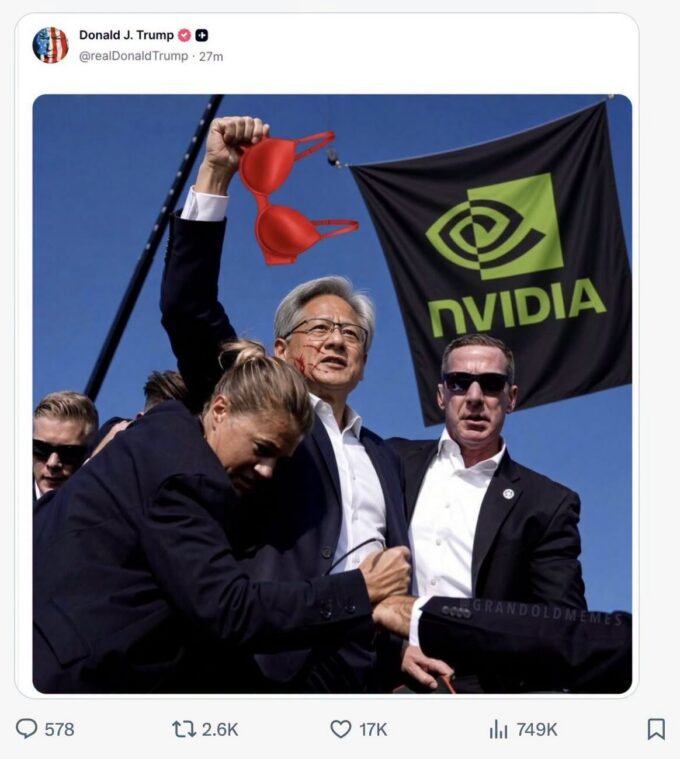
And those 30 points were enough for Trump. When the chips were down (so to speak), Trump chose his own personal bottom line over any trifling concerns about Chinese corporate espionage, in an age when the chips that power AI are more coveted than nuclear secrets. At the end of 2025, Trump held as much as $58 million in Nvidia stock. According to an analysis by the Associated Press, he made more than 100 transactions of Nvidia stock that were worth between $27 million and nearly $98 million between January 2025 and September 2026. That 30 percent drop could have cost Trump nearly $18 million. So he intervened, dialed into a Nvidia board meeting (no word on whether Natalie the Human Printer was giggling in the background) and demanded that his buddy Jensen Huang be restored to power. And it was so.
Tina Brown’s cri d’exaspération column explains the old thinking when it comes to the salacious, if not criminal or potentially traitorous, behavior of our oligarchs, who now seem to exist in a hyper-realm beyond borders:
What the actual fuck? The disgraceful actions of the spineless grovelers who call themselves a board and have reinstated Jensen Huang as CEO of Nvidia set my hair on fire. What does it take to get canned anymore? Now we know the real meaning of shareholder value: the abandonment of every other value except greed. It’s as if the immunity granted Trump by the delinquent Supreme Court in 2024 has now spread to the rest of his lawless circle, answerable to no oversight except avaricious presidential patronage. As one Silicon Valley investor vented to me, “I never thought the Nvidia board would act like FIFA. Is board chair Harvey Jones the second coming of Gianni Infantino?
But this is a new, more forgiving America. By all accounts, Huang grew his chip empire with a tyrannical management style, not unlike Trump’s. He is notorious for bullying and publicly humiliating company staffers. He’s had at least four extramarital affairs, including two with Nvidia employees and one with Kimberly Powell, a top executive at Nvidia. Once, this alone would have been grounds for termination. Now it’s apparently a sign of the corporate warrior ethic, sexual conquests as evidence of executive power. As for Huang’s ties with China, many Americans probably understand Huang’s desire to cut deals with a more rational, stable and prosperous regime and wish they could do the same.
In the end, Wen Ho Lee will have spent nine more months in chains in solitary confinement than Huang did in corporate exile, prowling the labyrinthine hallways of his 11,400-square-foot palace on the Gold Coast of San Francisco’s Pacific Heights.
Now back at the helm, Huang says he’s now having 90-minute-a-day sessions with his therapist (Jacques Lacan’s sessions often lasted 3 minutes or less–though he still charged for the full hour), which in the 70s and 80s would have been more worrisome to many Americans (cf., Thomas Eagleton) than a dalliance with a seductive Chinese spy. You’ve come a long way, America.