
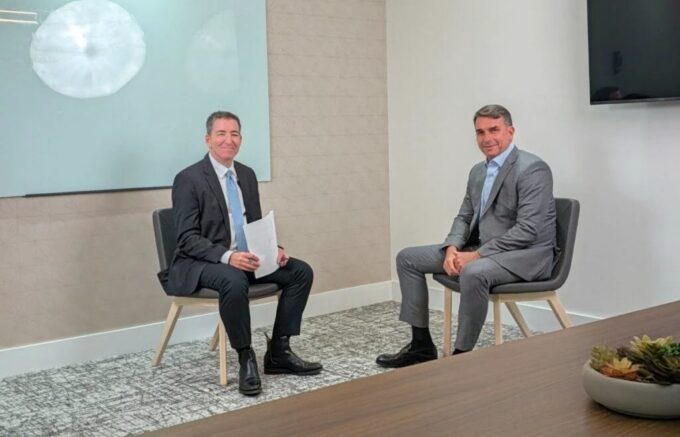
Glenn Greenwald grins before interviewing Flavio Bolsonaro in Miami. Afterwards, sponsoring newspaper Folha had to bring in its Washington correspondent Isabella Menon, who wasn’t present in the interview, as co-author to fact check 14 lies that Greenwald let pass during the interview. Photo: social media.
Folha de S.Paulo, Brazil’s second largest daily newspaper by circulation, has correspondents Isabella Menon stationed in Washington and Mayara Paixão in New York. In Brazil, it has renowned staff journalists such as Patrícia Campos Mello and Ana Luiza Albuquerque. It has Mônica Bergamo, one of the best connected professionals in Brazilian journalism, and Fábio Zanini, who knows the backrooms of Brazil’s right and far right.
In other words, the paper has no shortage of good journalists. What it hasn’t done is explain why, with the chance to interview Flávio Bolsonaro in Miami, it turned to Glenn Greenwald. The choice would have been controversial under any circumstances. After what Greenwald did during Brazil’s 2026 presidential election, it is even harder to understand.
I’m not raising this concern because his political views differ from mine, and I don’t believe professionals should be barred from interviewing politicians because of their ideology. The issue is something else: a commitment to the facts, editorial independence and responsibility in choosing who sits across from Flávio Bolsonaro.
During the election coverage, Greenwald spent the most decisive days of the race spreading extremely serious and false accusations about the integrity of Brazil’s electoral process to an international audience, without offering evidence that matched the gravity of his claims. Just a few weeks later, Folha handed him one of the most important assignments in political journalism: interviewing the defeated candidate who fled the country and now operates politically from the United States.
The Election Greenwald Described to the World
On October 3, I published an investigation in my newsletter Noites Húngaras into Greenwald’s activity in the final hours before the first round. With fewer than 24 hours until the polls opened, he stepped up a social media campaign to present Brazil’s election to foreign audiences as a process at risk of judicial manipulation in Lula’s favor.
In just two days, I counted at least ten posts in English in which Greenwald went far beyond criticizing controversial court rulings. He claimed that a supposed wing of the Supreme Federal Court that favors Lula was interfering to prevent a free election. He even put at 50% the odds that, if Flávio Bolsonaro beat Lula or appeared headed for victory, his candidacy would be blocked or the result annulled. He offered no evidence for that prediction.
In another episode, Greenwald used the temporary suspension of services at U.S. diplomatic offices in Brazil to feed suspicions about the electoral process. The Federal Police had carried out searches to investigate possible threats against U.S. diplomatic facilities, in an inquiry that began through cooperation with foreign intelligence agencies. After those searches, the police said they had found nothing to support the risks first reported. Greenwald highlighted the investigation but gave far less weight to the lack of confirmation of the initial suspicions.
The pattern repeated when TV Globo canceled a presidential debate. Lula had already decided not to attend. Court rulings then changed the conditions planned for the event, and Flávio Bolsonaro also dropped out, claiming censorship. Greenwald presented that candidate’s political justification to his foreign audience as if it were the objective explanation for the cancellation.
That is a fundamental difference. Reporting that a candidate accuses the electoral court of censorship is one thing. Folding the accusation into the journalistic narrative without showing that it matches the facts is another. The result was a story, told again and again, about a Brazil supposedly under judges allied with Lula who were ready to manipulate the election to guarantee his victory.
This was not merely a dispute over interpretation. These were accusations about the legitimacy of Brazilian democracy, delivered in English to hundreds of thousands of people.
From Vaza Jato to the Campaign Trail
It would be dishonest to erase Greenwald’s importance to journalism. In 2013, he took part in publishing Edward Snowden’s documents on mass surveillance by the United States. In Brazil, he played a central role in receiving the material that led to the Vaza Jato reporting.
That investigation, carried out by a team of Intercept Brasil journalists, revealed conversations that raised doubts about the impartiality of Operation Car Wash (Lava Jato) Judge Sergio Moro and the conduct of Lava Jato prosecutors. It was work of enormous public importance.
Greenwald faced threats, attempts to criminalize him and intimidation campaigns because of his journalism. None of that should be forgotten, but the past does not grant permanent immunity from criticism.
Since leaving The Intercept in 2020, Greenwald has appeared more and more often in the American conservative media world. He has moved closer to issues and figures at the heart of Trumpism, especially in campaigns against what he describes as a censorship regime. That doesn’t mean he has simply joined the Republican Party, and his positions still defy some conventional labels. The problem is less Greenwald’s ideological identity than how he has come to select, present and amplify certain political narratives.
During Brazil’s election, this took on a particularly worrying dimension. He offered the outside world a version of the process in which controversial court rulings were presented as signs of a deliberate plan to stop Flávio Bolsonaro from winning.
Journalism, Betting and Political Advertising
Another aspect deserves Folha’s attention: Greenwald’s business relationship with Kalshi, an American platform where users buy and sell contracts that pay out depending on how real world events turn out, including elections. In effect, they are putting money on the outcome.
During the election period, Greenwald ran paid advertising for the platform on Twitter, now X. Kalshi is not technically identical to a traditional sports betting site, since it operates under a U.S. regulatory framework for event contracts. But it offers products in which users put money on future outcomes, including political races.
That legal distinction doesn’t remove the ethical problem. When a journalist who comments intensely on an election is paid to promote a platform that sells contracts on election results, a clear question of transparency and potential conflict of interest arises.
The advertising alone doesn’t show that his opinions were bought or that his political posts were guided by the company, and it would be irresponsible to say so without proof. But it is perfectly legitimate to ask what standards of editorial independence apply to someone who combines political coverage, vocal advocacy on social media and advertising contracts tied to the election prediction market. Journalism has to be able to ask these questions, including about well known and decorated names in the profession itself.
The Choice Is Folha’s
It is important to separate two things. Greenwald has the right to interview Flávio Bolsonaro, to publish his interviews, to defend his interpretations and to build his own audience. Folha, for its part, has the right to hire whomever it wants. But editorial choices are public choices, and so they are open to scrutiny.
The paper has a skilled newsroom, correspondents in the United States and professionals with long experience covering Brazilian politics. It did not need to turn to someone whose recent conduct in the election debate raises such serious ethical questions.
This isn’t about demanding that an interview be hostile to the person being interviewed. A good interview depends not on aggression but on preparation, independence, relevant questions and a willingness to confront contradictions.
Flávio Bolsonaro is precisely the kind of figure who demands that kind of work. His political activity, his business relationships, the investigations surrounding him and his stay in the United States raise an enormous set of questions of public interest.
Brazilian journalism needs answers, not an interview that becomes an extension of anyone’s political narratives. I don’t know what internal conversations led Folha to this choice, and I can’t say its editors share Greenwald’s positions. But it is legitimate to ask them to explain the criteria they used.
Because in the end, the question is not only Greenwald. It’s what happens when one of the country’s most important newspapers seems to treat as irrelevant the recent conduct of the person it picks to represent it before such an important figure.
Folha had journalists, many of them excellent. It chose Greenwald. And that decision also tells a story about Brazilian journalism.
This opinion piece originally appeared in ICL Notícias, has been translated by Panamerican Dispatch with express authorization of its editor, and can be read in its original Portuguese here.


