
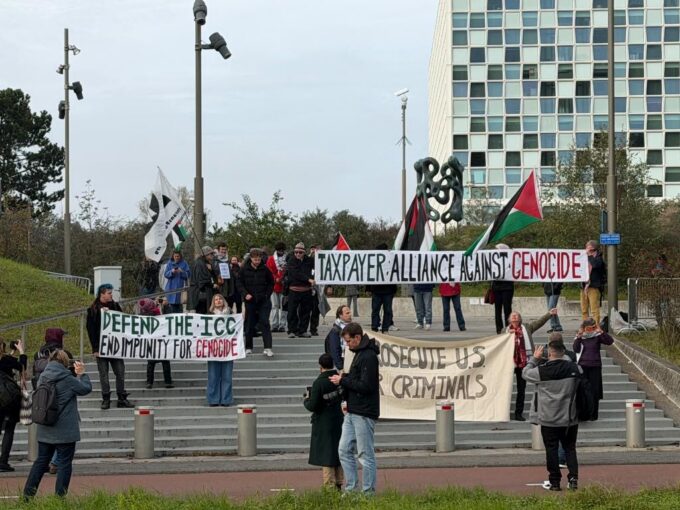
Photograph by Gregory Panzica executive director of PeaceNick.
On the 11th of November 2026 a delegation of U.S. taxpayers and human rights attorneys arrived in The Hague to force the question the empire has spent decades avoiding: whether the officials who arm, fund, and shield a colonial genocide can be treated as criminals rather than partners.
They held a press conference at the Marriott that was broadcast live, then gathered at the International Criminal Court. There they attempted to hand-deliver an Article 15 submission. The Court refused to even welcome representatives of the delegation.
The package—sworn affidavits from doctors who had worked in Gaza, eyewitness accounts, whistleblower testimony, video, and documentation of U.S. political, military, diplomatic, and financial support for Israel’s operations—was submitted electronically instead. Organized by the Taxpayer Alliance Against Genocide (TAAG), the submission calls for an investigation and arrest warrants against President Donald Trump, Secretary of State Marco Rubio, and other senior officials for aiding and abetting genocide, war crimes, and crimes against humanity. More than 500 discrete pieces of evidence were included. Details are available at taxpayeralliance.net and in the evidence submission referenced by partner organizations.
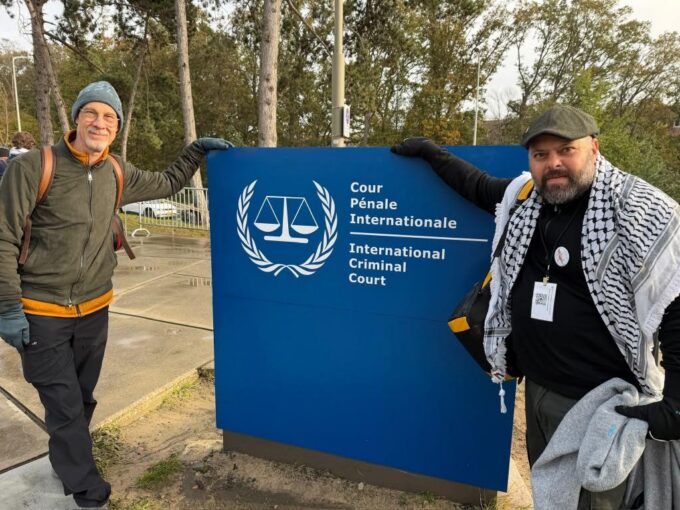
Photograph by Gregory Panzica executive director of PeaceNick.
It followed a federal court victory that protected the group’s First Amendment right to share evidence with the Court after the administration had tried to block such cooperation through sanctions.
The refusal itself was clarifying. There is no rules-based order that extends to those who finance and arm the operations now under examination. International law is not dying of natural causes. It is being dismantled, brick by brick, by the same officials the submission names, while the institution meant to enforce it declines to receive in person the evidence that would test its remaining function.
Outside the ICC the sidewalk was being power washed to remove a healthy green moss growing between the cracks, sterilizing the surface around this seemingly sealed and detached Court. Mohammad Ali, a co-founder of TAAG, noted the green in the cracks and remarked on the contrast with the brown and grey of places like New Jersey.
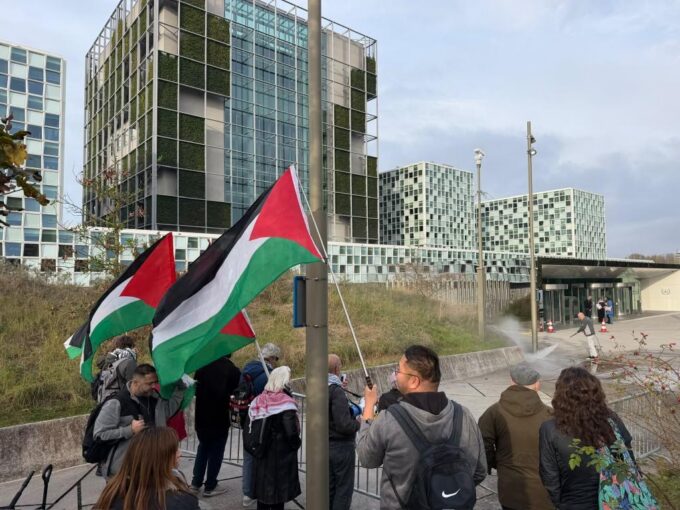
Photograph by Gregory Panzica executive director of PeaceNick.
The metaphor was hard to miss. Sidewalk cleansing as a stand-in for the ethnic cleansing and genocide whose evidence was being delivered just meters away.
Three lawyers prepared the submission. Two of them spoke at the press conference. Curtis Doebbler, appearing remotely, described the evidence as alleging that Trump and Rubio knowingly supplied, released, expedited, and protected weapons transfers after repeated warnings that those weapons were being used to cause mass civilian deaths, destruction, starvation, and displacement.
He noted that they had also directed coercive measures against the Court itself. Maria Kari, joining from Houston, spoke of clients she could not evacuate in time and of the more than 64,000 children killed or injured in Gaza.
The third member of the legal team is Terry Lodge, a Toledo-based attorney known in activist circles as “The Professor.” Lodge has spent more than four decades on the front lines of social and environmental justice work. He has litigated nuclear power and nuclear weapons cases, defended pipeline and mining protesters, helped draft rights-of-nature initiatives including the Lake Erie Bill of Rights, and more recently advised students and veterans on Palestine-related legal questions while drafting communications for Veterans for Peace on U.S. weapons transfers that violate existing statutes.
His participation places the submission in a longer lineage of legal resistance to state and corporate power, a lineage that includes the sustained work of Veterans for Peace, whose members have long insisted that the weapons paid for by U.S. taxpayers not be used to annihilate civilian populations.
Present at the press conference and later at the protest outside the ICC were taxpayers, Palestinians of the diaspora, human rights experts, activists, and ordinary citizens of the Taxpayer Alliance. Palestinian voices carried particular weight.
Among them was Susan Abulhawa, the internationally renowned Palestinian-American novelist whose work has chronicled the long arc of dispossession and survival. Her presence, alongside other Palestinian writers and organizers, gave the room the weight of literary and lived testimony that refuses the erasure of a people.
Annachiara Canetta, Europe Organizer for World Beyond War, spoke as part of the broader network that had helped carry the call for the submission into anti-imperialist and anti-war organizing across Europe. Organizations such as World Beyond War and the Black Alliance for Peace underscored that the demand for accountability was not confined to a single legal filing but belonged to a global refusal of the empire’s selective application of law.
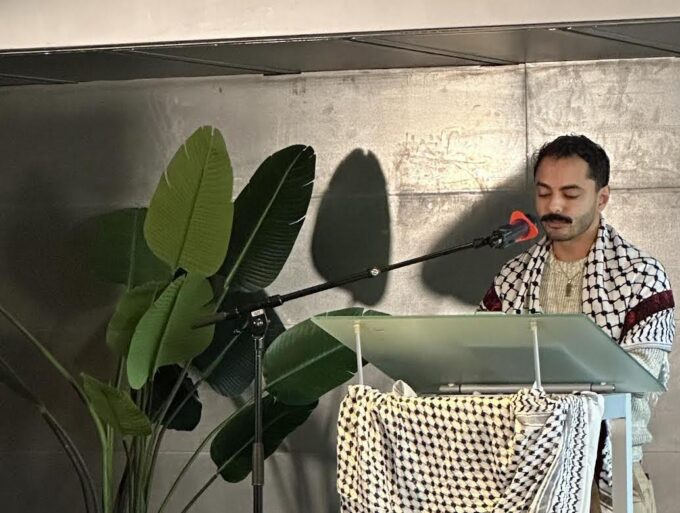
Photograph by Gregory Panzica executive director of PeaceNick.
Tariq Ra’ouf, a Palestinian-American co-founder of TAAG, spoke of the personal cost that had brought him to The Hague. He has lost 49 family members in the genocide in Gaza over the past three years. “We are here today at the Hague in the Netherlands to seek justice for my family,” he said. “I’ve lost 49 family members in the genocide in Gaza so far over the last three years. And we are just a small number of Palestinians that have been brutally murdered by the Israeli regime with the help and complicity of the US administration, both Biden and Trump.”
He described Trump’s attacks on the ICC as “nothing but a brazen attempt by the United States to avoid accountability for its war crimes—not just in Gaza, but abroad, all over the world.” For Ra’ouf the submission was not abstract. It was the demand that the chain of supply and decision that killed his relatives be examined under the law that was written to prevent exactly this.
Mohammad Ali, also a co-founder, joined the testimony as one of the ordinary citizens of the Alliance who had organized the effort. His observation of the moss being powerwashed outside the Court grounded the day’s symbolism in the physical act of sterilization around an institution that had refused to open its doors.
Other Palestinian voices in the room and on the livestream amplified the same demand: that the officials who provided the weapons, the diplomatic cover, and the financial means be named and investigated. Among the legal voices was Huwaida Arraf, the Palestinian-American human rights attorney and co-founder of the Freedom Flotilla Coalition, along with Lamis Deek, Director of Legal and Diplomatic Affairs for the Palestinian Assembly for Liberation Law Commission. The long documentation work of organizations such as Al-Haq, whose years of recording occupation and genocide have supplied the evidentiary foundation for submissions of this kind, made clear that the legal work was not being done solely from a distance.
The moment carried the heaviness of what was still unfolding on the ground. While the delegation stood in The Hague, heavy rains had flooded tents and makeshift shelters across Gaza, pushing a population already driven beyond imaginable extremes further into open air and sewage.
Families who had survived bombardment, forced displacement, and engineered starvation now faced the additional violence of weather on a landscape deliberately stripped of drainage, shelter, and infrastructure. The flooding was not a natural disaster. It was the predictable result of a campaign that has reduced an entire territory to rubble and then left its people exposed. That exposure sat in the same evidentiary record the delegation delivered.
The whistleblower testimony remains central. David McIntosh, a former manager at the Gaza Humanitarian Foundation (GHF), spoke at the press conference and is named among the expert witnesses.
Contractors who worked at the GHF sites have described Israeli forces and private security personnel firing on crowds of Palestinians who had walked for hours to collect food. Between May and October 2025 more than 2,600 Palestinians were killed and more than 19,000 wounded at or near the distribution sites and related convoys, according to Gaza’s Health Ministry.
Médecins Sans Frontières documented GHF sites as places of “orchestrated killing.” One contractor recounted a boy shot dead moments after receiving scraps of aid. The sites were not humanitarian distribution points. They were designed so that starving people would concentrate in range of Israeli guns. The submission places that design, and the U.S. political and financial support that made it possible, before the Prosecutor.
The same package sits alongside the evidence already in the public record of direct and intentional targeting of civilians. The 2026 documentary NAZA presents testimony from Israeli soldiers on the use of AI systems in targeting and the calculation of expected civilian deaths in advance of strikes. The film makes clear that the mass killing of civilians was not a tragic byproduct of a war against Hamas. It was a calculated policy. Netanyahu has demanded a criminal investigation of the soldiers who spoke. The testimony they gave is the kind of material the Court is being asked to examine.
The so-called ceasefire and the Board of Peace have not interrupted the supply of the weapons used in that policy. Trump’s Board of Peace, established as part of the October 2025 arrangement and later expanded, has been presented as the framework for reconstruction and governance. In practice it has functioned as cover.
While the Board met and issued statements, U.S. arms transfers continued. In September 2026 the Trump administration moved forward with a $2.8 billion package that includes 40,000 2,000-pound bombs—20,000 MK-84s and 20,000 BLU-117s—along with additional penetrator warheads. The submission details Trump personally authorizing the release of approximately 1,800 previously withheld MK-84s.
These are the munitions capable of leveling multi-story buildings and creating craters fifty feet deep. They had been paused under Biden amid concerns about mass civilian casualties; Trump restored the flow and has now expanded it. The Board of Peace has not conditioned its existence on an end to their use.
The body that was marketed as a path out of the war has instead accompanied the continued delivery of the instruments of it. Going forward it should be more accurately called the Board of Genocide.
Seth Donnelly opened the press conference by stating that the U.S. court system had proven incapable of addressing the crime and that the ICC was the court of last resort capable of prosecuting officials under the Nuremberg principles. He noted that the submission meets the legal threshold for warrants and called for the Prosecutor also to act on the earlier material submitted by DAWN against Biden and Blinken.
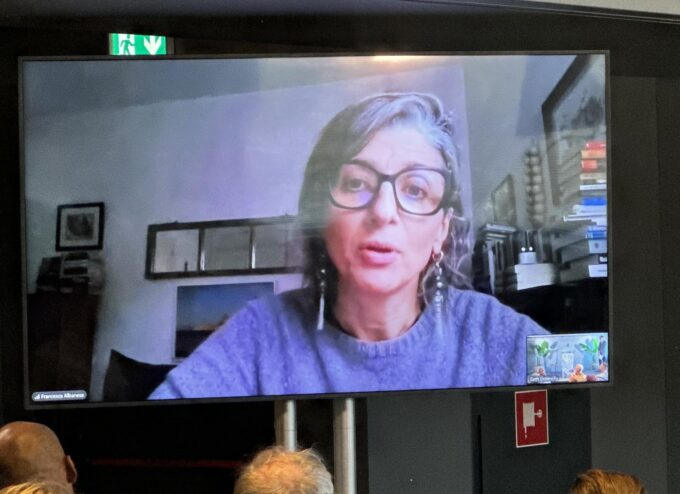
Photograph by Gregory Panzica executive director of PeaceNick.
Francesca Albanese, joining by video, called the submission a crucial step because the genocide would not have been possible without U.S. support. “International law remains the last peaceful instrument we possess to confront injustice and pave the way forward,” she said. “The legal tools are there. They are not the only ones but they are peaceful tools and what is missing is the political courage to use them. That political courage is the one that the taxpayer alliance against genocide is showing. And this is why today’s gathering matters. Today Palestine is the litmus test of international justice of what it means or what it stands for and what it can achieve for the people of Palestine and beyond.”
Lawyers on the team answered questions from the Associated Press and Reuters. Tariq Ra’ouf, Mohammad Ali, and Souzan, among others from the TAAG co-founders and the broader delegation, spoke as well.
Outside the ICC building a protest organized with Global Sumud Flotilla Nederland carried Palestinian flags and banners demanding an end to the genocide and to impunity. The Flotilla’s presence was strong and visible. The demonstration was orderly.
Its demand was the same as the one made inside the Marriott: that the Prosecutor act on the evidence just submitted electronically, and that the Netherlands and the European Union protect the Court from the sanctions that have already targeted its officials and chilled cooperation.
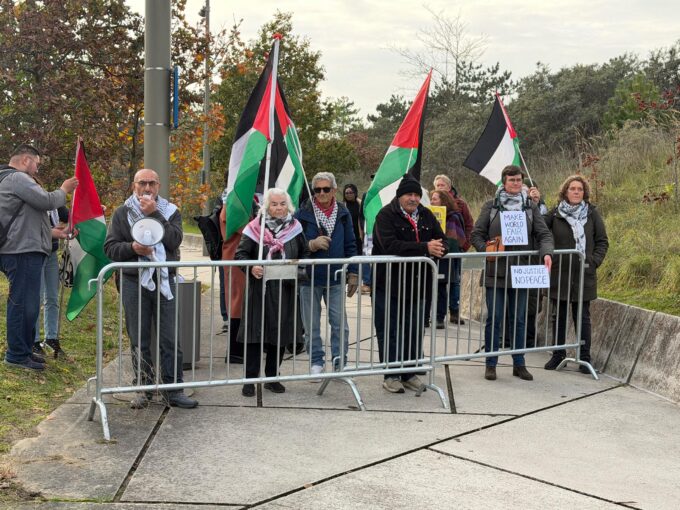
Photograph by Gregory Panzica executive director of PeaceNick.
The submission does not end the operations. It records, in the language of international law, the specific role of senior U.S. officials in enabling them. Whistleblower accounts of the GHF sites, the soldiers’ descriptions in NAZA of calculated civilian death, the continued transfer of 2,000-pound bombs under the cover of a Board of Genocide, the medical affidavits of what those weapons produced, and the personal testimony of Palestinians who have lost dozens of relatives now sit with the Office of the Prosecutor. The full submission and further information are available at taxpayeralliance.net.
The Court has already issued warrants for Israeli officials. The evidence delivered on the 11th of November asks it to examine the chain of supply and decision that has kept those operations running. National systems in Washington have refused. The taxpayers, the Palestinians of the diaspora, the human rights experts, the ordinary citizens of the Taxpayer Alliance, and the broader networks of World Beyond War, the Black Alliance for Peace, and Veterans for Peace who traveled or stood with them in The Hague are insisting that the option of selective application no longer exists.
This is a historic action. Ordinary citizens and the people most directly targeted by the violence have placed the highest officials of their own government before the court created to prosecute the gravest crimes when national systems refuse to act. The submission against Trump, Rubio, and other senior officials now sits alongside the earlier evidence delivered by DAWN against Biden, Blinken, and members of the previous administration. There is no rules-based order that protects any of them—the officials who authorized the weapons across both administrations—from the record of what they financed. There is only the evidence that has been assembled and the demand that the Prosecutor read it. The Court was built for this. The question is whether it will act, or whether it will continue to let the empire decide which crimes are visible and punishable.
A special thanks to CounterPunch for helping me attend this historic event.


