
Photo by Ricardo Gomez Angel
“A satirist,” wrote John Dos Passos, “is a man whose flesh creeps so at the ugly and the savage and the incongruous aspects of society that he has to express them as brutally and nakedly as possible to get relief.” The satirist he was writing about was George Grosz, a German who staunchly opposed war, exploitation, and Nazism. Grosz was harassed by the Nazis and fled to the United States before they finally took full totalitarian control of Germany.
Grosz has many similarities with Palestinian cartoonist Mohammad Sabaaneh, the creator of Welcome to Hell: From the West Bank to Gaza, published this year by Street Noise. Both have been the subject of official repression, Grosz by the Nazis, Sabaaneh by the state of Israel. Both are highly moral satirists. They do not take the pose of the aloof, disinterested critic. They feel anger, fear, sadness, and love and will not rest until readers feel as they do.
Welcome to Hell is Sabaaneh’s third book since the Gaza genocide began in 2023. It focuses on the treatment of Palestinian prisoners held in Israeli military detention. It is a subject the artist is intimately familiar with. In 2013, he was detained for five months in an Israeli military prison over specious charges of terrorism. The ordeal was recounted in the artist’s acclaimed 2022 book Power Born of Dreams: My Story is Palestine. Instead of telling his own story, Sabaaneh relates the tribulations of his brother, Thamer, and another prisoner after October 7, 2023. 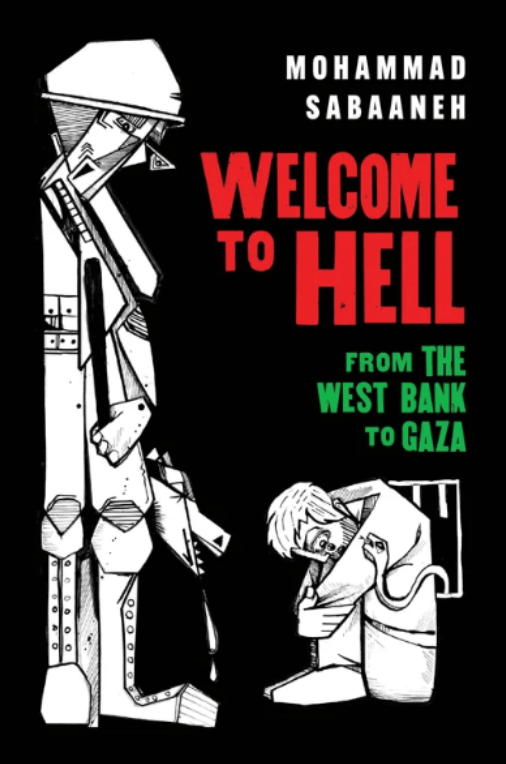
Sabaaneh makes it clear that the deplorable treatment of prisoners is no aberration from general Israeli policy. In his text introduction he states the routine violations of the human rights of those incarcerated are not “an anomaly but a continuation of settler-colonial logic—eliminating resistance by breaking bodies and spirits.” He draws a connection between the prisoners and victims of the genocide in Gaza, cross-cutting between the belongings of prisoners in bags and the belongings of refugees in similar bags. Sabbaneh describes the occupation as a “greater prison” that all Palestinians reside in. Their situations are similar, and generate a similar level of outrage.
The artist makes wise use of negative space. His panels are centered and framed in black or white, depending on whether the scene takes place inside or outside the prison. In either case, the effect creates an oppressive feeling. The scenes outside the prison are brighter, yes, but they are still claustrophobic. Sabaaneh puts only a few panels on each page, giving each image its own power.
One reviewer for comics website Slings and Arrows faulted this decision, saying it “doesn’t serve events well” to surround the drawings with these borders, and in fact diminishes their power. Yet Sabaaneh is making a salient point. By confining his panels in such a way, readers are never allowed to forget the prisoners’ status as existing within a wider prison, namely the Israeli occupation.
Surrealistic images abound in Welcome to Hell, something this work has in common with Power Born of Dreams. When I interviewed the artist two years ago, he asked me “After watching real news about Palestine do you think realistic illustrations and cartoons can reflect the truth?” Sabaaneh draws prisoners as melting candles, a tree shorn of branches, and being squeezed through an enormous hourglass.
To illustrate the repeated beatings suffered by prisoners, Sabaaneh draws a clock face with its hands replaced by truncheons. One guard proclaims, “We’ll beat you until you choose death.” Jets and tanks loom like the terror birds of prehistory. If weapons of war are made lifelike, the people are made to seem other than human. Prisoners resemble dolls, almost too fragile to withstand their daily torments. Prison guards display grotesquely huge jaws filled with serrated teeth. One prisoner remarks that a dog shows more humanity than the monstrous jailers.
Since the genocide in Gaza began, Sabaaneh has been pilloried by the pro-Israel media for his work. Publications in the UK tut-tutted over public funding allocated for an art festival he appeared at. Just as with these attempts to silence him via imprisonment and harassment, these have proven unsuccessful. Comics and the cause of Palestine are fortunate that they haven’t.


