
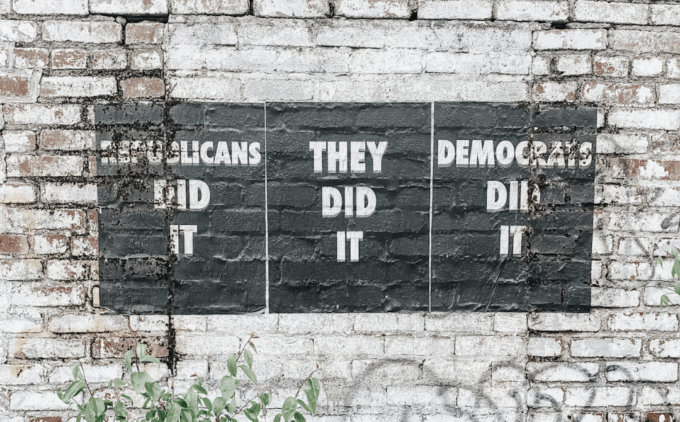
Photo by Derick McKinney
Life is an appreciation game. I’ll turn 65 next month, and the last two weeks have felt like the most gratifying weeks of my political life. They’ve also felt like the quietest. I’ve attended no rally, no victory party, no protest. I watched the news on TV or the small screen in my hand — not in the flesh, on location, or in a street. I have felt grateful, excited, and exasperated, too. Grateful to the voters and the workers, and the people for whom the cruelty and corruption was just too old, and way too much; exasperated by the pundits who’ve talked about a “miracle” in the South. Exasperated, also, by the DC Democrats who simply lie about the past. And excited by the places that are at last deemed “fit” for monied media to visit.
I’ve also been sobered by memories of “breakthrough moments” in the past which Democratic elites managed to mess up.
Twenty years ago, I wrote about some of those in a book, Blue Grit, published in 2007 by Penguin Press. It should have been called “What’s the Matter With Democrats.” The book was all about the things that democratically-minded people were doing well that the capital D Democratic Party was failing at. One of those things was “mobbing up” to defend the vote, and connecting with passionate voters in passed-over places that the party, in all its expensively bought wisdom, had written off.
For a chapter about vote-suppression and the DNC’s failure to take even basic care of its own voters after the defeat of John Kerry in 2004, I wrote that when it came to party investment and infrastructure “nowhere was the situation worse than in the Deep South.” Howard Dean, then chair of the DNC, was trying to do something to address that problem with his “Fifty States Project” which leaders like Chuck Schumer and Rahm Emanuel hated. Dean, like Jesse Jackson before him, was treated as a threat. Donna Brazile put it plainly. Speaking about power and money and the Democratic Party, she told me, “we have a lot of resources; we just don’t share it.”
Mississippi at the time had just one full-time staff person, a man called Keelan Sanders who served eighty-two counties with twenty-five hundred precincts with virtually no budget and no staff.
I am excerpting from Blue Grit here, not (really) to say “I told you so”, but rather to appreciate those who’ve brought us this far, and to remind myself (and you), that the DNC’s managed to squander wins before. This time, will they do different?
“I arrived in Jackson on August 30, 2006. Opening the door of the Mississippi Democratic Party office was Rita Royals, a fifty-seven-year-old white woman and former rape crisis counselor who became so frustrated with the sleepy state of her local party that a few years back she pulled together her own independent club of prochoice, antiwar progressives (“sixty-five of my friends who weren’t afraid to say they were Democrats”).
“When I first came through the door,” Royals tells me, she looked around, saw Keelan Sanders all alone in the office, and wondered where everybody else was. In 2004 the DNC invested so little in this state that Royals paid out of her own pocket to print John Kerry signs. Today she is back on a crisis hotline of sorts. One of Dean’s new hires, she spends her days calling Democratic county chairs who haven’t heard from anyone from the head office in years, let alone someone who is asking them to get to work. Royals shares an office with co–field director DeMiktric Biggs, who has been attending party committee meetings since he was in his sophomore year. “They didn’t really want me,” he says, “but I kept turning up.”
In 2006, a special election was happening in the Delta town of Greenwood, MS. Sheriel Perkins, a three-term city councilwoman, was running to become the first African American and first woman to become mayor. Sheriel and her husband had gone to bed on election night with election officials having certified the count, putting her ahead by two hundred votes. When they woke up, enough absentee ballots had appeared to return the twelve-year incumbent to office by a margin of just six votes. Suspecting fraud but not attributing blame to anyone in particular, the judge called for a new election.
The “new face of Jim Crow,” as Elliot Mincberg of People for the American Way describes it, is voter suppression in the name of fighting fraud: on top of felon disenfranchisement, we’re talking about photo ID requirements, restrictions on voter-registration efforts, and the denial of bilingual ballots under “English-only” laws. In Ohio a statewide survey found four instances of ineligible people voting or attempting to vote in 2002 and 2004 out of close to ten million votes cast. A survey in Washington state following the 2004 election found fewer than one case per 100,000 ballots. The most-often-occurring form of fraud is the sort that cropped up in the Greenwood mayoral race involving mailed-in absentee ballots. Voter-identification laws don’t stop that. Nonetheless, states around the nation have passed stringent ID rules. While it’s not unreasonable to request some proof of identity when voters register, Georgia passed a rule that required voters who didn’t have a driver’s license to buy a voter ID card. When the law went into effect, there was no office in the entire city of Atlanta that sold the card. A federal judge finally struck the rule down, calling it a virtual poll tax on the 300,000 people who needed the card—disproportionately old people and African Americans.
It took outside-the-party activists to force the problems facing their voters onto the Democratic Party’s radar, even though ignoring vote suppression would seem to make no sense. As one observer of the party in Washington told me, “Maybe you don’t hear about the bad things happening when you win . . . Maybe they’re happening, but you get the result that you want, so you kind of pay it no mind and move on.”
The DNC’s Voting Rights Institute, started by Donna Brazile after the 2000 debacle, has limped along with little support. (Brazile told me she had to appeal to the full membership to fund it at all. “I didn’t trust I’d get a penny from the leadership.”) In 2006 the DNC set up its own 1-888-DEM-VOTE hotline, but neither Dean nor Brazile nor the institute’s director, Greg Moore, would tell me how much the party has appropriated for the project. In September 2006 Moore (who supports a DNC resolution calling for a move to verified paper voting records by 2008) told me he had a staff of five working with pro bono lawyers in eighteen states. He acknowledged that there was more work ahead. “We’re late, but we get it. It’s going to take years to fix this system.” Now that it has swept the nation, losing not a single seat, many wonder whether the party will ever get around to that work.
In 2006 Democrats picked up blue seats in red states. Dean’s fifty-state plan can claim credit for the role its state party staffers played in places in Arizona, Florida, Indiana, Kentucky, and Kansas that have historically voted Republican. Democratic gains in Congress and among the nation’s governors were matched by a surge in state legislatures, where more than 275 seats and 10 legislative chambers from Iowa to Oregon switched overnight from Republican to Democratic hands. With six new Democratic governors, Democrats became the one-party government in fifteen states—including New Hampshire for the first time since 1874, and Colorado for the first time since 1960. No party has controlled that many states since the Republicans achieved that same number after the 1994 election.
In lots of ways, 2026 feels a bit like 2006. The people I spoke to then — like the much-missed, late Hollis Watkins of Mississippi — looked even further back, to the civil rights years in the South.
Then, the question was, could the party of Dixiecrat segregationists reinvent itself to be the party of minority voters, poor voters, women, immigrants, and the working class? Today, as then, the Democratic Party stands to gain from any effort to register, protect, and represent the most vulnerable voters. But up to now, the party has never taken that direction. One reason is that the power of the old party machine never did pass to the grassroots activists who had forced the party’s transformation in the 1960s. It got bottled up in Washington instead.
Student Nonviolent Coordinating Committee (SNCC) organizer Hollis Watkins, who still lives in Mississippi, remembers believing that if black people registered enough they’d be given a seat at the table. “We wanted to believe it, we believed it, but we were naïve,” he says today. Black Mississippians formed the Mississippi Freedom Democratic Party to challenge the all-white, pro-segregation delegation their state party sent to the Democratic Convention of 1964. LBJ was running for office on his civil rights record; he wasn’t planning on confronting white supremacy within the party itself. The segregationist delegation was seated. Fanny Lou Hamer and the Freedom Democrats were shut out. Four years later, the Mississippi state delegation was integrated, but by then frontline activists like Watkins had lost confidence. The DNC of the 1970s, determined to avoid confrontations on the floor of the convention like those of 1964, or those with the peace movement in 1968 and 1972, changed the rules on nominating presidential candidates so as to reduce the power of state parties and root the selection process in statewide primaries. State party posts became sinecures, and conventions became dreary propaganda affairs, where the deals are worked out in backrooms in advance. Those in the state parties obey their leaders in D.C. or watch their DNC dollars evaporate.
Money, decision-making power, and influence over policy stayed in Washington, the stomping ground of the party patriarchs, lobbyists, intellectuals, and press. Power remained in the suites, not the streets. The party’s weakness in the states didn’t go unnoticed, but every time the Democratic National Committee appeared to be on the verge of launching a massive voter-registration program, it backed off. In the 1980s Jesse Jackson entered the primaries, and campaign contributors who might have been tapped for the DNC voter-registration effort declined to give funds to the party for fear they would end up increasing the Jackson vote…
In the summer of 2006, while stumping for Ned Lamont in Connecticut, the Reverend Jesse Jackson told me that “the destiny of the Democratic Party lies in its ability to welcome new voices, especially poor people, people of color, young people, and immigrants.” It’s not clear just yet how much of the party is committed to that destiny.
Is it clear, yet?
On September 27, 2006, Greenwood, Mississippi, elected a new mayor. Just about all the black voters in town and seventy-six whites voted for Sheriel Perkins, the Delta city’s first woman mayor and first African American. The legislative black caucus came out to support Sheriel and her husband and campaign manager, Willie Perkins, on Election Day, as did the Magnolia Bar Association, but the two carloads of Mississippi Democratic Party staff didn’t return. “We delivered what we promised,” campaign director Parmley told me later. The party provided voting lists, conducted robocalls, and sent out a fund-raising letter for the candidate. “I don’t remember Election Day monitoring ever being a topic of discussion,” he continued. “We knew the local parties were well trained, and the Justice Department was going to be monitoring.” Perkins’s opponent had RNC lawyers at every black precinct. It took two days to count the provisional and absentee ballots, but Perkins won 3,135 to 2,843. Keelan Sanders’s grandmother was a Mississippi Freedom Party delegate to the 1964 convention. When I asked him why he stuck with the Democratic Party so long, solo, he answered, “Because of my grandmother.” Asked about the future, he said, “It’s the changing of the guard.” Well, maybe. Will those who have dragged the Democrats forward finally be permitted a seat at the party? It’s crunch time for Democrats.
Will they? Blue Grit, unfortunately, is out of print, but the activism that inspired it inspires me still, and the reasons for vigilance (and exasperation) abound, even in this energizing moment.
In March, 2025, Laura Flanders & Friends traveled to Selma, Alabama to report on the 60th anniversary of Bloody Sunday. That episode premiered right as the House passed the Safeguard American Voter Eligibility, or SAVE Act that would have made it harder for millions of Americans to vote. That bill failed in the Senate, but in the Callais decision last April, the Supreme Court decision made it even easier for states to redraw maps and disregard the requirements of the 1965 Voting Rights Act. Extraordinary organizers like LaTosha Brown and Cliff Albright co-founders of Black Voters Matter said then that this is a moment “to reset, resist and reimagine.” It still is. It’s up to all of us to stop history from repeating itself.
Quotes are from Laura Flanders, Blue Grit: Making Impossible, Improbable, and Inspirational Political Change in America.


