
Photo by Andy Feliciotti
Washington D.C. has never been one of my cities. I am drawn more to New York, where I was born, but I do take pleasure in visiting Washington, at least for the first day or two. After that, I am reminded of Abraham Lincoln’s description of the White House as a “second-rate hotel”.
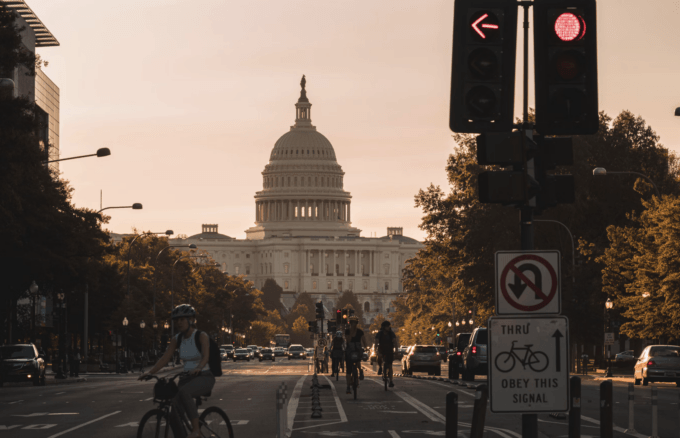
On a recent trip to Washington, I decided to try something different and dragged along my bicycle on an Amtrak Northeast Regional from New York’s Pennsylvania Station. The weather forecast was good, and I wondered if the capital’s broad boulevards might lend themselves to bicycle excursions.
At the very least, I could poke around, on my own terms, Trump’s gilded empire.
+++
The Moynihan Train Hall is the given name of the new waiting room for Pennsylvania Station, that which was largely torn down between 1963-66—an act of urban vandalism on par with Donald Trump’s destruction of the East Wing of White House. (Both offer a vision of America held hostage by real estate developers.)
The Moynihan Hall was carved out of the James A. Farley Post Office across the street from Penn Station. As with so many Amtrak stations, there’s a disconnect between the train platforms (closer to Seventh Avenue) and the new waiting space (mind you, for their $1 billion investment New Yorkers got almost no places to sit) between Eighth and Ninth Avenues. With Amtrak, it’s the political public relations (not the trains) that count.
+++
Union Station Washington is another railroad Potemkin village. It has a soaring granite rotunda inside the entrance, but the actual train work takes place out the back on shabby staircases and platforms unchanged since the early 1970s.
President Richard Nixon tried to enlist the station as part of his 1973 coronation (that which followed the Watergate shenanigans of the 1972 election), but, as with his presidency, it fell afoul of leaks—those from the roof, not to the Washington Post.
+++
It was a short bike ride in summer-like sunshine to the Capitol, which looks less like the American agora and more like a Crusader fortress surrounded by keeps, gatehouses, fencing, and drawbridges—everything but a moat and the noose that was measured for Vice President Pence.
To my amazement, the DC police allowed me to ride my bicycle around the empty plaza under the East portico, from which some of the January 6th attackers stormed the Capitol.
I was alone on the plaza. I think I could have done a few wheelies and no one would have cared. Instead, I biked over to a DC policeman and asked him if he was present on January 6th—that Trumpian “day of love” in which about 150 DC police were wounded and seven died of their injuries (some by later suicide).
The cop I was chatting with said, “I wouldn’t know anything about that,” which ought to line him up for a cabinet post.
+++
I biked a loop around the Supreme Court, a columned Greek temple opposite the Capitol. From 1789 until 1935, the Court was more of an idea than a place, and it met in New York, Philadelphia, and spare rooms around the Capitol. Nor were the justices (the number varied from 5 to 10, and was only fixed at 9 in 1869) considered an equal branch of government.
It was the judiciary as a whole, including all those rural judges who rode circuits, who were part of the third branch of government—mandated by Chief Justice John Marshall in the early 19th century to check Congress when it exceeded the bounds of the Constitution.
Now, a majority of Supreme Court justices are little more than in-house counsel for the Trump Organization, and in their black robes closer to vaudeville than constitutional justice.
+++
On my way to the Reflecting Pool, I wove along the Mall and admired the many buildings of the Smithsonian Institution. Normally, I would have locked my bicycle and gone into the National Museum of American History, but Trump has marked it down for revisionism and an agitation propaganda facelift, so I kept pedaling.
Better to recall a few lines from Dave Barry’s delightful Dave Barry Slept Here, in which he writes: “The Democrats seem to be basically nicer people, but they have demonstrated time and again that they have the management skills of celery.”
+++
Closer to the Lincoln Memorial—Abe on High (he would be appalled and tell jokes about it)—I found the Vietnam Veterans Memorial, with its engraved names of 58,318 war dead.
Personally, I think it’s best memorial in Washington, somber black granite embedded into the Mall landscape and the war reduced to the sufferings of 58,318 families—although a second memorial is needed for the 94,497 Vietnam War veterans who committed suicide between 1975 and 2019.
Since I last saw Maya Lin’s monument (she was a 21-year-old Yale student when she won the competition to design the memorial), I have written a history of the Vietnam War and gone five times to the battlefields of Indochina, beginning at Bien Bien Phu and ending up on the rooftops of Saigon.
On the ground in Asia and in the war’s literature (including the stories of CounterPunch contributor Marc Levy), the Vietnam War is more horrifying than even these engraved names can convey.
In the Vietnam War, everything and everyone failed—from the politicians who sent us there to the military brass that dropped Agent Orange.
In Winners and Losers, a great book about the toll that the war took on American soldiers, ex-New York Times correspondent Gloria Emerson quotes from one of the veterans she met in her odyssey to the underworld of veteran despair. He said to her: “I went down—America went down—we all went together.”
+++
The only thing reflecting in the miasma of the Lincoln Memorial Reflecting Pool is Donald Trump’s insanity, and his reduction of political discourse to The Endless Big Lie. (“…we’ve had some real problems with Vandalism at the beautiful Reflecting Pool, which sits between The Washington Monument and The Lincoln Memorial…)”
I could not get to the water of this particular Narcissus pond, as the National Park Service (clearly upon instruction from his majesty’s secret services) has erected fencing along the edges.
I did stand at the headwaters and look down at the mud flats (not exactly the Vegas nymph fountain Trump promised us) and wondered how CSI: Reflecting Pool will be able to film its forthcoming series. (“In Episode 3, the President, in the company of his “wrestling-buddy tiger”, steals away at midnight from the White House to subdue an Antifa gang armed with boxcutters…”)
+++
From the Mall, I rode along a bicycle path that led me toward Arlington National Cemetery, where I wanted to visit the graves of various family friends who died during or after World War II in the Pacific.
Arlington (once the private plantation of Confederate General Robert E. Lee) was a short ride from the Lincoln Memorial, but at the Memorial Circle roundabout I came across a protest rally against the proposed Arc de Trump, which symbolically would turn Arlington Cemetery into a Trump gated community.
Trump has already altered the entrance to Arlington Cemetery by re-gilding some of the classical monuments (at a cost of $5.1 million) on the Arlington bridge, making the statues to “Valor” and “Sacrifice” look like extras in a Bellagio floor show.
I sat down on one of the rocking chairs (they are symbols of this particular protest) set up in the shade of a nearby tree, and listened while war veterans, members of Congress, and ordinary citizens denounced the criminality of using public funding to erect a 250-foot-high monument to the bone-spurred draft dodger who described sexually transmitted diseases in the 1960s as “my personal Vietnam.”
+++
I lost the thread of the bike paths from Arlington to the Kennedy Center. I am sure somewhere there is a segregated lane, but I ended up on the fringes of Rock Creek Parkway until I could bail into a parking lot.
I knew the story, as you do, about how in December 2025 the lackey board of Trump placemen voted to rename the center the “Donald J. Trump and he John F. Kennedy Memorial Center for the Performing Arts,” and then about how, more recently, all the king’s architects had defaced the building façade by nailing up the words “The Donald J. Trump and…” on the line above the lettering for President Kennedy and the Center.
I had not seen the scaffolding that the vainglorious Trump had ordered remain in place so that the public could not see the result of a judge’s order—that Trump’s name be removed from the building and the organization.
Then in high dudgeon, Trump ruminated about tearing down the Center, much as he took the wrecking ball to the East Wing of White House.
+++
Only two sleepy mall cops were on duty in front of the Kennedy Center, which has been shuttered for months as both performers and audiences voted with their feet and stayed away.
Still, in front of the center were remnants of the protesters who had gathered in the dead of night to cheer the removal of Trump’s name from the façade.
I spoke with some of them, and in animated tones they repeated all the stories of Trump packing the board with yes-men and women, and of his many exaggerations that the Center is falling down, and one told me how at a cut-rate price Trump (as the Center’s chairman!) rented the hall to the Conservative Political Action Conference (CPAC) to hold one of its jamborees.
Who wants to hear Madame Butterfly or Sir Paul McCartney when you can attend a CPAC Christian Persecution Summit.
+++
It made sense to finish my own tour at the White House. To get there, I picked up a bike lane that headed east through the campus of George Washington University and past the State Department, where I wondered about Little Marco’s Trumpist contortions. (In 2016, he called Trump a “con artist.”)
The problem with biking in Washington turned out to be that often the bike lanes, so to speak, ran out of gas, which left me having to navigate the wrong way on a one-way street. But even when I was riding on the sidewalk through more construction, it was easy going.
As I drew close to 1600 Pennsylvania Avenue, what became most evident was the extent to which Trump has turned the White House complex into something between a job site and an armed camp.
In BTT (Before Trump Time), it was possible to stroll in front of the White House or sit and have lunch in Lafayette Square, but those avenues are now largely fenced off with concrete barriers (what you would expect in front of a Beirut embassy).
+++
In Lafayette Square (where in his first term Trump deployed a military escort so that he could wave an upside-down Bible in the direction of the Andrew Jackson statue), I got as close as I could to the White House but still had to view it through the prism of construction screening (clearly the administration’s gilding of choice, other than casino gold embroidery.
I could see cranes on the skyline over what was once the East Wing (soon to be The President Donald J. Trump Ballroom, Bomb Shelter, Drone Launching Pad and Resort Casino), but the construction itself is obscured (just as is the funding of the illegal project).
+++
From the Treasury or the Mall I thought maybe I could see more, but all that bought me was gentle harassment from a squad of Secret Service agents wearing black jump suits and mounted on eBikes. I did, however, get a good look at the Milken Center for Advancing the American Dream.
In case you’ve forgotten, in the 1980s junk bond trader Michael Milken’s dream was to engage in securities fraud for which he was sentenced to ten years in federal prison.
No doubt his center next to Trump’s pending Reich Chancellery will provide comfort to all those Trump Gauleiters who are now in line to take the fall for the president’s insider trading (diplomacy as a variation on a protection racket).
Otherwise, the only other good news from Washington is that Trump is reviled locally and confined to live in isolation amidst his own Washington job site—the Miss Havisham of American politics.


