
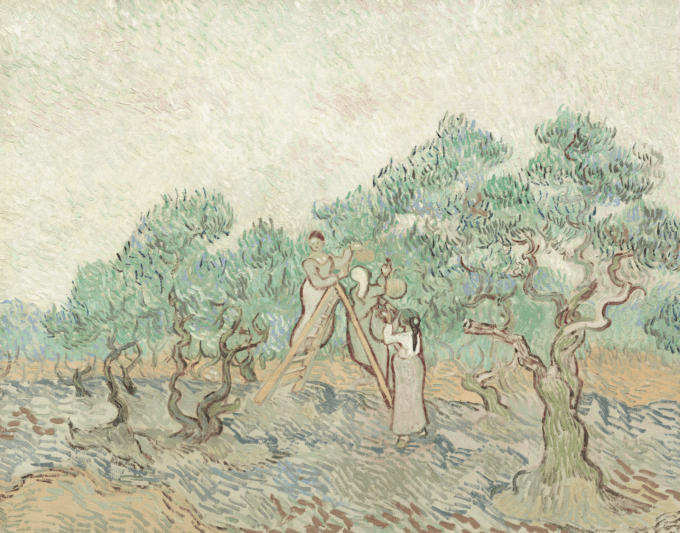
Photo by National Gallery of Art
The olive harvest has opened under fire. On October 7, 2026, armed colonizers killed 44-year-old Ali Hassan Yusor al-Bazzari while he was picking on his land near Burqa. The Palestinian health ministry named him. The Israeli Occupying Forces said both soldiers and the colonizers had opened fire, and left the distinction where the occupation has always left it: nowhere. That week the Palestinian Colonization and Wall Resistance Commission logged nineteen attacks in a single Friday. Groves burned. Trees ripped from ancestral soil. Crops stolen. Farmers beaten in Tal, Qusra, Jorish, Beita, Naqoura, Birzeit, Deir Bzeih, and Farata. More than fifty olive trees pulled out of Qusra alone. Near Yabroud a man was blocked on the road and beaten until he ran. The Central Command of the Occupying Forces announced that it had prepared for the harvest, then called the problem friction between two populations, with the added insult that Palestinians might commit “terrorist attacks” under the cover of picking their own fruit. The fruit is not the cover. The harvest is the claim to the land. The army that arrives to “separate the sides,” and then drives the Palestinians off, is not a referee. It is the second shift of the same campaign.
This year’s harvest is not an aberration. It is the harvest of an ethnic cleansing, and it is the third year in a row that the numbers have set a record. The United Nations has recorded more than 1,600 attacks by colonizers against Palestinians so far in 2026, an average of 6.7 a day, hitting 275 communities. Over two dozen Palestinians have been killed and more than a thousand wounded in the attacks. Between January 2023 and April 2026 more than 6,400 people, nearly half of them children, were driven from 130 communities. Forty-eight communities have been emptied. The Palestinian Authority counts at least thirty Palestinians killed by colonizers this year, and more than 45,000 trees cut or damaged in the first half of the year, more than 26,000 of them olive trees. The olive tree is the rootedness of Palestinians to their land. Families have tended the same trees on the same soil for generations. To burn them, uproot them, or steal the crop is to try to sever that root. The numbers are not a trend. They are the method.
On October 8, Democracy for the Arab World Now and the American-Arab Anti-Discrimination Committee published the demand that Washington stop paying for it. Their letter to Secretary of State Marco Rubio and Attorney General Todd Blanche includes a list of Americans the United States has declined to protect. Samed Khdair, 56, a Mississippi businessman, was stopped near al-Mughayyir on September 4 by about twenty armed colonizers. They used pepper spray, rocks, clubs, and pistols. They stole his passport, spat on it, took his phone and his car. Soldiers of the Occupying Forces watched. When people tried to help, the soldiers fired tear gas. The ambulance was attacked. Khdair was left with stitches and eye damage that may be permanent. His brother could barely breathe. The State Department offered him a replacement travel document and a phone call. His interview was set to air on 60 Minutes. The government that issues the passport has not issued a charge. He is not the first.
Sayfollah Musallet, 20, of Tampa, was beaten to death in Sinjil on July 11, 2025. Colonizers blocked the ambulance for hours. Khamis Ayyad, 41, of Chicago, died of smoke in an arson attack in Silwad on July 31, 2025. Nasrallah Abu Siyam, 19, of Philadelphia, was shot and beaten in Mukhmas on February 18, 2026, while soldiers stood by. Nine U.S. citizens have been killed by Israeli soldiers or colonizers since 2022. None of the cases has produced an indictment that stuck.
The siege of Loai Ridi is the method written on one house. Ridi, 46, a Palestinian American who has lived in Toledo, Ohio, for more than two decades, has been building on his family’s land in Qusra, south of Nablus, since 2023. Harassment around the house began in January 2026. In March his brother Qusay moved in to hold it, after the family watched a household in nearby Jalud besieged and then forced out, the house taken. On August 9 the pressure became a siege. Colonizers set up tents and an outpost at the entrances, blocked the roads with rocks, cut the water and the electricity. Qusay and his 18-year-old son Ahmad were inside. The United Nations said about fifteen Palestinians, including two children, were trapped in the affected homes. Ridi flew back. The Occupying Forces declared the area a closed military zone, filmed themselves with the men doing the besieging, and told the American citizen he could not walk on his own land while the colonizers moved freely around the house. In September he told RFI the siege had not lifted: no one could enter or leave without army coordination that took three or four days, and he could still see the colonizers at night, a few hundred meters from the door. Soldiers were filmed praying with the colonizers outside the houses. The army promised discipline. The men stayed. The embassy said it was monitoring. In Jalud the same sequence had already ended with the family gone and the house taken. Qusra is the version that has not yet finished.
Qusra is not an exception. The West Bank is under a rolling siege. As of December 2025 the UN Office for the Coordination of Humanitarian Affairs counted 925 checkpoints and obstacles restricting the movement of some 3.4 million Palestinians, the highest number in twenty years and 43 percent above the average of the two decades before. A UN expert warned in October that the system steals hours and days, separates families, keeps students from school and workers from wages, and blocks ambulances. In July a four-month-old, Ahmed Zaid, died after soldiers held his family at a checkpoint for more than an hour while an ambulance waited on the other side. In the northern Jordan Valley the military is cutting a barrier it calls Crimson Thread through Palestinian land, trenches and patrol roads, and has sealed Ras al-Ahmar: water cut, livestock dying, fifty-one children kept from school for two weeks, milk carried out at night on donkeys.
Over Sukkot the Occupying Forces closed Palestinian movement into large parts of the West Bank and deployed about twenty-four battalions, more than double the peacetime number. The Oslo maps, the Areas A, B, and C, the agreements that were supposed to govern who may move and who may build, are being completely disregarded. The International Court of Justice, in July 2024, found that Israeli policies had fragmented the West Bank, severed East Jerusalem from it, and encircled Palestinian communities in enclaves, obstructing the right of self-determination. The Fourth Geneva Convention forbids the transfer of the occupier’s population into occupied territory and forbids the forced transfer of the protected population out of it. Both are underway. The law is on the books. The occupation does not consult it, and the international community does nothing to enforce it.
DAWN and ADC asked the FBI to investigate the attacks on Americans, the State Department to bar the Israeli units facilitating the violence from U.S. assistance under the Leahy Law, and the president to reinstate the sanctions on the enablers that the last administration let lapse. Omar Shakir, DAWN’s executive director, put the point without mincing words. When a foreign state-backed militia attacks an American and nothing follows, the message is that the alliance is worth more than the citizen. The United States bankrolls the army that stands by, and arms the men the army stands beside. The complicity is not a mood. It is a line item.
The Israeli government does not pretend these men are civilians in any ordinary sense. Since October 2023 it has issued more than 165,000 gun licenses. It called some 5,500 colonizers into West Bank “regional defense” reserve battalions. About 7,000 armed colonizers have served in those units. Roughly 8,000 U.S.-made firearms went to them. Civilian “rapid response squads” were given uniforms, weapons, and policing powers. Itamar Ben-Gvir’s ministry ended administrative detention for colonizers in November 2024. Yesh Din’s figures show that 93.6 percent of investigations into attacks on Palestinians between 2005 and 2025 were closed without an indictment. Police enforcement against nationalist crime directed at Palestinians has fallen 73 percent since 2023. A Palestinian who wants to file a complaint must often do it inside a colonial outpost, wait for an escort, and hope for an investigator who speaks Arabic. The procedure is the impunity. The Occupying Forces are not failing to stop the violence. They are the conduit that carries it: escort, cover, closed military zone, tear gas for the people who try to help, and a uniform that makes the mob look like a unit.
B’Tselem has called it state violence. Human Rights Watch, in August, found the government arming, funding, and granting impunity to the men doing the work. A UN Commission of Inquiry concluded in June that the violence functions as a means of implementing Israeli state policy, and that the distinction between colonizer and soldier has collapsed in practice. The International Court of Justice found that Israel’s systematic failure to prevent or punish these attacks violates its obligations as an occupying power. Article 29 of the Fourth Geneva Convention makes the occupier responsible for the treatment of protected persons by its agents. Customary law attributes to the state the conduct of soldiers and reservists, and the conduct of armed civilians whom soldiers direct or escort. The men in the groves are not a militia the state has failed to control. They are a militia the state has armed, uniformed, and deployed against people picking olives on land their families have worked for generations.
The word for them is not settler. Craig Mokhiber, the former director of the New York office of the UN High Commissioner for Human Rights, has said it plainly: Palestine has been settled for millennia. These are not settlers. They are violent Zionist mobs and regime paramilitaries. They do not live in settlements. They live in armed and unlawful colonial outposts. They are not engaged in clashes. They are engaged in lynchings and pogroms. The olive harvest strips the euphemism. The tree is the proof of presence. Destroying it is the attempt to erase the presence. The Occupying Forces that close the grove, escort the mob, and call the result security are the instrument of the cleansing.
Washington has the names, the dates, and the video. It has not applied the Leahy Law to a single Israeli unit, despite a lawsuit filed in December 2024 under the Administrative Procedure Act for that exact failure. It has not treated the killing of its own citizens as a federal crime under 18 U.S.C. §2332. It continues to supply the weapons. Ambassador Mike Huckabee, on September 5, the day after Khdair was beaten, managed a comment on the violence that did not disturb the supply line. A Senate resolution on September 29 failed. The Arms Export Control Act forbids U.S. weapons from being handed to non-state actors for the purpose of committing abuses. The weapons have been handed over. The abuses are on video. The law has not been opened. The lawlessness is not a failure of Israeli discipline. It is the discipline. Impunity is the policy. Ethnic cleansing is the campaign. The Occupying Forces are the conduit, and Washington is the paymaster.
The harvest will run into November. The groves that are still standing will be picked under escort, or not picked, or picked and then burned. The communities that have not yet been emptied will lose another house, another well, another night of sleep. The Americans who go back to visit family will be told, if they are lucky, that the embassy is monitoring. The demand from DAWN and ADC is the minimum a government owes its own passport holders, and it is still more than Washington has been willing to do. End the aid that arms the units. Investigate the attacks on citizens. Reinstate the sanctions. The larger fact does not depend on the letter. The West Bank is being taken, tree by tree and house by house, from people on their ancestral land, under a siege the occupation does not bother to disguise and agreements it does not bother to keep, by men the state has armed and the United States has paid for. The olive is not a symbol. It is the crop, the proof, and the target. The harvest is the embodiment of sumud and the Palestinian resistance.


