
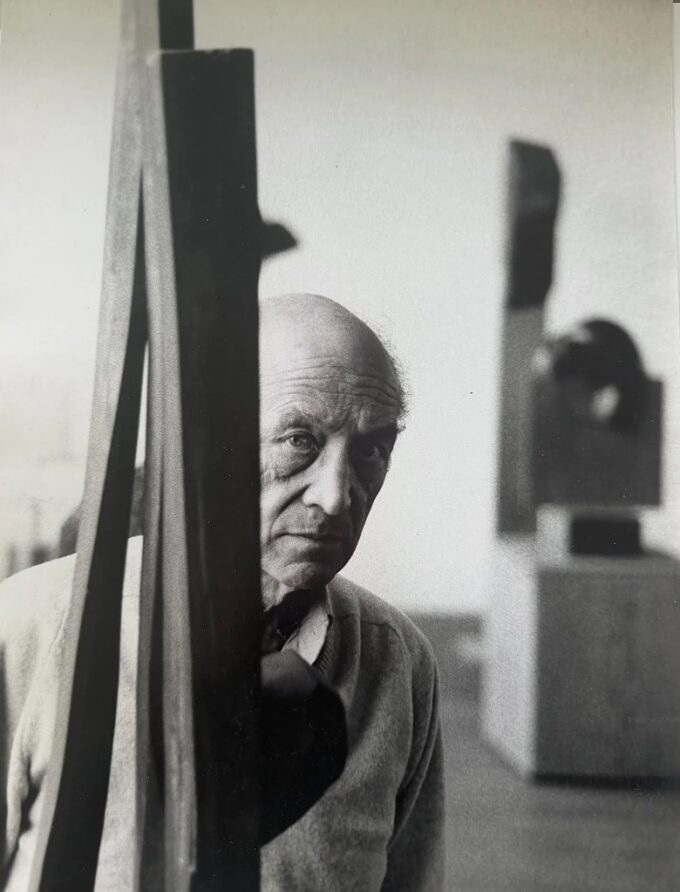
Truthful Fiction
The notes led to chords I hesitantly followed into uncertain territory. I acted as if I knew. The room believed I did. Somewhere in the room, a musician–a guitarist, pianist, or maybe a golden sax player, could be heard tinkering sprightly with unvarnished chords that might have been a prelude to a masterpiece. My mind immediately heard a unique gathering of words, not quite like a shoal of fish or a flight of birds, or a band of monkeys, but unique as they are both heard and seen when I entered the working domain of a legend. I may not have been fully aware of the magnitude of who he was. The words continued to echo throughout the windowed, velodrome-like space but without the steeply banked tracks. Then I saw my breath vanish into black and white celluloid- Tri-X film. I made the pic that mattered to me;In a Silent Way, there was Miles Davis.
The deluge: Artists sometimes create voluminous volumes of work. The scale can be blinding.
Isamu Noguchi was different. He was more like his mentor, Constantin Brâncuși. The hearts and minds of both geniuses appeared married to a true fiction, to Pinocchio’s father, Geppetto. While art for the sake of beauty is admirable, one perceives that these three creators were more alike than history might admit: Like Geppetto, Noguchi and Brâncuși mined their art and craft into a whispering bellow for companionship, an end to loneliness where bliss over time melded into something final. These artists utilized time to push past isolated loneliness, ushering in a repetitive commitment: make the work for today, bind the mind in time. One could almost imagine an involuntary feathery tissue connecting their days to their future work. They communed with time, defined a life entangled with the angst-filled comfort of making art.
The strength of secrets: I never felt that Noguchi walked wth his head in despair; maybe disillusionment. Yet, the first time I met him, he had a stride stacked with profound pride.
The undercurrent of a man is never seen nor heard; it is merely there to be imagined. Recalling meeting Isamu Noguchi always reminds me of watching Spencer Tracy in Bad Day at Black Rock. The entirety of my waking hours seems to be imagining cinema and the stories within, stories and the cinema within.
Noguchi’s days of internment at Poston and Spencer Tracy’s polished grit in Bad Day at Black Rock appear on both sides of me like Promethean Titans-conjoined twins of the mind.
I often feel the desert emptiness and the silhouetted mountains beside me as I juxtapose these two protagonists existing in different environments, cultures and agendas. Yet they are my imagined composites of each other, posing with qualities I envy: to know. The essay could be long and romantic, but that is for another day.
Memory, like imagination, plays tricks on our histories. Noguchi was very social and never appeared to be lonely. His work was his identity. He was someone who owned extraordinary. He danced with my camera, not for it. I wanted to ask him about how and why pieces were made this way or that. In hindsight, the mature masters of my memory and art history didn’t like to be questioned too much, but just enough.
I remember seeing a piece that today might seemingly remind me of the Silver White Crescent of the Levant. I can’t explain the why. A piece of design marvel has remained in a closed section of my brain. From time to time, I imagine; I reimagine.
It brings racing fast to the eyes the notion that Noguchi had an idea and envisioned its being even before in reality the notion existed. Yet the eyes perched behind his irises saw ahead as an adult with child’s eyes impregnated with fire, awaiting the crystallized idea in earth’s time.
He was like a famous film star from the silent era. He walked in a hush with the camera detailing his life in steps. We are all equal on the same planet until, just until, someone demonstrates the unexpected, the exceptional. At times, I am reminded of this funny, sexy story about a ménage à trois involving Isamu, a young lady, and someone I know, as told to me by that very person. Isamu Noguchi was certainly no monk. Yet, when the artist performed his limitless goodbye, he turned, and I was alone.


