
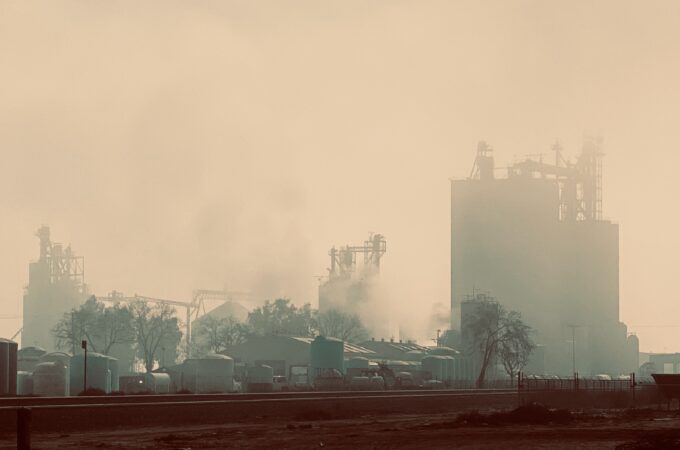
Refinery near Bakersfield, California. Photo: Jeffrey St. Clair.
In arguments before the Supreme Court on Oct. 5, Suncor Energy Inc. made its casethat local governments cannot sue corporations over their ties to climate change because emissions and the resulting pollution are a federal matter. If this feels like serious deja vu, that’s because CEPR has covered other cases like this in the past. So how does this case fit into the pattern of previous lawsuits, and what can we expect?
The current case, Suncor Energy Inc. v. County Commissioners of Boulder County, dates back to 2018, when the city and county of Boulder, Colorado, sued Suncor Energy over its role in climate change. Boulder accused Suncor of knowingly causing and contributing to “the alteration of the climate by producing, promoting, refining, marketing and selling fossil fuels at levels that have caused and continue to cause climate change, while concealing and/or misrepresenting the dangers associated with fossil fuels’ intended use.” The city and county are seeking monetary damages to compensate for past and future costs, which include funding projects to mitigate the impacts of climate-related disasters. These impacts include increasing wildfires, flooding, drought, and infrastructure damage.
The case was heard in Boulder County District Court, but Suncor successfully moved it to federal court, arguing that federal laws governing interstate pollution and the Clean Air Act preempted Boulder’s claims. Essentially, Boulder’s laws cannot extend beyond its borders; the federal government handles that. The federal court, however, remanded the case to the county district court multiple times, rejecting Suncor’s argument and even a motion to dismiss. If that sounds familiar, similar actions occurred in Plaquemines v. Chevron over a 12-year period. In that case, Plaquemines Parish in Louisiana argued that fossil fuel companies in the Gulf violated Louisiana’s State and Local Coastal Resources Management Act of 1978 and that coastal parishes are owed damages, as well as funding for restoration, because the companies’ activities rapidly degraded coastal wetlands. Like that case, Boulder is claiming a direct connection between a company’s actions and destruction at the local level.
In May 2025, the Colorado Supreme Court took up Suncor Energy Inc. v. County Commissioners of Boulder County and again rejected Suncor’s claim that it was a federal, not a state, issue, upholding the lower court’s ruling. That brings us to last week, when the case came before the Supreme Court.
In their arguments before the Supreme Court, Suncor’s lawyers once again claimed interstate air and water pollution falls under federal authority. Suncor also warned that a ruling for Boulder would expose more than 60 pending cases — each seeking billions in damages — to proceed under state tort theories nationwide. On Boulder’s side, lawyers argue that states have long been able to apply tort law when an action harms residents.
We won’t know the Supreme Court’s decision until potentially June 2027, since it releases decisions on a rolling basis throughout the term. Some have noted a potential 4-4 split decision since Justice Samuel Alito recused himself, citing, via an interview, his potential financial stake in the outcome. In that interview, the Justice implied an outcome favorable to Boulder could trigger lawsuits nationwide that directly affect his stock holdings.
So how do previous cases give us insight into where this is all going? Even though Plaquemines v. Chevron was sent back to the lower court on a technicality, it’s worth looking at the case to understand how the Court might decide. Chevron essentially argued that it was a military contractor during World War II, and that the war effort required the parish’s oil fields to increase aviation fuel production.
It’s also worth noting that the Department of Justice (DOJ) has taken a similar stance in a lawsuit the NAACP filed against Elon Musk’s xAI and MZX Tech LLC. The NAACP is arguing that xAI did not receive Clean Air Act permits from the EPA to operate the Colossus Gas Plant in Mississippi. The gas plant powers xAI’s Grok technology, but it has also increased pollution and affected residents of Boxtown, a predominantly Black neighborhood in nearby Memphis, Tennessee. However, the DOJ claims Grok is critical to military operations in Iran, and any measures against the data center are a matter of national security.
The common thread in all these cases is that the federal government favors corporations over the public interest, and the corporations know it. When given a chance, corporations will use this to their advantage. On top of that, the administration is actively working through various executive orders and policy changes to strip local communities of regulatory power, forcing residents to endure the environmental fallout of corporate pollution. But the upcoming election could affect federal complicity. Congress can pass or amend laws that strengthen protections for localities. One example is the Clean Air Act, which for now Trump has rendered ineffective but can be revived through Congressional action. But until there is more change at the federal level, whether through a new Congress or a new administration, we can expect more of the same.
This first appeared on CEPR.


