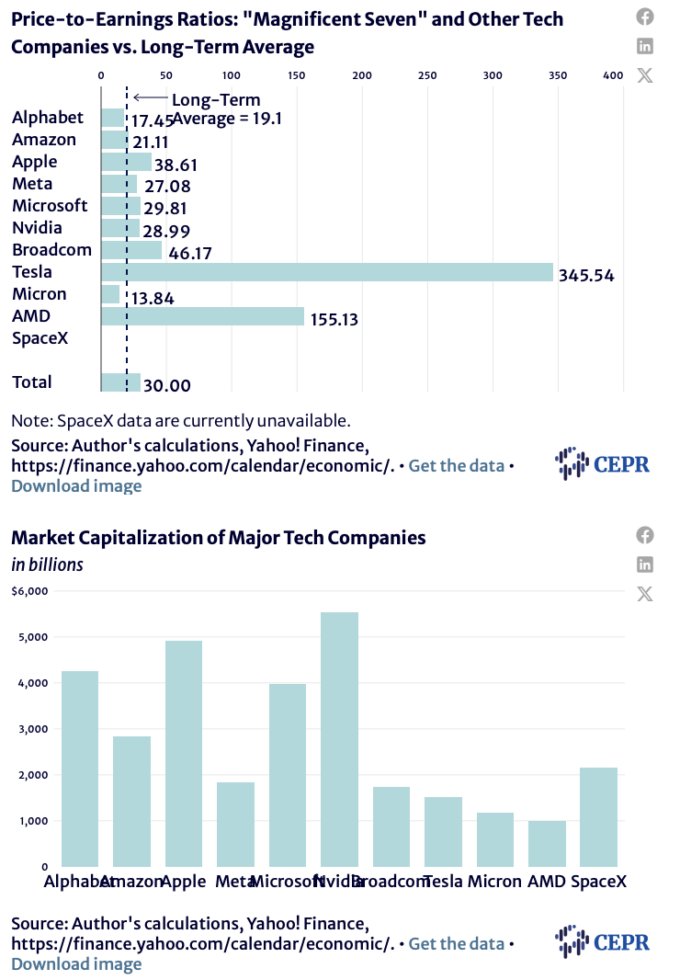
First off, here are the latest numbers from the AI giants:
A couple of months ago, I decided to ask AI about the incentive structure facing asset managers at places like pension funds and hedge funds. The issue I raised was that these asset managers may face perverse incentives when it comes to investing in AI-related companies. These companies have been far outpacing the rest of the market over the last few years. This means that if they didn’t invest in them, their performance would badly lag their peers. That could cost them bonuses and even lead to their firing. On the other hand, if the AI-related stocks all plummet, they will get a “Who could have known?” amnesty, where they can avoid responsibility by saying that everyone made the same mistake.
In this scenario, AI agreed that asset managers would keep throwing money at the AI companies even if they believed that their growth model doesn’t make sense. This means that even if the asset managers had the exact same view I do of the prospects of the AI companies being record-setting profit makers, they would continue to invest in them. The incentives are totally asymmetric; keeping their job might mean ignoring their judgment and riding the wave.
Unfortunately, this is not the only case where a perverse incentive structure can lead to counter-productive behavior. The top executives at the hyperscalers — Amazon, Alphabet, Meta, Microsoft, and Oracle — may be in a similar situation.
At this point, all of them have committed hundreds of billions of their companies’ capital to building data centers to support the AI producers, primarily OpenAI and Anthropic. Suppose they came to hold the view that the AI companies would be unable to meet the trillions of dollars in lease commitments for which they are on the hook. This would mean that the hyperscalers would be sitting there with trillions invested in data centers for which they have no market.
From the standpoint of the companies, if they held this view of the future of AI, it would be best to cut their losses and stop building today. However, from the standpoint of the top executives at these companies, it would likely make more sense to just keep investing. After all, they can’t be sure; maybe AI will ultimately pay off.
However, if they were to pull the plug and try to cut their losses, they would be admitting that they threw hundreds of billions of dollars of their companies’ assets in the toilet. This would likely get them fired and probably end their career as a top executive of a huge tech company. In that scenario, they would likely keep building data centers even if they believed that they were throwing good money after bad.
This is the question I posed to AI. As I did last time, I posed the identical question to Gemini, Grok, and ChatGPT.
AI Says the Hyperscalers Will Keep Blowing Hundreds of Billions
I have posted my question and the answers verbatim, which you can read below, but the basic story is that AI agrees that the CEOs and other top execs might continue to throw good money after bad. As with my last question about the incentives of asset managers, I may have loaded the deck with my description of the incentive structure facing top management, but does anyone think I have mischaracterized it? What would happen to Satya Nadella at Microsoft or Sundar Pichai at Alphabet if they announced that they had been mistaken in investing hundreds of billions of dollars of their companies’ money in data centers, and they were prepared to write down the spending as a massive loss?
It may be a somewhat different story with Mark Zuckerberg at Meta, since he largely controls the company. After all, he owned up to an $80 billion loss on Metaverse and is still running the show. This may give Zuckerberg more freedom than the other top execs, but it’s not clear we should feel much confidence in his judgement.
These sorts of agency problems kept the housing bubble going as long as it did. Mortgage issuers were happy to issue mortgages to people who they knew were unlikely to be able to make payments, because they knew they could resell almost any mortgage, regardless of its quality, to the investment banks.
As part of the story, appraisers deliberately began giving inflated appraisals because they knew the issuers expected them. Most appraisers work as independent contractors. They knew that if they came in with an appraisal too low to allow a mortgage, they would be unlikely to be rehired.
The investment banks were happy to buy any mortgage they could get, because they knew they could package them into mortgage-backed securities (MBS). They could in turn count on getting investment-grade ratings from the credit rating agencies, because the investment banks were paying the credit rating agencies for their rating. The credit-rating agencies’ analysts understood that they were expected to come back with investment-grade ratings regardless of the quality of the security. This rating allowed the investment banks to sell their MBS all over the world.
Agency problems are common in capitalism. Markets should be structured to minimize them, but there is rarely a constituency to crack down on a specific abuse until it causes something really bad. And even then, the affected industry may delay action until everyone has forgotten about it. (Then Senator Al Frankenproposed an amendment to the Dodd-Frank financial reform bill that would have eliminated the conflict-of-interest problem with the credit rating agencies by having the SEC choose the agency hired for bond issues. While it passed the Senate with a huge bipartisan majority, Treasury Secretary Timothy Geithner had it killed in conference by imposing a two-year study period.)
Anyhow, after the AI bubble bursts, we may get some investigations into the agency problems that have allowed it to grow so dangerous. Until then, it will be business as usual.
The Prompt
Suppose the CEO and top management at a major hyperscaler had spent hundreds of billions of dollars on data centers. Although they think there is little likelihood that investing hundreds of billions more will pay off for the company, acknowledging their mistaken investment could mean getting fired and professional humiliation. What would they be likely to do?
Gemini
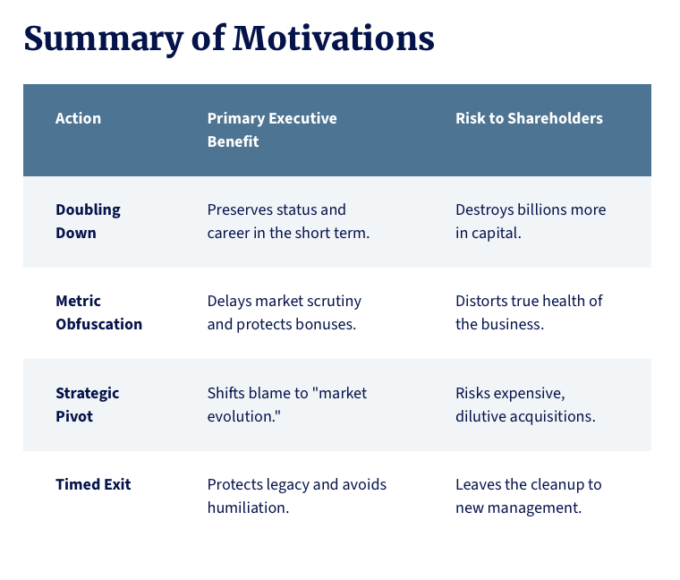
Based on established corporate governance, psychological behaviors, and economic theory, top executives facing this dilemma are highly unlikely to admit the mistake immediately. Instead, they often engage in specific face-saving and risk-shifting behaviors to protect their positions.
Here is what management would likely do, ranked by probability:
1) Double Down on the Investment (The Sunk Cost Fallacy)
+ Escalation of commitment: They will likely invest billions more, hoping a larger scale finally unlocks profitability.
+ Narrative shifting: They will pivot the justification from “immediate revenue” to “building an unassailable infrastructure moat.”
+ Buying time: Continuing to invest delays the moment of reckoning, pushing the potential fallout further into the future.
2) Redefine and Obfuscate Financial Metrics
+ Creative accounting: They may shift how “data center utilization” or “ROI” is calculated to make the assets look performing.
+ Bundling revenues: They might bundle AI or cloud infrastructure revenue with highly profitable legacy businesses to hide underperformance.
+ Longer depreciation: Extending the accounting life of the data centers reduces immediate annual depreciation costs on the balance sheet.
3) Orchestrate a “Strategic Pivot” or Acquisition
+ Acquiring growth: They may buy high-flying software or AI applications companies at a premium to artificially boost demand for their data centers.
+ Blaming external shifts: Management might rebrand the overcapacity as a deliberate, visionary pivot toward a new buzzword tech trend (e.g., “spatial computing” or “sovereign mesh networking”).
4) Engineer a Graceful, Timed Exit
+ Staged departures: Knowing the bubble will eventually burst, the CEO and top allies may quietly plan their exits.
+ Pre-planned retirement: They announce departures 12–18 months in advance, citing personal reasons or “mission accomplished” after finishing the infrastructure buildout.
+ Cashing out: They maximize stock sales via 10b5-1 plans before the market realizes the data centers are underutilized.
Would you like to explore historical corporate case studies where executives doubled down on infrastructure gluts, or analyze how activist investors typically spot and intercept this specific behavior?
Grok
They would be likely to keep investing (or at least publicly commit to further large-scale spending) rather than acknowledge the error. This follows directly from the incentives described. Once hundreds of billions have already been spent, the managers face a classic escalation-of-commitment / sunk-cost problem compounded by career risk:
+ Admitting the prior outlays were a mistake triggers immediate professional consequences (termination risk, board scrutiny, reputational damage, possible shareholder lawsuits). The personal downside is concentrated and certain.
+ Continuing to spend keeps the original thesis alive in public narrative. It buys time, allows optimistic forecasts or “AI demand will eventually materialize” stories, and makes it harder for outsiders to declare failure while capital is still flowing. The personal downside is deferred and probabilistic.
+ Corporate cultures at hyperscalers reinforce this: large capital programs create internal constituencies (construction, power procurement, chip supply chains, sales teams selling capacity) that resist abrupt reversal. Boards and investors often interpret continued spending as conviction rather than error, at least in the short run.
Empirical patterns in large-scale capital projects, tech platform build-outs, and prior infrastructure bubbles show the same dynamic: decision-makers rarely volunteer that the original thesis has collapsed when doing so ends their tenure. They more often expand the program, reframe metrics, seek external validation (partnerships, government support, analyst coverage), or stretch timelines until external force (cash constraints, board intervention, market collapse) intervenes.None of this requires malice or unique irrationality; it is the predictable result of misaligned incentives between managers’ career utility and the firm’s long-term returns. Shareholders ultimately bear the cost of the continued capital allocation.
They would be likely to continue investing hundreds of billions more (escalate the commitment), rather than cut losses and acknowledge the error. This is a classic case of the sunk cost fallacy combined with escalation of commitment. Decision-makers who have already poured enormous resources into a course of action frequently keep pouring in more, even when the expected returns look poor, because:
+ Admitting the prior investment was a mistake threatens their status, jobs, reputation, and self-image.
+ Continuing allows them to frame the situation as “we’re still executing the long-term vision,” “the market just needs more time,” or “competitors are doing the same so we can’t stop,” which is psychologically and politically safer than writing off the prior capital and facing the consequences.
+ Organizational incentives (boards, investors, internal politics, narrative control) often reward persistence and punish visible reversals, especially at the scale of hyperscaler data-center buildouts.
In practice, this tends to look like:
+ Announcing further capacity expansions, new campuses, or power deals while downplaying utilization, ROI timelines, or demand risk.
+ Shifting the public story (“AI demand is inevitable,” “we’re building for the next decade,” “efficiency improvements will catch up”) rather than treating the prior outlays as largely sunk.
+ Searching for partial justifications or salvaging uses (different workloads, leasing, etc.) that still require additional spend.
+ Delaying hard write-downs or strategic reversals until external pressure (cash constraints, clear demand shortfalls, activist investors, or a new CEO) forces the issue.
Rational, forward-looking analysis would ignore the already-spent capital and evaluate only incremental expected returns versus alternatives. The combination of career risk, social/professional humiliation, and organizational inertia strongly biases top management toward the opposite: keep spending. Historical corporate examples of megaproject overruns, failed technology bets, and infrastructure buildouts show the same pattern repeatedly.
ChatGPT
They would be likely to keep investing, defend the existing investment, and try to make the next round of spending appear indispensable—even if they privately believe the expected financial returns are poor. The strength of this tendency would depend on how much discretion they have over investment, how quickly the financial consequences become visible, and whether the board can hold them accountable.
The key is that the CEO and top management are maximizing something different from the company’s long-run financial return. They are also concerned with their jobs, reputations, compensation, and place in the industry.
1. The sunk-cost problem becomes a career-incentive problem
Suppose management has already invested $300 billion in AI data centers. They now believe that investing another $200 billion has little chance of generating an adequate return.
From the company’s perspective, the correct decision is to compare the expected incremental return on the next $200 billion with its opportunity cost. The $300 billion already spent should not, by itself, justify spending another dollar.
But management faces a different calculation.
Management’s private incentives
Continue investing
Management can argue that AI is a strategic necessity, that demand will eventually catch up with capacity, and that abandoning the investment would surrender the company’s future to competitors. If the investment succeeds, they receive credit; if it fails, they can point to an industry-wide miscalculation.
Cut investment sharply
Management must acknowledge that its previous forecasts or strategic judgments were wrong. It risks losing its position, damaging its reputation, and inviting scrutiny of decisions made under its leadership.
The crucial asymmetry is that the benefits of admitting the mistake accrue largely to shareholders, while many of the immediate costs fall on the executives who admit it.
If management expects to be punished for stopping but faces little additional punishment for continuing, even executives who recognize the problem may rationally choose to continue from the standpoint of their own careers.
2. How this behavior would probably unfold
I would expect several mutually reinforcing tendencies.
First, management would reinterpret the evidence.
Executives rarely need to tell themselves that they are making a bad investment. They can convince themselves that the investment is justified under a somewhat different set of assumptions.
They might argue that:
+ AI inference demand will grow much faster than current forecasts suggest.
+ The cost of computation will fall, expanding the market.
+ Owning capacity will become a decisive competitive advantage.
+ New applications will emerge that are not yet reflected in revenue projections.
+ Falling behind a competitor would be more damaging than accepting a low return on capital.
+ Some of these arguments may be entirely valid. The problem is that career incentives can make management systematically favor optimistic interpretations over pessimistic ones.
Second, they would keep spending to avoid conceding defeat.
Once a company has committed hundreds of billions of dollars, management has strong incentives to characterize the next investment as the final step needed to realize the value of the previous investments.
This produces a familiar progression:
+ The initial investment is justified by projected demand.
+ Demand disappoints, but management argues that additional capacity is needed to capture the opportunity.
+ Returns disappoint again, but management argues that the company must invest to avoid falling behind.
+ Each new commitment increases the reputational and organizational cost of admitting the original strategy was mistaken.
This is the classic escalation of commitment, amplified by executives’ personal incentives.
Third, they would emphasize strategic necessity rather than financial returns.
The narrative could shift from “this investment will generate an attractive return” to “we cannot afford not to make this investment.”
That distinction matters. A company might plausibly need some AI infrastructure to remain competitive without needing anything close to the amount of infrastructure management has planned.
Framing the decision as a competitive arms race makes it harder for boards, investors, and internal dissenters to ask whether the next dollar invested will earn an adequate return.
Fourth, management might become more committed to the strategy as the evidence worsens.
This sounds paradoxical, but it can happen. The worse the existing investment performs, the more threatening it becomes to acknowledge the mistake. Executives may respond by making more ambitious promises about the next phase.
The result can be a feedback loop: disappointing returns increase the pressure to demonstrate that the strategy will work, and that pressure encourages further commitments.
3. Why the hyperscaler setting makes the problem particularly acute
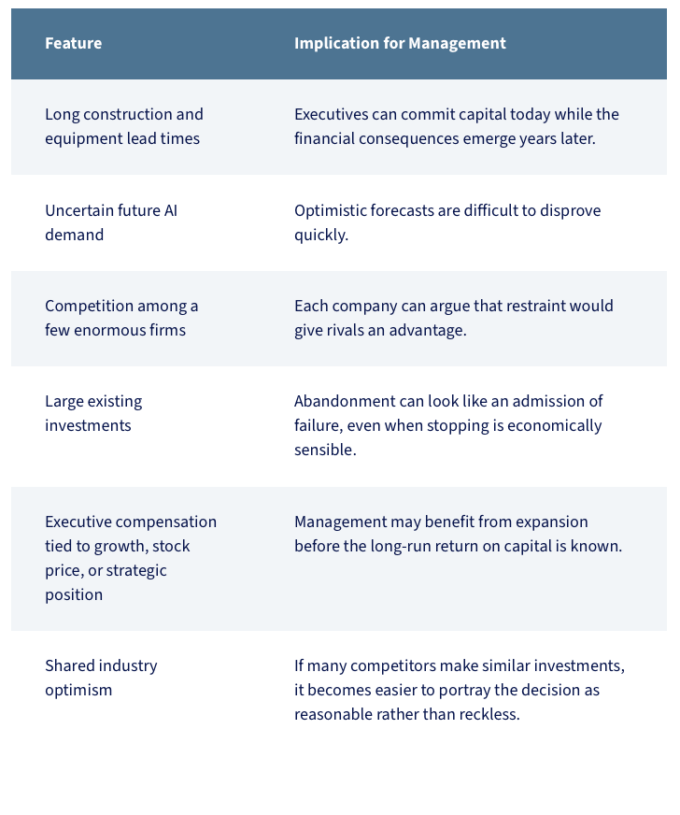
There is an additional complication: the investment may be defensible for one company even when it is collectively excessive for the industry.
Suppose every major hyperscaler expects its competitors to build aggressively. Each may conclude that investing heavily is necessary to protect its position. Yet if all of them expand capacity faster than profitable demand grows, the industry as a whole can end up with excess capacity and disappointing returns.
In that situation, each company’s defensive reasoning can contribute to a collectively poor outcome.
4. What would make management especially reluctant to stop?
The most important factor is how the CEO expects the board to evaluate the decision.
Consider two hypothetical governance arrangements.
Scenario A: Asymmetric accountability
Stopping is visibly punished; continuing is tolerated.
+ A decision to halt expansion triggers an immediate write-down and public acknowledgment of error.
+ A decision to continue preserves the possibility of a turnaround.
+ If the strategy eventually fails, management can blame unpredictable technology, competitors, or market conditions.
Likely result: Continued investment, optimistic guidance, and delayed recognition of losses.
Scenario B: Symmetric accountability
Executives are evaluated on the quality of their decisions, not just their outcomes.
+ The board independently reviews incremental returns.
+ Management must justify new commitments using updated evidence.
+ Executives receive credit for stopping a project whose economics have deteriorated.
Likely result: Greater willingness to slow spending, stage investments, or cancel projects.
Scenario A creates a particularly dangerous incentive. Even if the CEO is convinced that another $200 billion is unlikely to pay off, continuing may be the privately safer option.
There is also a timing issue. If the CEO expects to leave the company before the losses become undeniable, the personal cost of continued investment falls further. The company may bear the eventual consequences while the executive has already collected years of compensation and moved on.
5. Does this mean management would inevitably keep spending?
No. There are important countervailing incentives.
A CEO may believe that continued investment risks destroying the company’s stock price, undermining credibility with the board, or leaving the company burdened with expensive and underutilized assets. Some executives also place substantial value on their long-run reputation for sound capital allocation.
Moreover, the investment may have genuine strategic value even if the expected direct financial return looks weak. Data centers can support existing cloud businesses, improve customer retention, or protect a company’s competitive position. The relevant question is whether those benefits justify the next investment, not whether AI has any value at all.
A board can also force management to stop, especially if directors recognize that further spending is unlikely to create shareholder value.
The hypothesis in your question is therefore not that every hyperscaler must keep investing. It is that when executives expect to be punished more for acknowledging a mistake than for extending it, their private incentives become biased toward continued investment.
6. The deeper implication: a possible capital-spending bubble
The mechanism you describe is one reason an investment boom can persist even after influential decision-makers become privately skeptical of its economics.
The process does not require fraud, collective delusion, or executives who cannot understand financial returns. It can emerge from ordinary career incentives:
+ Executives are rewarded for growth and punished for visible strategic retreats.
+ The benefits of restraint are uncertain and often delayed.
+ The costs of stopping are immediate and personally identifiable.
+ Competitors’ continued spending provides a ready-made justification for doing the same.
+ The eventual losses may occur after the executives responsible have left.
The result can be a situation in which individual executives privately doubt the economics of further investment, yet continue to authorize it.
My central prediction under your assumptions: If the CEO and top management at a major hyperscaler genuinely believe that additional hundreds of billions of dollars are unlikely to earn an adequate return, but expect severe personal consequences if they acknowledge the earlier mistake and little personal accountability if they continue, I would expect them to favor continued investment over an abrupt retreat. They would probably defend it as a strategic necessity, emphasize optimistic long-term scenarios, and delay a decisive reassessment until financial results or external governance pressure made the decision unavoidable.
The most revealing evidence would not be whether management publicly expresses confidence in AI. It would be whether it changes its capital commitments when updated evidence indicates that the expected incremental returns have deteriorated. That is where the conflict between the company’s interests and management’s personal incentives becomes observable.
This first appeared on Dean Baker’s AI Monitor.