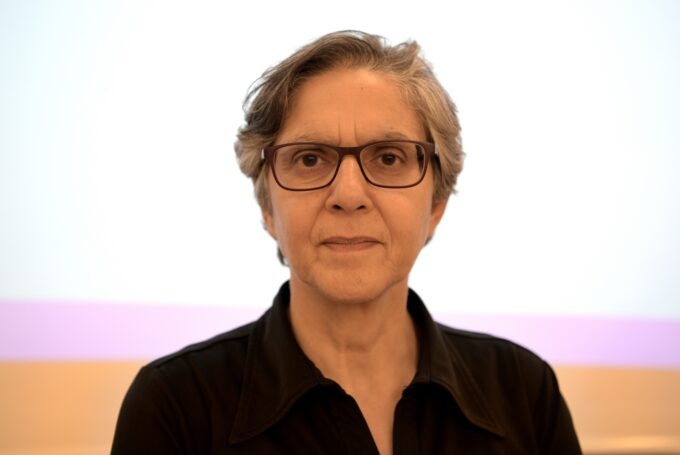
Elena Aoun, photograph by the author.
The colonial gaze, which pitted “civilized” peoples against “savages,” continues to leave its mark on Western politics and institutions.
Unfortunately, academia is not immune. According to Elena Aoun, a professor and researcher in international relations at UCLouvain, Belgium, “a large portion of Western academic institutions remain rooted in a colonial worldview.”
Few researchers in academic circles question these ideological biases. “There are too few of us researchers able or willing to speak out on these matters. In Belgium, students cannot necessarily say everything, whereas professors enjoy greater freedom,” Aoun told CounterPunch.
At the same time, the political establishment shows no interest in scientific data that refutes the colonial framework. “Leaders around the world are in denial about these issues. And since scientific premises and factual, empirical knowledge do not support the instrumentalization of reality they wish to perpetuate, they take no interest in them,” she points out.
Academic research, she explains, relies on archives, statements, discourse analysis, and factual elements—such as polls, expenditures (particularly military), trade data, and so on—all of which provide understanding. Added to this are codified and tested concepts, as well as analytical and theoretical frameworks that provide meaning. “We are not dealing with an exact science—we aren’t doing molecular chemistry—but we know that certain situations generate violence,” Aoun adds. “We do not posit that violence is innate, nor do we assume that the problem today is, for instance, Hezbollah or Hamas. We ask ourselves what causes gave rise to those actors. And we are ready to discuss and analyze that.”
According to her, the same type of questions arises regarding the issues surrounding the war in Ukraine. “Today, it is very difficult to get people to listen—even in a country like Belgium—to the idea that understanding the conflict in Ukraine requires an analysis that incorporates, among other factors, the promises made in the wake of the fall of the Berlin Wall and during the early years of German reunification, as well as NATO’s eastward expansion.”
Elena Aoun emphasizes that taking a long-term perspective is absolutely fundamental. “You cannot understand the situation if you fail to analyze it, if you distort the facts, or if you lose sight of the timeline. One thing I personally find deeply alarming is the alacrity with which European states are moving towards—and normalizing—the prospect of a conflict with Russia.”
This biased approach also implies that “we” are never responsible for what happens. “We weren’t responsible for 9/11. We aren’t responsible for October 7. We aren’t responsible for anything at all,” she notes emphatically.
The consequence of this denial is a repetition of errors, leading to increasingly grave outcomes. “We allow explosive situations to spiral out of control. If you didn’t like the war in Ukraine, persisting on this path without questioning its underlying causes risks leading to a situation far worse than the one we face today.” If you disliked Hamas and Hezbollah, continuing down the same path without ever questioning yourselves, and you risk facing even more severe violence. If you disliked the Islamic State, maintaining that approach without questioning anything, and you will see worse.
A gaze that constantly alienates the other
By cross-referencing empirical findings with events on the international stage, academic research identifies not only the imprint of colonization but also the deep-seated nature of coloniality. “We see the pervasive influence of this colonial gaze, whereby the former dominant power maintains a perspective of superiority—often one of contempt—vis-à-vis others,” notes Aoun. “Based on this fundamental premise, those who stand in opposition to the ‘civilized’—those who do not resemble them—are viewed as backward or barbaric. The only way to avoid being labeled a barbarian is to align oneself with the ‘civilized’: to think like them and to subscribe to their political stances and interests,” she adds.
Confronted with a distorted mirror that portrays them as inferior, the individual is led to internalize contempt for themselves and their own people. Of Lebanese origin, Elena Aoun is well-acquainted with these mechanisms of alienation. “I grew up in a social environment where people were not particularly comfortable with Arab culture, even though it is my own heritage. Overcoming that reluctance towards one’s native culture requires effort,” she explains. “In some respects, Lebanon is extremely Westernized. Today, there are vast numbers of people there who remain in denial about their own identity. They are also ignorant of the history, the fault lines, and the violence endured during both the colonial and post-colonial eras. This is because coloniality has persisted through the Lebanese elites’ dependence on the West.”
Certain divisions fostered by colonial rule persist to this day, with segments of the population allowing themselves to be instrumentalized. “Many Lebanese are content to play the role of instruments for interests that do not serve Lebanon—acting as clients of those interests in exchange for symbolic rewards, such as being viewed as ‘good people’ or feeling close to the heart of the Empire.”
Elena Aoun’s field of work focuses primarily on issues such as terrorism. In this realm, too, colonial parameters once again prevail, dictating definitions, epistemologies, and narratives. “After the infamous events of September 11, anything Arab or Muslim was cast as potentially terrorist. That event was used as a pretext to further alienate Arab and Muslim populations. We are all aware of the devastation wrought based on proven falsehoods—notably the invasion of Iraq, the war in Afghanistan, and so on.”
The definitional framework through which terrorist acts are understood is closely tied to a persuasive rhetoric that portrays the West not only as inherently democratic but also as the primary global defender and exporter of democracy and human rights. This reality is equally relevant within individual countries. “With the rise of the far right across many Western nations, deeply marginalized populations are viewed as inherently suspect. Being Muslim today carries a heavy stigma of suspicion.”
Aoun emphasizes the importance of a long-term historical perspective. “Without a long-term view, nothing makes sense. If we fail to grasp, for instance, the sheer violence of the French mandate in Lebanon and Syria, or the brutality of the British mandate in Palestine, we miss crucial elements. We cannot hope to understand the resentment felt by Syrians and Lebanese—particularly the Shia community, who bore the brunt of French colonial violence.”
Similarly, understanding Hezbollah’s stance and its deep distrust of the Lebanese state requires knowledge of the historical context. “We need to take into account the fact that it was burned by the Lebanese state, which at the time held the monopoly on the legitimate use of force,” she points out. “To understand what is happening today, we must examine the continuum of violence. It starts with discrimination to end in genocide.”
Elena Aoun is an associate professor and researcher in International relations at UCLouvain, Belgium, and a member of the Centre for the Study of Crises and International Conflicts (CECRI) and the Research Group on the Contemporary Arab World (GERMAC). She holds a PhD in Political Studies from Sciences Po Paris and completed a postdoctoral fellowship at the Institute for European Studies (Universities of Montreal and McGill). Her research focuses on Middle Eastern crises and conflicts, particularly the role of external actors, especially the European Union.