Delaney Hall, YouTube screenshot.
Three months have passed since the hunger and labor strike ended at Delaney Hall, and while cameras and protestors have dwindled on Doremus Avenue, conditions at the for-profit immigration detention facility have only further deteriorated.
“That was their cry for help,” Sally Pillay, director of The Mami Chelo Foundation, told me in an interview. “It was beautiful organizing inside which we have not seen before….that collective resistance was fundamentally what brought about the light being shined on Delaney Hall.”
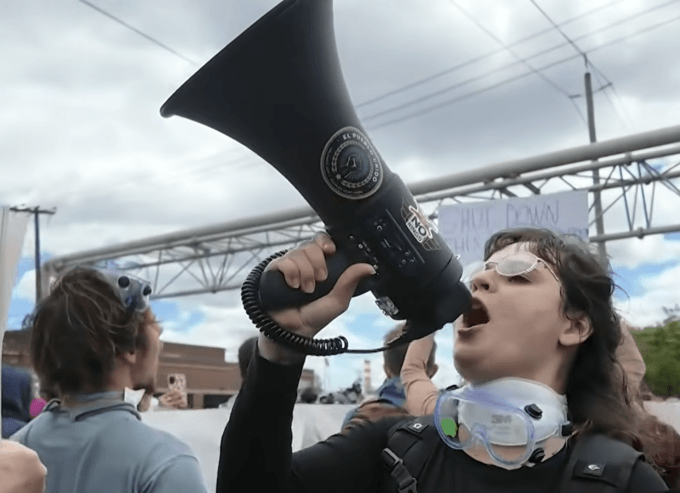
Indeed, the hunger strikers’ letters to the public and the hundreds of people who came to protest outside brought unprecedented media attention to the facility. The cameras captured detainees’ shadows waving from the windows, ICE beating protestors with batons and pepper spray, and New Jersey state troopers clearing protestors with tear gas and cavalry.
For a moment, freedom felt possible: some hunger strikers were released, and several other immigration facilities began striking too. But ICE and the for-profit facility manager GEO Group met the strike with cruelty: families were denied visitation, the strikers inside were pepper sprayed and beaten, and hundreds of people were transferred to other facilities, breaking the strike.
Martin Soto, one of the strike leaders, has been in solitary confinement at the nearby Elizabeth Detention Center ever since. His wife, Gabriela, suffered a miscarriage in August from the stress.
“That’s the way carceral facilities respond. They respond with violence,” Kathy O’Leary of Pax Christi New Jersey told me last week.
Conditions at Delaney Hall have only worsened since the strike ended, but volunteers with the Eyes on ICE coalition, like Pillay and O’Leary, continue to fight for freedom and support detainees through mutual aid.
Delaney Hall is a kind of black box, with inspectors and legislators denied full access and ICE and GEO Group issuing boilerplate statements that detainees are “provided proper meals, water, [and] medical treatment” and “receive full due process.”
Released detainees, who receive mutual aid at an Eyes on ICE tent outside the facility, continue to report that the food is sometimes served frozen or infested with worms. They say the drinking water is yellow and tastes metallic – a description Senator Andy Kim agreed with after tasting the water during a restricted visit in August.
Dr. Norma Bowe is a volunteer who runs a mobile health clinic outside Delaney Hall every Saturday. Last year, she did a dipstick test of the tap water and found it positive for lead, copper, bacteria, and other contaminants. In June, she told me she worried that this contaminated water contributed to the symptoms detainees are released with, including rashes, diarrhea, and vomiting.
The dipstick test necessitates more official testing, but ICE and GEO Group, the incarceration company with a $1.2 billion contract to run the facility, have repeatedly denied state health inspectors full access to the facility.
In June, New Jersey sued GEO Group to gain access to the facility after receiving a report that a Delaney Hall detainee was hospitalized with tuberculosis. The litigation is ongoing and no full inspection has occurred yet.
Tuberculosis is a highly dangerous and contagious disease, and carceral facilities are a perfect storm of conditions for outbreaks that threaten the lives of detainees and the wider public.
“We haven’t been able to confirm, but we have heard on and off about cases of TB,” O’Leary told me. She said that detainees who are hospitalized for one condition or another are not permitted to finish their course of antibiotics. “It is the type of place that is ripe for a TB infection outbreak. If you do things like not give somebody their full course of antibiotics, you end up with multi-[drug] resistant TB which is dangerous for the rest of the community.”
Detainees and their families have consistently complained about not receiving essential medications – for diabetes, seizure disorders, heart arrhythmias, and other conditions.
In early August, detainee Edwin Lopez-Conejo told his family that the facility was not giving him his medication for diabetes, high blood pressure, and seizures. He died the next day.
His death was the third confirmed at Delaney Hall since the facility reopened in May 2025, prompting the New Jersey attorney general to open a civil rights investigation. At least 50 people have died in ICE custody since President Trump’s inauguration.
“The paramount goal is for us to get people free,” Pillay told me. Since the strike, the Eyes on ICE coalition has brought reports and cases to legislators for case management support and the hope of shutting down Delaney Hall.
Every day, volunteers with Eyes on ICE provide essential support for detainees and their families outside of the facility. Fully supported by donations, they distribute grocery bags and grocery gift cards to family members who lost a breadwinner to ICE detention. They help people locate loved ones when ICE transfers them, fill commissary accounts, and navigate the complex, ever-changing immigration legal system.
They also provide “compliance clothes” for family members visiting the facility. GEO Group has strict clothing policies for visitors, so the Eyes on ICE coalition keeps a stock of extra clothing to prevent people from being turned away. Sometimes, volunteers told me, clothing approval depends on the mood of GEO Group employees.
The volunteers describe their work as “radical hospitality,” which is about “being supportive of those that are being released, to make sure that they are safe, to make sure that they get home safely, reunited with their loved ones,” according to Pillay.
The volunteers reported that more detainees have been released recently, thanks to a rise in cases approved for ICE bonds, creating another way for people to be released beyond habeas corpus petitions. With an ICE bond, detainees can pay $7,500 and be released only a few days after detainment, an arrangement O’Leary said “kind of sounds like a shake-down.”
Still, she said, the bonds get people free. They work with SOMA Community Cares and Envision Freedom Fund, organizations that explicitly raises money for these bonds and other legal aid.
“Donating to those places literally frees people, so that’s a really good thing,” said O’Leary. “In terms of us and what we need in the tent, the number one thing that we always need are grocery store gift cards, because that helps the families survive.”
Another volunteer, Paula Rogovin, emphasized that people can help in many ways beyond donating. People can volunteer at the radical hospitality tent, but also organize their home communities to collect grocery gift cards, or knit warm accessories for families forced to wait outside Delaney Hall during the winter months.
“What I love about this…is that that we’re from all the different movements,” Rogovin, who has a background in the environmental movement, told me. “Nobody said you have to be here, but we know – we all know, from our various movements that we have to help in some way, even if we can’t physically be here.”
Pillay firmly believes in the possibility of shutting down Delaney Hall – and all the horrific conditions detainees are subjected to inside.
“We are in unprecedented times right now – in very dark times, but it doesn’t mean it’s not possible. Anything is possible. And again, the power of the people united will never, ever be defeated.”