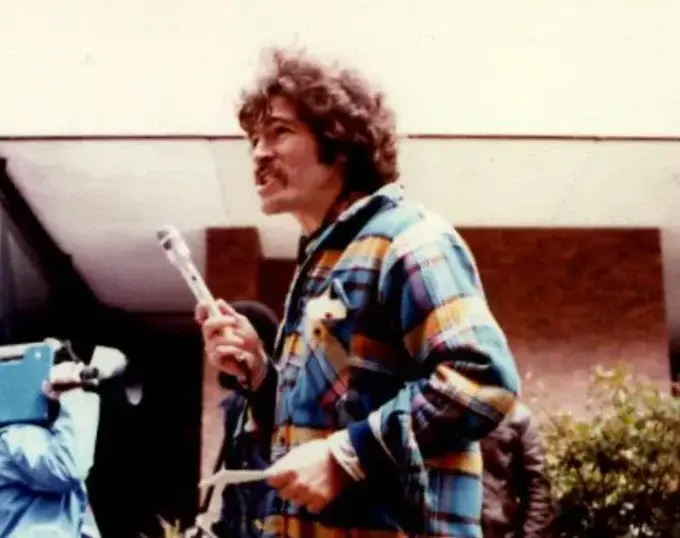
David Hunt rallying strikers and supporters, October 1978. Photo Courtesy of Michael Letwin.
I learned recently that my old history professor David Hunt passed away in early September. He was a kind, unique, and serious scholar, who skipped teaching at elite universities, which he could have easily done, to teach working class kids at the expanding campus of UMass Boston starting in 1969. He taught there for five decades, an extraordinary example of his commitment to UMass Boston and its students.
David’s overriding specialty was the Vietnam War. He produced countless articles, reviews, conference papers, and books. I can easily say that if it weren’t for the influence of my late cousin Stephen Crosby, himself a former UMass student, and David Hunt, I would have never written my own, more modest book on the Vietnam War.
David taught courses on Vietnam long after the war was over. His archive of research and papers are impressive to say the least. David’s papers, archived at UMass, included multi-year interviews with Vietnam Veterans. He also played a major role in shaping the William Joiner Institute for the Study of War and Social Consequences.
But, David didn’t start out that way. He was trained in European history with a very conventional approach to understanding history and historical change. What he called later his “six unhappy years I spent in the graduate program of a nearby Ivy League university.” His first book, that he was later very critical of, was Parents and Children in History: The Psychology of Family Life in Early Modern France.
The big change for David was the impact of the writings of British historian E.P. Thompson, especially The Making of the English Working Class. David recalled in an interview for the UMass-Boston Memories Project how the book changed his (and others) view of history:
For my generation of social historians, whose political and scholarly agendas were forged in the 1960s, E.P. Thompson, The Making of the English Working Class, served as a foundational text. Every chapter in that great book came as a revelation: “Planting the Liberty Tree,” which followed reverberations of the French Revolution as they spread through working-class milieus in England; “An Army of Redressers,” with its homage to heroes and martyrs of the Luddite Movement.
Soon after arriving (1969) at UMass/Boston, I offered a topic course on Thompson’s 800-page masterpiece. The class was packed with student activists of various stripes, and I had a sense that everyone learned something from the text and the discussions it occasioned. I know I did. I spent a lot of time with people in that class both on and off campus. One apartment occupied by a couple of them was a dingy place, with mattresses on the floor and leaflets, underground newspapers, and books by Fanon, Magdoff, and Malcolm X “strewed” about. On the wall, no, covering the wall corner-to-corner, floor-to-ceiling, was the red and blue flag with a gold star of the National Liberation Front of South Vietnam. A bunch of people were sitting around listening to music and talking politics. I said to myself “This is what Thompson was talking about.
It was the interaction with the newer, young faculty and students, increasingly radicalized by the Vietnam War, as well as the social movements of oppressed peoples in the United States and around the globe, that shaped his political and academic commitments. He recalled the heady atmosphere, including larger numbers of Vietnam Veterans flooding the campus:
The young UMB professoriate of those days, galvanized by the cultural and political currents of the 1960s, was often self-important and self-righteous, and occasionally I cringe on remembering our brash arrogance. But there was something courageous and right in our engagements, in the realization that when personal commitment is postponed to moments when risk recedes, we lose ourselves. Struggles waged together created bonds of friendship that have lasted a lifetime.The best way to put it is to say that the remarkable students and teachers I met at UMass/Boston rescued me from irrelevance and gave a meaning to my existence that I have tried ever since to honor.
Thompson’s approach he later applied to his teaching of courses on the French Revolutions of 1789 and 1848. He always enjoyed his students even when we were pretty silly. I remember one time when a whole group of us, who spent way too much 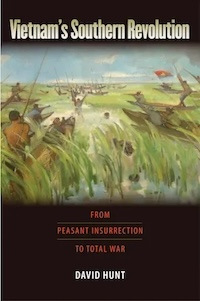 time drinking at the UMass Pub, went to class early, piled all of the furniture on top of one another, and appended a sign that read, “A barricade!” David came in, rubbed his square jaw, and said, “That’s the worst barricade I’ve ever seen.”
By the time I arrived at UMass Boston in Fall of 1978, the glory days of public higher education were over. Cutbacks and dwindling support for schools, like UMass Boston were becoming the norm. Much worse was to come. Yet, that didn’t mean the end of student and faculty activism, in many ways it spurred it forward against great odds for a few years. Just a few weeks into my first semester, the recently formed Faculty and Staff Union (FSU) called a two day strike. It was my first picket like.
A large group of us invaded the Board of Trustee’s meeting on campus demanding a good contract for the faculty and staff and better conditions for us students. The Mass Media, the UMass-Boston student newspaper, reported:
At 11:30 the official rally began. Prof. David Hunt of the History Department, opened the program by thanking students and staff for their support. Jean Radcliffe, one of the student organizers, spoke about the impact of level funding on Umass. “Massachusetts ranks 48th in public spending per capita on public higher education,” pointed out. Wally Durocher, an electrician and former UMass, urged the union “to go all the way” in fighting for a contract.
After the speech, the crowd resumed singing union songs adapted for the occasion. The New Women’s Chorus led the group in many of the songs.
The FSU considered the strike action and student support a huge success. In a public letter signed by much of the left faculty in the FSU, including David Hunt and Linda Gordon, for the “Socialist Column” in the Mass Media, gave much credit to the student activists for boosting the morale of union activists and marshalling the student support for the strike. They wrote:
The surge of energy coming from the students sent shock waves across the campus and radically transformed the situation. One could sense this energy in the large, efficient, democratically conducted meetings which occurred almost daily in the week before the work stoppage, and in the many animated discussions taking place in the lobbies and cafeterias of building one and two, as people debated, listened,and asked questions, and exchanged information, all with an intensity not seen here since the days of the anti-war movement.
Our small generation at UMass- Boston in the late 1970s and early 1980s, as David told me a long time ago, were the last “Sixties style activists on campus.”
David’s greatest strength was teaching generation after generation of students at UMass-Boston. He was always available for the many teach-ins during the decades where his expertise elevated our political understanding on any question. David, along with a handful of other historians, kept Vietnam and its legacy alive, long after it had been pushed to the margins of American political life. UMass will always have a special place in my heart and those years are inseparable from David’s teaching and activism. I will always be indebted to him.