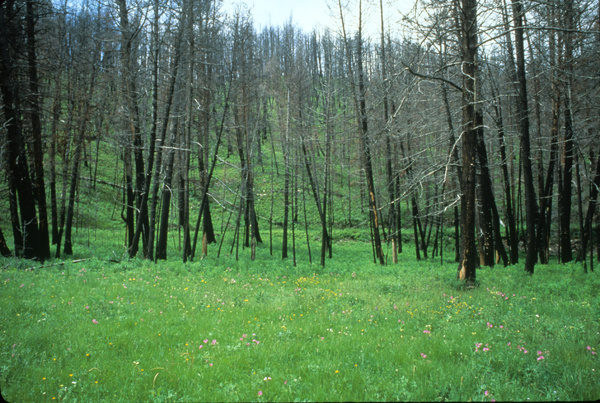
Snags and grass regrowth after 1988 fires near Elk Creek, Yellowstone National Park. Photo: George Wuerthner.
A recent CNN article titled “Why even resilient forests are struggling to regrow after wildfires” paints a picture of how wildfires are “destroying” our forests and lacks perspective and context.
Like much of the information in the media, the article is full ofhyperbole and a failure to understand forest and wildfire ecology, though it does articulate some good concepts here and there. The language is full of pejorative terms: “a desolate clearing,” “charred soil,” “massive destruction,” “forests are being obliterated,” and so forth.
One of the main problems with the article’s starting assumptions is that forest conditions and vegetation cover are static. It assumes that after a major disturbance, vegetation will “recover” to its former condition. However, because climate controls vegetation over time, a changing climate will inevitably lead to significant changes in plant communities.

The article begins with a photo of a blackened landscape in Yellowstone and describes botanist Monica Turner in 2017 trekking across the charred remains of the 2016 Maple Fire. The author notes that only 5% of the area had seedlings.
Apparently, the author is unaware of several complicated factors that influence tree seedling survival. First, tree establishment is often episodic and, in the Rockies, largely dependent on moisture.
You may not see immediate tree regeneration because successful seedling survival depends on a variety of factors, such as moisture timing, temperature, and even the abundance of seed sources. The fact that a year after the Maple Fire, there was little apparent regeneration is not that unusual.

The second fact the author ignored, or did not know, is that the Maple Fire burned through a portion of the 1988 Yellowstone fires burn area.
Why is this an important factor? Because tree regeneration after the 1988 blazes consisted of small, dense stands of lodgepole pine. Lodgepole pine’s susceptibility to wildfire changes as it matures. When the trees are young and crowded, they tend to burn at high severity, much like plantation forests grown after timber cutting.

One study of California wildfires found that the odds of high-severity fire occurrence were 1.45 times higher on private industrial land than in publicly owned forests because of the high density of recently replanted clearcuts.

As lodgepole forests mature, typically between 50–200 years post-fire, they become increasingly resistant to wildfire except under the most extreme fire weather conditions. Then, as understory tree species like subalpine fir become established and provide a “ladder” fuel to the canopy, the likelihood of a high-severity stand-replacement blaze increases.

A third factor is significant variation in Yellowstone fire regimes over time. Nearly all of it is climate-driven. A study of fire history over the past 17,000 years in Yellowstonedocumented that large fires varied considerably. The record indicates that fire frequency was moderate (4 fires/1000 yr) during the late glacial period, reached the highest values in the early Holocene (>10 fires/1000 yr), and decreased after 7000 calendar yr B.P. The present fire regime (2–3 fires/1000 yr) was established in the past 2000 yr.
As the record shows, during warming periods, fire frequency increases, and we are witnessing a similar potential change in fire occurrence in some parts of Yellowstone due to climate warming.
Whether this is “bad,” as the article suggests, depends on your perspective. Over the last 17,000 years, wildfire haveincreased and decreased, but we still have forests. There is no reason to believe that the current phase of wildfire frequency will eliminate forests from the park.
What may happen, however, is a shift in forest elevation, and perhaps species. Trees more tolerant of drier conditions, like Rocky Mountain Douglas Fir (which currently occupies the lower elevations of Yellowstone), may shift upward.

Grasslands may expand. If you are a bison, elk, or pronghorn, such a change may be an advantage.
INDIGENOUS BURNING MYTH
The author repeats the myth that a loss of Indigenous burning has led to large wildfires. “Every scientist CNN spoke with emphasized the need for fire on the landscapes they researched. But the lack of prescribed burning, a practice long used by indigenous people to clear out dead plants and to keep landscapes healthy, has left these trees vulnerable.”

The problem with this characterization is that Native American burning was very localized. It did not shape landscape-scale ecosystems.
This is particularly true in the Greater Yellowstone Ecosystem. For instance, a fire study in Grand Teton National Park concluded that the climate, not Indigenous burning, primarily influenced wildfire in the region.

The paper summarizes that: “From these initial results, it is clear that climate has predominantly shaped the fire regimes of Grand Teton National Park over the last 2100 years.”
A similar study in Yellowstone National Park came to the same conclusions.
Even in areas with well-established Indian villages, such as Yosemite National Park, overwhelming evidence suggests that human ignitions were localized and climate was the major driver of regional fire occurrence.

For instance, a study of what is now Yosemite National Park, where large Indigenous communities historically lived. Their research found a direct correlation between climate and the amount of burning on the landscape.
“We analyzed charcoal preserved in lake sediments from Yosemite National Park spanning the last 1400 years to reconstruct local and regional area burned. Warm and dry climates promoted burning at both local and regional scales …”
Our record indicates that (1) climate changes influenced burning at all spatial scales, (2) Native American influences appear to have been limited to local scales, but (3) high Miwok populations resulted in fire even during periods of climate conditions unfavorable to fires. However, at the regional scale (< 150 km from the lake), fire was generally controlled by the top-down influence of climate.”
The idea that Indian burning kept forests “healthy” is another value-laden conclusion that fails to see the forest ecosystem for the trees.
A healthy forest has high mortality from numerous sources. Disease, insects, droughts, and wildfires are the primary ecological processes that maintain “ecosystem health.”
PRESUMPTION THAT HIGH SEVERITY BLAZES ARE “BAD”
The problem with overstating the importance of Native American burning is that it creates a dichotomy between “good fire” (low severity and frequent) and “bad fire” (infrequent and high severity). It suggests that Indigenous people were so wise that they recognized burning the land maintained ecosystem health. However, high-severity wildfires are not abnormal, and at the ecosystem level, the snag foreststhey create are critical to many species.

Another issue for me is the idea that nature can’t survive without human intervention. The hubristic idea that Indian burning created “healthy” forests assumes that forests without humans’ intervention are a hell of a mess.

The irony is that in North America, humans have been on the continent for only 15,000 or 16,000 years, yet many of the species that so-called “benefit” from Indian ignitions, like ponderosa pine forests, have existed for 55 million years. One must wonder how they survived all those millions of years without the wisdom of TEK (traditional ecological knowledge).
SHRUB LAYERS IMPORTANT
Another problem later in the piece, when discussing forests in California’s Plumas National Forest, is the villainization of shrubs. Shrubs are critical to ecosystems since many species capture nitrogen from the air and convert it into a form usable by other plants. Short-cutting this period of shrub dominance may lead to long-term consequences for future tree growth.

In California in particular, chaparral comprises the highest percentage of vegetation type in the state. Demonizing chaparral and shrubs misrepresents the critical role that chaparral vegetation plays in the state’s ecosystems.
However, the article includes a strong quote from a California researcher: “I do sometimes try to think from the perspective of like, what if there were no humans, and there is no society to decide what our values are,” he said. “In that scenario, I think the sort of definitive answer is the most valuable ecosystem is the one that is adapted to the site in the absence of all the human intervention.”

The ominous warning that our forests may not regenerate after severe wildfires demonizes high-severity blazes. One problem is time scale. It may take decades for conditions to occur that favor tree establishment.
Our human perspective is based on an inappropriate time scale. Vegetation conditions change over many decades and even thousands of years, usually driven by climate. We are often too impatient in our expectations. A further issue is that most humans have a static view of Nature. But natural conditions are continuously changing, and what may be the “norm” now may not be the situation in the future. As the quote above notes, we may not like the changes we are seeing, but from an evolutionary perspective, they may be completely “normal.”

However, the climate warming we are witnessing today is largely the result of human carbon emissions from burning fossil fuels. So, we are creating conditions that favor wildfire.
We can also reverse climate change to a degree if we discontinue the use of fossil fuels. However, whether the expansion of shrubs, decline in forests, or any other large-scale vegetation change is “bad” is primarily a human value. The planet and its forests will survive ongoing climate warming, even if we do not.
In the meantime, we can watch and learn from Nature. And reserve judgment. The old line that “Nature Bats Last” is, in the final analysis, what we will witness and document.