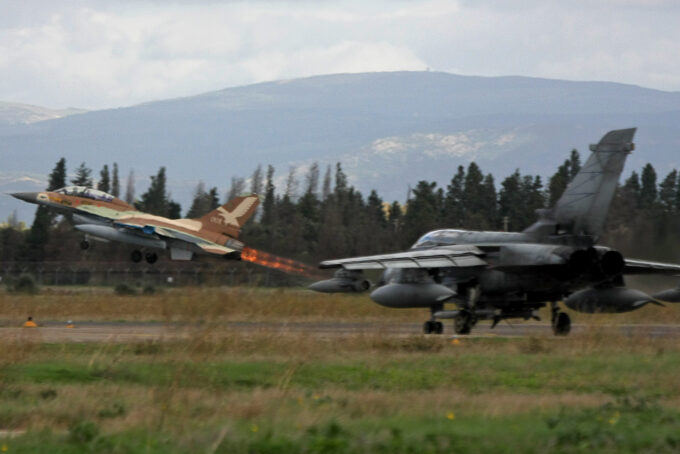
The Israel Air Force and the Italian Air Force conclude an extensive, two-week joint exercise in Sardinia. Photograph Source: Israel Defense Forces – CC BY 2.0
This is written for readers who already know the name of the crime. They do not need a primer on occupation, a debate about whether Zionism is a form of colonial rule, or a paragraph that treats “genocide” as a word still awaiting permission. The record in Gaza is the record. Free Palestine is not a closing slogan. It is the demand the status quo exists to defeat. What follows is Italy’s place in it: a client state, held to an American and Israeli alignment, with no political representation seriously willing to break it.
Italy sits in the middle of the sea that points at the oil of West Asia, and for eighty years it has been used as the flight deck of someone else’s carrier. The bases are American. The nuclear stockpile is American, and the host is not allowed to discuss it. The stay-behind army was built by the CIA and NATO under the name Gladio. The intelligence service Italian magistrates and reporters have been tracing since the 1970s is Israeli. Eric Salerno, in Mossad Base Italy (2010), and Ferdinando Imposimato, the magistrate who ran the early Red Brigades trials in the Aldo Moro case, argued that Israeli intelligence knew the Italian subversive scene from the start and worked inside it. Imposimato wrote that those services had knowledge of the operation from its beginning. Salerno’s reporting put Mossad in early contact with the milieu that kidnapped and killed Moro in 1978. These are investigations, not verdicts. What is documented is enough. Gladio’s fascist cells, the strategy of tension, and the Lodo Moro — Palestinian arms allowed to cross Italy so long as they were not used on Italian soil — are lines of policy and of covert practice. A state that lost its prime minister inside a conflict its own intelligence services had already mapped did not later acquire a voice of its own. It acquired the next set of conditions, and no political force able to refuse them.
Claudio Mutti, editor of the geopolitical review Eurasia, names the present form of those conditions in “Israele in Italia.” Israel is no longer one ally among others. It has become the symbolic and legal reference for government policy, political parties, media, and schools. Atlantic alignment now runs, in part, through Tel Aviv. The prize, the definition, the senator for life, and the lesson plan are the local instruments of an imperial order whose regional form is Zionism. The “special friendship” is older than the bill now in Parliament: a colonial ethnocracy cast as the West’s moral outpost, and a Mediterranean client taught to treat criticism of that outpost as a stain on the Republic. NATO’s rearmament of Europe sits on the same deck. More spending, more interoperability, a continent pointed at a wider war, and an opposition that treats the spending target as a matter for amendment. The PD, the Italian Democratic Party, arrives at weapons, at Ukraine, and at Israel already compromised. Not because a cable from Langley or Tel Aviv is on the table. Because the party has never built a line that could survive one. An anti-imperialist politics would break the alignment. The party that leads the opposition will not.
The country without that voice is not an ignorant country. From September 28th to the 30th, Naza — Israeli soldiers, on camera, describing the killing of unarmed people in Gaza — held first place at the Italian box office: €1.81 million and 243,466 spectators in three days. On the 30th alone it drew 94,970 people, about 40 percent of everything the country’s cinemas took that day. The same day The Bibi Files, Alexis Bloom and Alex Gibney’s film of Netanyahu under interrogation, opened at number two with 22,973 spectators. Halls sold out. The audience has already accepted what the soldiers say. The unarmed were the target. What it cannot find is a defined political opposition that will carry the conclusion, genocide, into a vote.
On March 22nd and 23rd that public defeated the Nordio reform. The constitutional referendum on splitting the careers of judges and prosecutors, a government text passed by a simple majority and signed by the justice minister, lost. No took 53.74 percent. Turnout was 58.93 percent, higher than the 2024 European election. Young and first-time voters leaned No. Elly Schlein, secretary of the Democratic Party, called it proof the young were with the opposition. They were with the No. On Palestine, and on rearmament, they are not inside a formation that can use them. The Gaza generation and the referendum generation are the same people. Neither has a seat that will say free Palestine as policy rather than as a slogan for a Saturday piazza.
The government has been more explicit than the opposition. On July 22nd, 2025, in a hall of the Chamber of Deputies, Matteo Salvini received the Italy–Israel prize. The organizations giving it, and Israel’s ambassador Jonathan Peled, called him Israel’s best friend in Italy. The genocide in Gaza was underway. Salvini, deputy prime minister and transport minister, said a ceasefire depended on Hamas releasing the hostages. The railway he oversees is defined by delay. The ceremony was on time. A prize for friendship with a state under an ICC arrest warrant is the government saying the warrant does not bind.
Maurizio Gasparri, of Forza Italia, has been among the steadiest defenders of the bill that would write the friendship with Israel into legal code. The Senate passed it on March 4th, 2026. The Constitutional Affairs Committee of the Chamber cleared it on September 30th, with Fratelli d’Italia, Lega, Forza Italia, and Italia Viva in favor. A final discussion on the floor was set to beging on October 2nd. Called the DDL on Antisemitism it writes the IHRA (International Holocaust Remembrance Alliance) definition of May 26th, 2016 into Italian law, indicators included, and makes those indicators necessary to applying the statute. These indicators are the same typs of laws implemented to ban the BDS movement in the United States. Under them it is antisemitic to call Israel’s existence a racist endeavor or to compare Israeli practices with Nazi conduct. The bill creates a national coordinator against antisemitism inside the Prime Minister’s office, a three-year national strategy, and mandatory training for teachers, students, the armed forces, the police, prefects, and the judiciary. Public broadcasting is pulled into the campaigns. The Senate struck the new criminal penalties and the power for universities to ban events. It left the definition. No new offense is required. Police and magistrates already have public-order and hate-speech laws. This law tells them how to read a speech, a lesson, a picket, or a post. Gasparri says criticism of the Israeli government remains legal. The text’s work is to sort anti-Zionism, and the naming of the genocide, into the category those previous laws already punish. For readers who hold Zionism to be the political form of the crime, this is not a dispute about tone. It is an attempt to make the politics punishable under another name.
The opposition speaks. It does not decide. Campo Largo — the big tent, the center-left’s electoral alliance, named the way the Democratic Party is named in the United States — is neither coherent nor large enough for the refusal already made in the streets and in the March referendum vote. In committee it split three ways. The Five Star Movement and Alleanza Verdi e Sinistra (The Green Left Alliance) voted against. Italia Viva voted for. The Democratic Party did not vote. Schlein has said that if the IHRA definition is not amended the party will vote no. At the Senate the PD abstained, and six of its senators voted yes. Sinistra per Israele (Left for Israel) has called a no vote a wound that will be hard to heal. Graziano Delrio, a PD senator, was among those who originally drafted the measure. Lia Quartapelle has argued that a vote of conscience for the bill should be respected. The meetings ran for hours. The bill advanced. Schlein’s party has not used the word genocide for Gaza. A conditional no, after an abstention, and after PD senators helped write the text, is the management of a faction. It does not speak for the crowds that repeatedly filled the streets for Palestinian liberation and an end to the genocide last fall. It does not speak for the audience that has since filled the halls for Naza. It will not carry a free Palestine into government.
The biography does not explain the abstention. It locates it. Schlein holds Italian, Swiss, and United States citizenship. She worked on Barack Obama’s campaigns in 2008 and 2012. She has said she is proudly the daughter of a Jewish father. Melvin Schlein, an American political scientist, lives near Lugano. He spent time on Kibbutz Nahal Oz, beside the Gaza fence, in the early years of the state. In a 2023 interview with the Corriere del Ticino he backed his daughter’s call for a humanitarian truce and called the civilian cost of the operation disproportionate. He also said he has no belief in a two-state settlement. The father is a Zionist: the kibbutz, the early years of the state, a politics that still treats the project as legitimate. That record does not make him an operative. It places a Zionist family history at the head of a party that will not name the crime. The PD’s working allegiance is an undefined center-left, an Atlantic alignment, and the fear of being called the wrong thing. The Zionist current inside the party now treats even a conditional no as too much.
The political formation that matches the streets cannot enter the count. Potere al Popolo — Power to the People — came out of the Palestine mobilizations and from rank-and-file union work and poor peoples issues, the same current that has treated the port as a battle line.It has a politics. It does not have a seat. The Rosatellum, passed in 2017, is still the law for electing Parliament. A political party inside a coalition needs 3 percent of the national vote before it wins proportional seats. A political party running alone needs 10. Below the line the votes are counted and then discarded. The reform deposited by the center-right in February 2026 keeps the barrier and adds a majority prize for any coalition that clears 40 percent, so a plurality can be turned into control of the Chamber. The parties already inside wrote both rules. A formation the size of Potere al Popolo can fill a piazza and finish the night with no representation in Parliament. The old guard left has been better at arguing inside the tent than at building a real political opposition that clears the threshold. The government does not need a believing majority. It needs the resistance kept outside the count.
The civic cover for the IHRA bill is older than Israel itself. Liliana Segre, senator for life and a 96 year old survivor of Auschwitz, wrote on September 28th that she was incredulous at the divisions, and that the Chamber text presents no real problem for political criticism. Over decades her name has been made into an almost mythological figure, the survivor who stands in for the Republic’s conscience, cited whenever antisemitism is identified with attacks on Israel “conceived as a Jewish collectivity.” The family around that figure sits in the political world the bill comes from. In 1979 her husband, Alfredo Belli Paci, stood for Parliament on the list of the MSI, the Movimento Sociale Italiano, founded in 1946 by veterans of the RSI. The RSI, the Repubblica Sociale Italiana, was Mussolini’s last state, set up in the north in 1943 under German occupation and armed against the Resistance. Belli Paci took 698 votes in Milan-Pavia. Their son Luciano called the candidacy anticommunist, not fascist. The party was still a part of that same lineage. Another son, Alberto Belli Paci, took a Forza Italia card in November 2025 from foreign minister Antonio Tajani. Forza Italia is the party Silvio Berlusconi founded. The MSI’s heirs sit beside it in the governing coalition. Survival of the Shoah is a fact. The political use of that survival is another. Norman Finkelstein named the mechanism in The Holocaust Industry: memory turned into capital, then into a license for the state that claims it. Segre has been the Italian form of that license, in the schools, on the memory days, and now on a bill that sorts anti-Zionism as hatred before it can be argued. Taught as the price of respectable speech, that narrative shields a colonial ethnocracy in the classrooms the bill would instruct, and before the police and magistrates the bill would train.
The price of the client state is on the bill, and it has not come back down. In 2025 Italy’s wholesale electricity averaged €115.9 per megawatt-hour, the highest of the main European exchanges — Nuclear France was at €61.1, and Spain that heavily invested in renewables, at €65.3. ARERA, the energy regulator, traces the gap to gas. Italy still makes its power from a fuel it must import, and the cost lands on the household. Domestic electricity remains above the euro-area average. Fuel at the pump is among the most expensive in Europe, loaded with excise before the driver has left the station. Skyrocketing inflation in the years of the energy shock has lifted food, rent, petrol, and the ordinary bill.
The pressione fiscale — the share of income taken in tax — is among the heaviest in Europe, and it falls on wages and on consumer goods. A public-health appointment can take months. The schools are underfunded. The trains Salvini oversees are late as a matter of course. France and Spain have answered less severe economic shocks with strikes that stop the state. Italy, after the Palestine wave, has not. There the rage is in the streets. Here it stays under the surface, without a representation that will carry it.
The borghesia still has the house at the sea. A broad but always shrinking middle class has spent what it can still spend in place of a politics that does not deliver a wage, a train that runs, adequate schools, or a break with the genocide. Giorgia Meloni has not produced the growth she promised. Antonio Tajani’s foreign-policy positions have repeatedly been mocked, like his statement when the Global Sumud Flotilla was being intercepted in an act of state piracy that: “International law was valid up to a certain point“. The alignment has not moved. Washington first. Tel Aviv as the fixed point in West Asia.
The strikes of 2025 were not given a political home. On October 3rd, CGIL and USB were both in a general strike that filled the streets and disrupted shipments linked to Israel. The piazzas then thinned, and the unions divided. USB, the rank-and-file union, stayed on the cargo: the arms shipment, the dock, the demand that an Italian port not load a genocide. CGIL, the largest confederation, was in the photograph and uneven after it. Maurizio Landini did pledge a general strike if the flotilla were seized. The organization then returned to what it is, millions of members, a heavy share of them pensioners, better at a declared day than at a line that holds. USB says CGIL joined the October 3rd strike once the piazza was already defined, and that Filt, CGIL’s transport federation, has claimed a record on arms shipments the dockworkers say it did not earn. Other national unions have been further from the docks and the battle front. While one union has tried to stop the ships. The others marked a day and went back to the calendar. That is not silence. It is a scale of organization that does not match the genocide, the price of power, or the audience now buying tickets.
The port is the exception. USB, Unione Sindacale di Base, has treated the docks as a line in the sand. In Genoa, Livorno, Piombino, and La Spezia, strikes have been called against arms shipments, complaints filed with prosecutors and harbor masters, ships delayed or left unworked. That is Boycott, Divestment and Sanctions at the crane, the tactic that does not ask a party for permission. These are hints, not a second wave. They are the only place a second wave can start. They are not waiting for a resolution from a tent that cannot hold them.
Italy has a public without a political voice. Keep the two facts apart. In three days, 243,466 people paid to hear Israeli soldiers describe the killing of the unarmed. On September 30th another 22,973 also paid to watch Netanyahu under interrogation. Last fall the same public repeatedly filled the streets for Palestinian liberation and an end to the genocide. In March, 14.5 million voted No to a government reform, and the opposition that celebrated the result could not make it a political force. On the docks, workers have already refused the cargo. None of these refusals has a representation willing to carry it. Campo Largo will not say genocide. It will not break with Zionism. It will not oppose NATO rearmament except by amendment. It split on the bill that classifies the refusal as antisemitism, and PD senators helped draft the text. The government does not have to persuade the country. It only has to pass the law. A public that can fill a cinema, and that has already filled the piazzas, cannot translate its resistance into a defining politics. An opposition that can hold a press conference cannot fill that gap. Free Palestine is the line. The political caste will not draw it. Until the people who have already drawn it, in the streets, in the halls, at the referendum, and at the ports, draw it as a politics, Italyremains what it has been since Gladio. A flight deck pointed at West Asia, spoken for by Washington and Tel Aviv, governed as if the audience were not in the room.