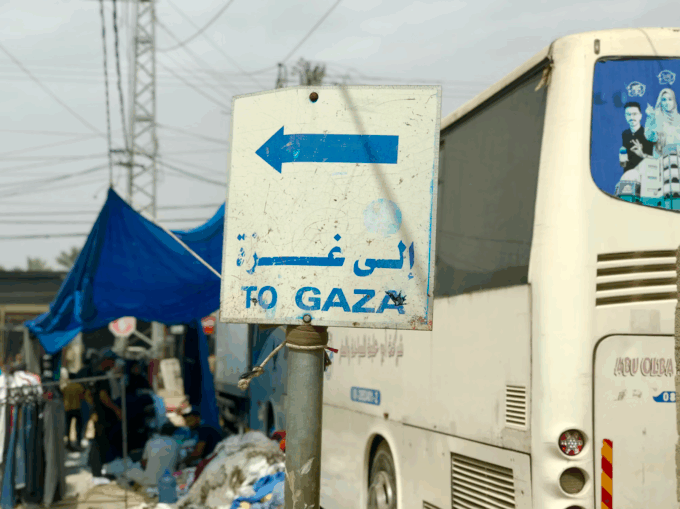
Photo by Emad El Byed
“Did you want to see the photographs?”
“I feel like I’m gonna end up blurring it or not using it.”
“Why? Who are you offending?”
Thus begins American Doctor (2026), in a frank exchange between an orthopedic surgeon and first time director Poh Si Teng about the ethics of the journalistic choice in front of her. Assured that she has the permission of the survivors to show the images of the victims, Teng does end up including—judiciously—the uncensored photographs exhibiting the savage consequences of Israel’s war in Gaza. With this, American Doctor is best understood as an anti-censorship film. It’s legacy, however, will be as a historical record of the day-to-day work in a Gaza hospital under fire.
A Jewish doctor, a Palestinian Arab doctor, and a Parsi Zorastrian doctor, each American, collaborate in hospital hallways and operating rooms with local medical students and staff. The personalities and backgrounds of the three doctors are strikingly dissimilar. They didn’t know each other before Gaza. Each has their own personal reasons for coming from the US. But each came out of a deep sense of responsibility.
Between Palestine and America, we follow these men as they go about their business, practicing medicine and social activism—from surgeries with limited resources, to relaxed chats on the hospital terrace, to live CNN interviews, to moments with family back home.
Documentary films produced in Gaza are by their very nature evidence of a deliberately obscured reality. With assassinations of journalists an apparent (and successful) part of Israel’s war effort, news and information about everyday life in Gaza has been reduced to a mass media trickle. But these films continue to be made. Awarded Special Mention in the Human Rights competition at this year’s Copenhagen International Documentary Film Festival (CPH:DOX) where the film had its international premiere in March, the team behind American Doctor managed to smuggle hours and hours of high-quality 4K footage out of Gaza to New York.
A veteran producer, Teng makes more than just news in her directorial debut. The film brings a particular ethical and aesthetic perspective with it that amounts to an urgent plea for ending US support for the destruction of Palestinian hospitals, and other human rights violations.
While the effects of such violence are included—reality is the intended priority here—the film is hardly a constant barrage of graphic imagery. In the end this is mostly a film about ideas—about social responsibilities and ethical imperatives. The most shocking images, for this viewer at least, come from drones, flying peacefully like stunned birds, showing the endless devastation of the city, block after block after block of utter destruction and uniform ruin. How many human corpses lie beneath the dizzying amount of monochrome rubble?
A major struggle for the American physicians in the film is simply to be allowed entry into Gaza by the Israelis. Humanitarian aid is often blocked at the Palestinian border, and this includes doctors and their medicine. Hiding antibiotics in luggage in order to get it past customs is a necessary part of the work for the American Jewish doctor. The American Palestinian doctor is not only stopped at the border by the Israelis on one of his visits to Gaza but, he explains, he was then interrogated by DHS on his arrival home to Chicago. So instead of working in scrubs back at Nasser Medical Center in Khan Younis—which the end credits show us was subsequently bombed in a triple tap strike—we watch as he gives talks and works the American media back home.
Against the reasonable advice of friends and family, Teng put up her own savings to get this film made, a commitment born of political and personal exasperation. By foregrounding the work and perspectives of the American doctors—at great risk to their own lives and reputations—Teng exposes difficult truths that we are not used to seeing. She shows the human consequences of Israeli crimes in Gaza, her angle emphasizing American responsibility for them.
Would the atrocities continue without the diplomatic, military, and economic support of the US government and its taxpayers? Teng believes not. She has said that she didn’t have any more words to explain what was going on and was tired of speaking about it—she just needed to make this film and show it. Her intention is to bring it to as many Americans as she can in the hope that it might do its part to help shift US policy toward Israel and end a genocide.
While a view into Hamas’s socio-political role on the ground during this period would have taken the film deeper into the maelstrom and further into complexity, that’s a different documentary. To be able to experience life and work in Gaza on film through an American medical perspective is very unusual, and undeniably powerful. If you have an opportunity to see American Doctor, don’t shy away. Look.
1700 healthcare workers were killed in Gaza between 2023-2025.
American Doctor is currently playing in theaters only. To find a screening near you: https://americandoctorfilm.com/