
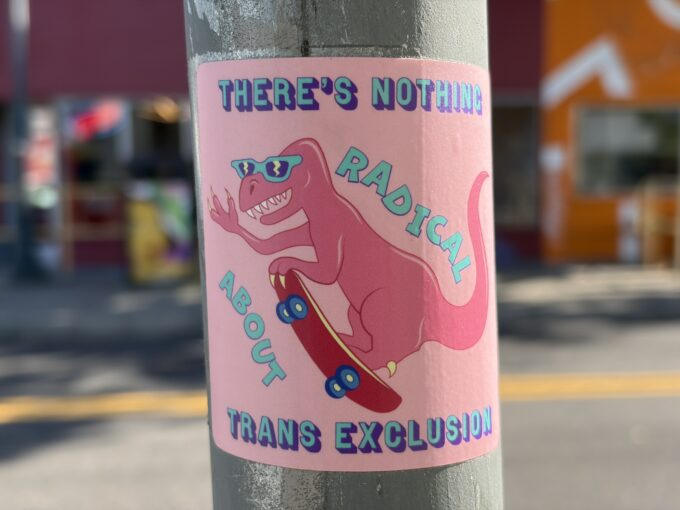
Photograph by Nathaniel St. Clair
In 1952, George Jorgensen, a 26-year-old former private in the U.S. Army, traveled to Denmark to undergo a gender reassignment procedure, what was then known as a “sex change” operation. Returning to New York as Christine Jorgensen, her daring gained a famous Daily News headline: “Ex-GI Becomes Beauty.” The Jorgensen story was the Daily News’ “most read story of 1953.”
The UC Berkeley scholar Danya Lagos noted, “Jorgensen’s popularity led to the popularization of the term ‘transsexual,’ and its emergence as a social category led both medical and scientific researchers and the popular press to distinguish gender identity as a factor distinct from sex and sexual orientation.” The Jorgensen story helped kick off a major shift in the acceptance of “gender non-conforming” or “transgender” people, what Lagos identifies as “the transgender tipping point of the 2010s.”
When Donald Trump and other top administration officials first took office in 2017, they pledged to fulfill the 2016 Republican Party’s platform that asserted:
“Traditional marriage and family, based on marriage between one man and one woman, is the foundation for a free society and has for millennia been entrusted with rearing children and instilling cultural values. We condemn the Supreme Court’s ruling in United States v. Windsor, which wrongly removed the ability of Congress to define marriage policy in federal law.*
On January 20, 2025, when Trump took office for his second term, he issued a “Presidential Action” that insisted: “Sex” shall refer to an individual’s immutable biological classification as either male or female. “Sex” is not a synonym for and does not include the concept of “gender identity.”
Two-Spirit People
Sadly, the Republicans and Trump apparently know very little of America’s long experience with non-traditional gender identity. The Human Rights Campaign has found that “more than 150 different pre-colonial Native American tribes acknowledged third genders in their communities.” It stresses that “Two-Spirit and third gender people varied by tribe.” And it adds, “What is clear from these accounts is that gender and sexuality was certainly more fluid in Native American society than it was in European society.”
“Third gendered” or “Two-Spirit” people is a translation from the Anishinaabemowin phrase niizh manidoowag, indicating a person whose body houses both a masculine and a feminine spirit. Among Two-Spirit people were the nádleehi people of the Diné (Navajo Nation) who Wikipedia defines as “one who changes” or “one who is transformed,” that is a male-bodied person with a feminine nature or fluid gender expression. Another was the badé people, a minority within the Crow Nation of males at birth who live, dress and fulfill social and ceremonial roles typically held by women. The Lakota long honored winyanktehca or Winkte people, who were male-bodied individuals who embody feminine characteristics; those who “want to be like a woman.” The Zuni people long honored lhamana, males who take on the social and ceremonial roles usually performed by women.
Sadly, the legal scholars Kat Reilley Harlow and Aubrey Owen Shiffner found, “the Bureau of Indian Affairs (BIA) agent E.P. Briscoe ‘launched a campaign of terror’ against Osh-Tisch and other badé people ….” They noted that in the late 1890s, Biscoe “incarcerated the badés, cut off their hair, made them wear men’s clothing. He forced them to do manual labor. . .” They added, “Native children who fell victim to federal Indian boarding schools, a form of cultural genocide intended to sever tribal ties by violently assimilating Native youth into settler society.”
There have been transgender people in America since before the U.S. became a nation. Genny Beemyn, in “Transgender History in The United States,” notes that in the 1620s Thomas/Thomasine Hall, an English servant in colonial Virginia, “claimed to be both a man and a woman and, at different times, adopted the traditional roles and clothing of men and women.” At trial in 1629 concerning her/his scandalous behavior, the court ordered Hall to wear both a man’s breeches and a woman’s apron. Beemyn also notes that in Middlesex County, MA, in 1692, charges were filed against an individual named Mary Henly for wearing “men’s clothing” because such behavior was “seeming to confound the course of nature.”
In 1776, Jemima Wilkinson, a 23-year-old woman living in Cumberland, RI, suffered from a severe fever and nearly died. When she awoke, she insisted she was a changed person, that the old female self was reborn as neither a male or female. A couple of years later, Deborah Sampson attempted to enlist in the U.S. army but was rejected because she was a woman. In 1782, she tried again as Timothy Thayer, but was recognized by a neighbor and again was rejected. Later that year, she entered the Uxbridge, MA, army recruitment office and enlisted as Robert Shurtleff and joined the Light Infantry Company of the 4h Massachusetts Regiment, an elite unit composed of “soldiers tall and strong enough to keep pace on rapid marches.”
Between 1845 and 1900, numerous laws were passed in 34 cities in 21 states prohibiting cross-dressing by both women and men. Emma Snodgrass, a 17-year-old girl, was arrested numerous times in Boston during the 1850s for wearing breeches and she was charged with vagrancy. The New York Daily-Times of January 8, 1853, reported:
The foolish girl, Emma Snodgrass, who goes about in virile toggery, was taken before the Court here, as a vagrant, a day or two ago. But it was proved that she did not beg nor misbehave herself, and that she paid her way. She was therefore let go — to pursue a wretched life of idleness and immorality.
Dr. Mary Walker, a Civil War surgeon, the first female U.S. Army surgeon and the only woman to receive the Medal of Honor, was another woman who wore men’s pants and was repeatedly arrested. In April 1864, Walker was captured by Confederate troops as a spy and held as a prisoner of war for four months. While in prison, Walker refused to wear the women’s clothes provided to her. As Women’s History reports, “She wore men’s clothes her entire life because she felt they were more comfortable and hygienic and made her job as a surgeon easier. She had even wore pants under her skirt at her wedding.”
Effie Waller Smith was a teacher and poet who was born male but lived as a woman. She occasionally attempted to comply with cross-dressing laws by wearing men’s clothing but was instead arrested three times for impersonating a man. One of her poems, “Bachelor Girl” (1909), opens with these lines:
She’s no “old maid,” she’s not afraid
To let you know she’s her own “boss,”
She’s easy pleased, she’s not diseased,
She is not nervous, is not cross.She’s no desire whatever for
Mrs. to precede her name,
The blessedness of singleness
She all her life will proudly claim.
And then there is William Dorsey Swann, popularly known as “The Queen,” who originated the modern drag ball at his legendary private parties. According to the Southern Poverty Law Center (SPLC), “In the 1880s, Swann began hosting secret dancing competitions disguised as family gatherings in his Washington, D.C., home. Swann’s guests had masculine, working-class jobs like butler, coachman, cook and messenger.” At the “House of Swann,” he introduced the “‘cakewalk’ because decorated cakes were presented as prizes, the events included singing, dancing and minstrel-style pageantry.” Dubbed “the queen of drag,” the SPLC adds, “Swann helped transform cakewalks into one of the most vital forms of expression of queer expression.”
In 1890 San Francisco, Dick/Mamie Ruble was arrested for wearing men’s clothing, thus violating cross-dressing laws. He told the judge, “I’m neither a man nor a woman and I’ve got no sex at all.” Ruble argued that they should not be forced to wear women’s clothing because they “couldn’t pass for a woman anywhere, even if [they] tried.” Ruble’s insistence on their gender identity was taken as evidence of insanity, and they were committed to the state-run Stockton Asylum, where they spent the remaining 18 years of their life before dying of tuberculosis.
Trans & Gay Movement
In popular “before” and “after” period photos of George/Christine Jorgensen, it appears that a man was not merely transformed into a woman, but a butterfly was liberated from its caterpillar self. A reportedly meek, retiring guy left New York and a glamorous, sexy gal returned. The new Jorgensen appears with high cheekbones, long eyelashes, full, painted lips, adorned with a stylish hat and often wrapped in a full-length fur coat.
Jorgensen was born on May 30, 1926, and – along with his sister, Dorothy — grew up in the Bronx, children of working-class parents. Like many transsexuals, he was not a homosexual, but long felt he was a female living in a male’s body. He researched scientific literature about people suffering similar conditions, including Paul De Kruif’s study, The Male Hormone (1945).
Jorgensen wanted to be a documentary filmmaker and went to Europe to ostensibly make a vacation film. While in Denmark, he sought out medical assistance from Dr. Harry Benjamin, author of the influential study, The Transsexual Phenomenon (1966), and, over a three-year period, received hormone therapy as part of the gender reassignment procedure. Jorgensen began living as a woman following her second surgery.
It should be noted that no publication was more critical of Jorgensen than Time, which, in its April 20, 1953, issue, called her an “altered male” and a “male castrate,” claiming she was exploiting her transition to make money. Nevertheless, Jorgensen took full advantage of her newfound celebrity, becoming a popular nightclub performer, entertaining her audiences with dancing, humorous commentary and singing “I Enjoy Being a Girl.”
During this post-WW-II era, the transgender and gay rights movements were beginning to flex its muscles. This movement came to a head during the Stonewall Riots of 1969; among those who gave voice to the movement was transgender activist Sylvia Rivera. However, a decade earlier, in May 1959, there was the Cooper Do-Nut (aka Cooper’s Do-nuts) riot in Los Angeles. As the University of Southern California notes:
“The five patrons — two drag queens, two male sex workers, and one gay man — were led outside to be arrested following the ID checks, and when the officers attempted to shove all five into the same police car, one of the men began to protest being crammed into the packed car. His protest spurred the crowd of onlooking fellow patrons into action, and together a group of lesbians, transgender women, drag queens, and gay men rushed into the streets and began to pelt the officers with donuts, paper plates, coffee cups, and anything else they could get their hands on.”
In April 1965, the staff of Dewey’s Restaurant, at 219 South 17th Street in Philadelphia, refused to serve more than 150 people, trans and gay, “wearing non-conformist clothing.” Three teenagers — two boys and one girl – who had been served, refused to give up their seats, thus starting a sit-in. The sit-lasted a week and restaurant’s owners lifted the ban.
In August 1966, George Compton’s cafeteria, in San Francisco’s Tenderloin district, was a late-night hangout for trans women, drag queens and sex workers. One night, when the police tried to evict a drag queen, she threw a cup of coffee in his face. This fueled a riot in which has been described as “people flipped tables and threw cutlery. Sugar shakers crashed through the restaurant’s windows and doors. Drag queens swung their heavy purses at officers. Outside on the street, dozens of people fought back as police forced them into paddy wagons. The crowd trashed a cop car and set a newsstand on fire.” One participant said, “We just got tired of it …. We got tired of being harassed. We got tired of being made to go into the men’s room when we were dressed like women. We wanted our rights.”
Patriarchy’s Erosion
The Christian right launched the current round of the culture wars in the 1970s, targeting abortion, transgender youth, book censorship and other issues. Nevertheless, Americans are “freer” — less restricted by traditional values and legal prohibitions – than at any time in the nation’s history. Nowhere is this more evident than among sexually non-traditional people, especially what was long identified as “Two-Spirit” people.
In 2014, Time magazine reported that the U.S. had reached a “transgender tipping point.” As it stated, “I stand before you this evening,” Laverne Cox, who starred in the Netflix drama Orange Is the New Black, proclaimed, “a proud, African-American transgender woman.” In 2017, National Geographic released a special issue, “gender revolution,” with a photo of a transgender girl on the cover.
Contemporary America’s conception of Two-Spirit or gender non-conforming people has gotten even more complex. B. Lee Aultman proposed a glossary of today’s Two-Spirit people that includes:
“androgyne, cross-dresser, genderbender, genderf*cking, gender neutral, gender nonconforming, genderqueer, gender-variant, masculine of center, neutrois, pangender, queer, translatin@, and Two-Spirit (culturally specific) androgyne, cross-dresser, genderbender, genderf*cking, gender neutral, gender nonconforming, genderqueer, gender-variant, masculine of center, neutrois, pangender, queer, translatin@, and Two-Spirit (culturally specific).”
The Williams Institute estimated that in the U.S. in 2025 there were 2.8 million people 13 years and older who are gender non-conforming or transgender. It also estimated that 13.9 million American adults were LGBT.
Equally revealing, sex before marriage is common and a 2026 YouGov survey of 1,107 adults found that 81 percent of those surveyed have had sex and that nearly half (46%) had sex between the ages of 16 and 20 years of age. In addition, Pew Research reports that 77 percent of U.S. adults aged 38 to 43 have lived with an unmarried partner.
Cumulatively, these profound shifts in gender and/or sexual identity as well as sexual practices among Americans suggest the scope of the erosion of traditional patriarchy.
* U.S. v. Windsor was a 2013 Supreme Court ruling that found the 1996 Defense of Marriage Act (DOMA) violated the Fifth Amendment’s Due Process Clause by depriving same-sex couples of equal liberty and protection.


