
I am often struck by the disconnect between non-revolutionary authors’ often brilliant descriptions of grave contemporary problems and those authors’ far less impressive understanding of the origins of those problems and what is to be done to solve them[1].
Fascism with an Apocalyptic Twist
Take the celebrated social democrats Naomi Klein and Astra Taylor’s new book End Times Fascism and the Fight for a Livable World. To their credit, Klein and Taylor don’t hold back from properly labeling what we are up against with the Trump regime and likeminded regimes around the world as fascism. They deserve further praise for naming the system behind the menace as capitalism.
Klein and Taylor advance a serviceable if rather incomplete and perhaps overly elaborate description of fascism:
“Revolutions are often uprisings of the weak and downtrodden. Fascism, in contrast, is a revolt of the strong or relatively strong and injured that, while antidemocratic, taps into powerful popular passions and resentments. Its leaders have frequently been military veterans who recently lost on the battlefield, working with business owners facing threats to the bottom lines, and, at times, conservative religious leaders. In moments of widespread economic crisis and social turmoil, fascists build mass movements by fusing and equating elite experiences of injury and lost status with the more widespread pain of working people, particularly men whose pride has been injured. Unlike workers’ revolutions, which have the goal of transforming and remaking societies from below, fascists movements claim to be defending powerful institutions – the nation, the market, the military, the family – from internal and external pollutants. In the logic of fascism, the task of defeating those threats, and reimposing order, requires emergency measures, often destroying many of the very institutions fascists claim to be defending” (End Times Fascism, p. 9).
None of that is incorrect – and neither is the description they paste in from the historian Robert Paxton[2] – but the meat of the matter gets a bit lost in that paragraph. Fascism seeks the dictatorial “might makes right” makeover of government, politics, and society in service to virulent and often genocidal racism, misogynist patriarchy, xenophobic nationalism, endless war, and savage capitalist class rule.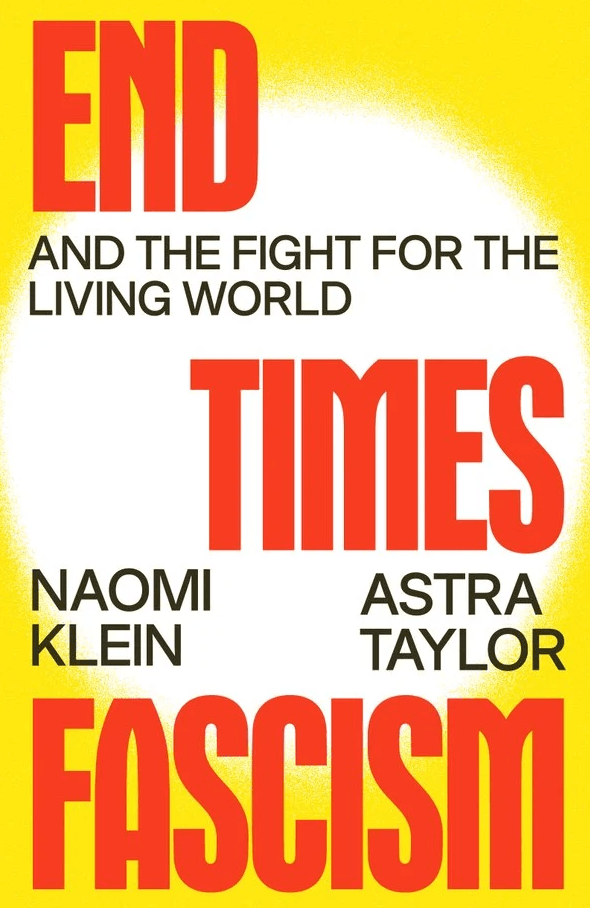
Consistent with Klein’s previous books The Shock Doctrine and Disaster Capitalism, Klein and Taylor distinguish between the classic historical fascism of Mussolini and Hitler and the “end times” fascism of Trump and his 21st century ilk, who have arisen in a time of accelerating climate catastrophe and thermonuclear war menace:
“While the violence European fascists inflicted on their internal outgroups and external enemies was indeed apocalyptic, they were not typically imagining the end of the world so much as the destruction of particular parts of it. At least some of them foresaw a future where the wars came to an end, and a purified, wealthy, stable national body emerged…[serving] not just the rich, but for the working-class base as well…This is where Trump and other far-right leaders in his orbit depart sharply from their predecessors…The politicians driving end times fascism are too kleptocratic, too focused on hoarding for themselves and their class, to deliver on their vague campaign promises of better days…[Their] Armageddon complex …has become a unifying and guiding principle. End times fascism does not offer an end to apocalyptic violence and turmoil, only the chance to believe in one of its visions of bunkered survivalism as the human project goes down.”
I am reminded here of something Noam Chomsky said in a January 2020 interview, explaining why he considered Trump and not Hitler as “the most dangerous criminal in human history”:
“Hitler had been perhaps the leading candidate for this honor. His goal was to rid the German-run world of Jews, Roma, homosexuals and other ‘deviants,’ along with tens of millions of Slav ‘Untermenschen.’ But Hitler was not dedicated with fervor to destroying the prospects of organized human life on Earth in the not-distant future (along with millions of other species). Trump is. And those who think he doesn’t know what he’s doing haven’t been looking closely.”
(That is even truer now than it was seven years ago: the Trump47 regime makes the Trumpp45 one look mild by comparison.)
Three Core Constituents
Klein and Taylor identify three leading driving forces behind this new apocalyptic end-of-days fascism: (i) the “religious end-timers,” the “Rapture-ready” Christian fascists who look forward to a Biblical Armageddon; (ii) the “tech end-timers,” the billionaire Silicon Valley “Nerd Reich” tech bros who Klein and Taylor rightly call “the faction of the capitalist class that would most dramatically flip to align with end times fascism” (p. 35), seeking “an escape into the [digital] cloud” following the destruction of jobs and livable ecology that they themselves advance; (iii) the “ethno-nationalist end-timers” and “remigration” advocates who seek a “bunkered Fortress State” in genocidally racist response to the supposed existential menace to “Western civilization” posed by nonwhite migration and “white replacement.”
“The Left’s Own Dangerous Messianism”
It isn’t just the right that Klein and Taylor charge with horrendous thinking. End Times Fascism skewers “the left’s own dangerous history of messianism, culminating in its own horrors,” reflecting what they call “once-pervasive dogmas and delusions, including a mechanical and misleading view of history marching ineluctably towards a workers’ utopia.” This is a not-so veiled attack on the communist-led socialist revolutions and first socialist states in Russia (1917-1956) and China (1949-1976). Klein and Taylor advocate “a more credible and unassuming Eden: the ongoing work of improving our collective condition on a living planet, ailing but still teeming with divinity” (p. 267).
“Migrants are the Contemporary Monster”
Klein and Taylor take their reader on an extensive tour through the new triple end-timer fascist nightmare that has congealed its hatred around the supposed dire threat embodied in “the figure of the migrant…In the past,” they write, in an exceptional passage:
“fascism has been animated primarily by hatred of fellow citizens – those of a different ideological persuasion, religion, skin color, or sexual orientation – as well as of enemy nations. Today, these rages persist, but it is the figure of the migrant, the noncitizen ‘invader,’ that most bands together the global far right in common hatred and fear, from Norway to Australia, Canda to Chile. The centrality of migrant hatred is inextricable from the end times quality of today’s fascism. Migrants are the contemporary monster precisely because so many millions of people on this fast-warming and war-ravaged planet are on the move…” (emphasis added).
This is a very important historical and political observation.
“Capitalism’s Most Ferocious Threat Response”
Klein and Taylor also advance some instructive reflections on the specific historical conjunctures and capitalist calculations that permit fascist movements to gain political traction and even state power in capitalist nations:
“fascism is a throughline in the history of capitalism…[We are not] saying that every capitalist democracy is always on the brink of flipping fascist. Long periods go by without the kind of sweeping, supremacist spasm we are seeing now. Clearly, fascist tendencies rise to the surface at specific historical moments, not others…Those moments share two notable characteristics: they are times of widespread crisis, when the market economy is quite obviously failing large numbers of people…they are also periods when capitalism faces credible challenges from below – primarily from organized workers, but also from marginalized groups long excluded from prosperity. Put another way, fascism is capitalism’s most ferocious threat response, a way of making sure that the public anger that wells us during periods of deep crisis is directed downward at the vulnerable rather than upward at the system itself and its most privileged stewards and beneficiaries” (pp. 31-32)…The pattern is clear: fascism emerges in moments of systemic crisis, conjoining popular passions with traditional authority and protecting elite power against the threat of economic redistribution from below. That was true after the Civil War and emancipation in the US. South. It was true after World War I and the Great Depression…rather than address crises at their root, fascism shakes off all democratic niceties and crushes the threat of a fairer economic order, while directing mass anger and frustration toward vulnerable scapegoats. Fascism is capitalism with bared teeth” (pp. 33-34, emphasis added).
The phrase “primarily from organized workers” is an anachronistic distortion, an overhang from classic European fascism, which formed in the wake of the Bolshevik revolution, a crushed German workers’ revolution, and in response to the existence of mass socialist and communist parties in early 20th Century Europe. And indeed, Klein and Taylor make an interesting case that their “capitalist threat response” analysis applies to the 21st Century United States, where there is little serious threat to capitalism “from organized workers.” They mention a number of developments that have provoked “the billionaire class” to believe that “the pitchforks are at the gate”: the Occupy Wall Street rebellion, the Black Lives Matter movement, “socialist” Bernie Sanders’ two serious presidential runs, the global fossil fuels divestment movement, global climate strikes, popular movements against gas and oil pipelines, Alexandria Ocasio-Cortez’s rise and championing of the Green New Deal, the rise of cheap alternative renewable energy technologies, anti-Amazon campaigns, rising popular opposition to Big Tech and AI, and internal Silicon Valley movements against racism and sexism in Big Tech. All of this and more – Klein and Taylor could have mentioned popular support for the health insurance CEO killer Luigi Mangione and for a spate of warehouse protest fires that broke out earlier this year – have helped fuel fascism across a certain powerful minority section of the American ruling class.
Clearly and contrary to what numerous Marxist grouplets have told me over the last decade, a significant section of the capitalist class can opt for fascism even in the absence of a “revolutionary” rich national proletariat.
+++
Beyond its real and thought-provoking contributions regarding differences between the original and contemporary versions of fascism and the capitalist calculations and conjunctures that give rise of fascist ascendancies, End Times Fascism has six key and related problems.
+1. No China
First, a major world historical development central to the rise of the new fascism is egregiously missing in End Times Fascism: the rise of authoritarian state-capitalist China as an ever-richer and more powerful competitor to the United States’ status as the world’s dominant nation. The emergence of this potent new capitalist-imperialist rival to US wealth and power provides key context for why powerful sections of the US ruling class have moved against previously normative bourgeois democracy, rule of law, civil rights, and decency. The capitalist calculations here are about toughening up, meeting the new challenger without the supposed hindrances on business freedom and military assertiveness posed by decent programs, policies, standards, and norms won in part by people’s movements – labor, civil rights, voting rights, women’s rights, LGBT rights, free-speech rights consumer rights, environmental rights and more – in the US. Remarkably enough, there is not a single reference to rising China in Klein and Taylor’s book.
+2. No Actual Revolution
Second, there’s the problem of what is to be done about this new capitalist fascism, however we define and describe it. Everything that Klein and Taylor celebrate and advocate as meaningful resistance to the Trump fascist regime and agenda (my language, not theirs) falls short of the sustained mass movement required to defeat fascism in the short term and the actual socialist revolution required to sweep fascism into the dustbin of history. Despite their radical-sounding conclusion that “we can abandon and betray [our living] world, or we can break with capitalism and build new economic and political systems” (p. 325, emphasis added), the activism and policies acclaimed and promoted in End Times Fascism come nowhere near the “revolutionary reconstitution of society” (Marx and Engels, 1848) that is desperately needed if humanity is going to step back from the brink of societal collapse at best and extinction at worst.
Klein and Taylor’s book is very into staying where we are. The authors rejoice in the place-based “hereness” and “neighborliness” of activists who have defended their local communities and ecologies against ICE assaults, pipelines, and data centers. They even call the “hereness” of Zohran Mamdani’s centrist and social democratish campaign to make New York City more affordable for ordinary people “the antithesis of fascism.” The reformist essence of this “antithesis” is summarized well on p. 266 of End Times Fascism:
“The best way to help people be their best selves is to make their lives better in the here and now. This is what Minnesota’s remarkable movements have to teach us, and this is what the politics of hereness has to offer. This points to a critical lesson about how to fight end times fascism: efforts to help people feel safe enough not to turn on one another must be front and center…ensuring people’s basic needs are met is a critical component of effective antifascist strategy.”
No, sorry. Capitalism is unreformable in “the here and now” thanks to its endless anarchic chaos of competition, its relentless and growth-addicted race for the rapacious exploitation of human and natural resources, and it unbreakable attachment to racism patriarchy, war, militarism, nativism, and ecocide as well as to an underlying class dictatorship that renders democracy farcical and meaningful and durable social democracy simply impossible. The antithesis of fascism is not a progressive-sounding, capital-appeasing mayoralty or an inspiring, even heroic local campaign against a data center or an ICE invasion – a community self-defense movement replete with admirable racial and ethnic inclusion and mutual aid. It’s what Dr. Martin Luther King, Jr, (no revolutionary himself) called near the end of his life “the real issue to be faced” beyond “superficial” matters: “the radical reconstruction of society itself.”
That’s a different-sounding Dr. King than the King Klein and Taylor trumpet near the end of End Times Fascism: one for whom (in Klein and Taylor’s words) “the promised land was the place that the people of Memphis were fighting for when they demanded fair wages.”
Here we see the economistic surrender of revolutionary imagination that is so sadly pervasive across much of “the left,” past and present: “fight for better wages,” not for the end of wage slavery itself.
“We Need Only Look to the New Deal”
The non-revolutionary reformism at the heart of what the “socialist” authors of End Times Fascism call “the antithesis of fascism” is especially evident when the book looks beyond the fetishized local say what they advocate at the national and international levels: “robust corporate taxation and other redistribution mechanisms” to share the economic benefits of AI; new “less exploitative” (!) systems to curb AI’s harms; a federal jobs guarantee funded by a tax on tech companies; wealth caps and a global crackdown on corporate tax evasion to “curb billionaire power.”
“We need only look to the New Deal era for inspiration” (p. 306), Klein and Taylor write. I did a double take when I read that. To the New Deal, which provided some material benefits to working-class Americans to preserve the underlying profits system, the explicit objective as articulated by its leader Franklin Roosevelt – a reform program that left the proto-fascistic Jim Crow system of racial oppression and terror untouched and even emboldened? Really?
“If billionaires are going to act like a modest tax is an existential threat,” Klein and Taylor write, “why bother with fiddling with half measures instead of going for real solutions?” (p. 309). “No victory will be safe,” Klein and Taylor add, “until we address the forces that drive end times fascism…We need to “address crises at their root” (p. 33)? Okay, true enough…so can we can stop screwing around with neo-New Dealism and localist feel-good kitchen table mutual-aid in “the here and now” – as wonderful and essential as that mixture has been in places like the Twin Cities last winter – and get serious about the real solution: an actual proletarian revolution to abolish the capitalist mode of production and more broadly take up “the revolutionary reconstitution of society” along socialist lines on the path to full emancipation from all forms of exploitation and oppression – that, is, to communism? To create another world instead of the class ruled one we inhabit? It’s not for nothing that radicals have long said “Another World is Possible” and that I scribbled “Let’s Not” on page 239 of End Times Fascism, right under the title of the book’s fourth part, which reads “Let’s Stay.”
No, let’s not stay under the capitalist mode of production and the political and ideological superstructure that has grown up around it. Another world is possible and in fact another world is required.
No, not another planet in this or some other galaxy. An Earth transformed by actual revolution. This is about science and heart, even spirit, but not “divinity.”
+3. Misrepresentation and Ignorance Regarding Marxism and the First Socialist States
Klein and Taylor here badly misrepresent both the complex, at once inspiring and troubling history of the first socialist states and the world view of those who led their formation and who rejected the teleological inevitable-ism and determinism that partly infected Marxism’s original theorization. Neither the Bolsheviks under Lenin nor the Chinese revolutionaries under Mao were remotely captive to “a mechanical view of history marching ineluctably towards a workers’ utopia” —quite the opposite was the case. The states those communist revolutionaries led carried out significant and remarkable, positive accomplishments. Neither of those states successes nor their failures and mistakes can be properly understood without reference to the remarkable imperialist and internal counter-revolutionary hostility, terror, and inertia they faced [3].
Hardly unusual in the left intelligentsia, Klein and Taylor are woefully ignorant of the existence of a New Communism that builds both on Marx and on significant critique as well as appreciation of the first socialist states.
+4. Misrepresenting the Base
Beneath the reformist and economistic argument in End Times Fascism lay two related empirical mistakes regarding the fascist MAGA base in the United States: an exaggerated sense of how economically aggrieved and working class that base is and an exaggerated, worker-fetishizing sense of how susceptible that Amerikaner base is to breaking off from MAGA and indeed to embracing the social-democratic attractions of Klein and Taylor’s reformist (“socialist”) friends and heroes Bernie Sanders, Alexandria Ocasio-Cortez, and Mamdani. The core Trump base measures its status and well-being not in terms of how far behind the bourgeoisie it is or of how economically secure it is, but rather in terms of how far it is ahead of racialized nonwhite Others. It is deeply invested in the oppressive systems and traditional and reactionary values of racism, sexism, nationalism, and (often) religion, all of which have long been poured into the foundations of the capitalist system. Its reactionary politics are often sparked as backlash to real and imagined threats to those systems and values posed by popular movements and rebellions against racism, sexism, and nativism — systems and values that cannot be overcome under the capitalist-imperialist system.
+5. An Excessively Economistic and Class Reductionist Understanding of What Drives Fascism and its Targeting of Marginalized Others
It is very revealing that Klein and Taylor reduce the proto-fascistic attack on the post-Civil War US Reconstruction governments to “threat of economic redistribution from below.” That threat to big southern landowners was certainly part of the reactionary Redeemer and Jim Crow mix, but the author’s glib formulation badly underestimates the relatively autonomous relevance and particularity of the threat to broad Southern white supremacism that was represented by the defeat of slavery and occupation of former slave states by a Union Army that included Black soldiers. Racial oppression and racist ideology do not simply reduce to economic inequality and class disparity.
Fascism doesn’t just shed “all democratic niceties” and “direct mass anger towards vulnerable scapegoats” in order “crush the threat of a fairer economic order”! The Machiavellian imperative is there at the elite capitalist level, to be sure, but fascism across classes targets Black and brown folks to crush real and perceived threats of racial equality. It targets women and LGBT folks to crush threats to patriarchy and traditional gender roles. It targets immigrants to crush threats to typically racialized “blood and soil” nationality. In doing all this it functions in service to very real material oppression structures that have lives of their own even as they have been dialectically inseparable from capitalism-imperialism for many centuries.
The mistake here is an emblematic expression of Klein and Taylor’s buy-in to a common leftish and progressive, laborite, old-fashioned social-democratic tendency to see racism, nativism, and sexism as derivative “divide-and-rule” tools of a devious capitalist class rather than as what they more deeply are: relatively autonomous oppression systems with their own logics and distinctiveness even as they are all bound up with, inseparable from, and un-transcend-able under the rule of the capitalist mode of production and the broader capitalist-imperialist system.
+6. No Call for the Removal of the Trump Regime
Finally, there’s something else missing in End Times Fascism: any call for the immediate removal of the lethal Trump fascist regime, the leading immediate and current menace to life on our “divine” Earth. It’s quite an omission. The Trump regime has no intention of permitting further “normal” elections. It has set the stage and put into place pieces for a many-sided assault on the 2026 midterms: false claims of fraudulent voting and foreign interference; the neo-Nazi demonization of the Democratic Party as a “Muslim communist” and “terrorist” threat to freedom and “western civilization”; threats to deport opposition politicians; threats to sue and prosecute election officials; the preparation of Homeland Security forces, the military, and emergency powers to suppress the vote and/or disrupt the count if not cancel the elections; plans to cancel the certification and seating of Democratic winners. Unlike in 2020-21, the regime now has in place people dedicated to rigging and suppressing elections across the entire executive branch, atop the military, and both houses of Congress. The Trump-crafted Supreme Court has granted Trump lifetime criminal immunity, approved his gutting of the Voting Rights Act, and signed off on a federal voter suppression database.
At one hate (“campaign”) rally after another, Trump is rallying his fascist base to respond with violence to potential Democratic Party election victories. But of course: this is the leader and party of January 6.
If the country descends into “civil war,” one of Trump’s leading private advisors (a lawyer who advocates Trump seizing ballots across the country) recently told right wing media, “it’s better that it would be martial law with our side in control of the armaments.” If this fascist, Trump’s longtime friend Peter Ticktin, is saying this to far-right podcasters we can be sure he’s saying it to Trump himself.
Even a Democratic takeover of Congress – something the regime has the will and the means to prevent – would leave the regime in place crimes for two more years.
There’s no way the Trump regime can be removed without a sustained mass nonviolent movement declaring no business or politics as usual as long as fascists rule. Nobody can save us from the Trump nightmare but We the People ourselves acting in the millions day after day, beneath and beyond the savagely time-staggered, corporate-crafted big money election extravaganzas that are sold to us as the only politics that matters.
None of this receives a hint of a wisp of serious attention in End Times Fascism beyond the following question asked very near the end of the book: “…while Mamdani has twice visited the White House and come out unscathed, the question looms: What happens if Donald Trump decides he has had enough of New York’s experiment with democratic socialism and sends in the troops?” (294).
No shit. That’s a real threat, one of many under Trump and very oddly mentioned only near the end of End Times Fascism. As we say at Refuse Fascism, the Trump Fascist Regime Must Go Now! Hello?
Beyond that, of course, our “ailing but still divine” world is headed to destruction short of a new socialist-to-communist revolution far beyond the “ongoing work of improving our collective condition” through progressive reform, localism, and scattered single-issue activism.
Endnotes
+1. Perhaps the most dramatic example of this disconnect is a remarkable volume that I hope to review in the near future, assuming that imminent political developments (see the last section of this review essay) leave time for such endeavors: Luke Kemp, Goliath’s Curse: The History and Future of Societal Collapse, a brilliant study of the long historical origins of human inequality and oppression that culminates in a stunning and chilling description of how global capitalism has brought humanity to the very precipice of self-elimination. The book contains not a single reference to Marx’s profound scientific breakthroughs on the historical development of modes of production and class rule and ends with the mildest imaginable bourgeois-democratic recommendations to possibly pull homo sapiens back from the brink of societal collapse at best and extinction at worst.
+2. Paxton’s definition in his classic work The Anatomy of Fascism: “Fascism may be defined as a form of political behavior marked by obsessive preoccupation with community decline, humiliation, or victimhood and by compensatory cult of unity, energy and purity, in which a mass-based party of committed nationalist militants, working with uneasy but effective collaboration with traditional elites, abandons democratic liberties and pursues with redemptive violence and without ethical or legal restraints goals of internal cleansing and external expansion.”
+3. Highly recommended on the first socialist states: Raymond Lotta, You Don’t Know What You Think You ‘Know’ About the Communist Revolution and the Real Path to Emancipation: Its History and Our Future (Berkeley, CA: Revolution Books, 2014).


