Photograph Source: Ricardo Stuckert – CC BY-SA 4.0
“Reality resists”, said poet Arnaldo Antunes in the heat of the battle we won on Sunday. Reality resists lies, resentment, and all the technologies that replace human experience with the sham reality fabricated by and for the plutocrats and techno-oligarchs of financial, platform, and surveillance capitalism.
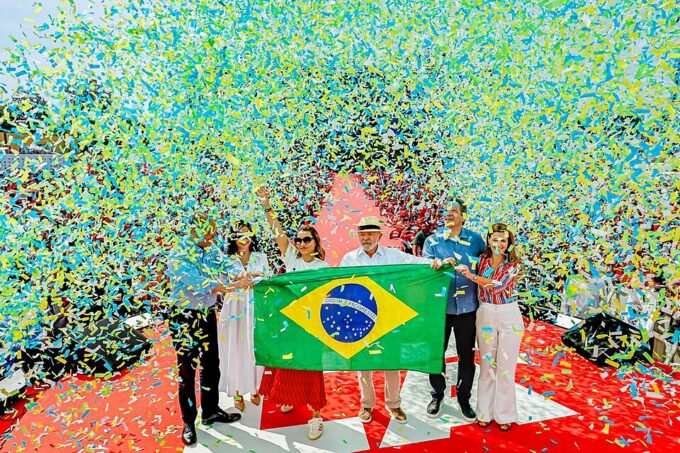
Lula’s victory in the second round of the elections of 25 October is one that transcends Brazil’s borders. It gives hope and offers ideas to struggles against the far-right everywhere. He was elected with 64,256,232 votes (51.79% of valid votes) compared to the 59,826,041 votes (48.21%) for Flávio Bolsonaro. Thanks to social mobilisation and a battle of narratives, it was the first time since Brazil’s return to democracy that a candidate who lost in the first round went on to win in the second round.
Reality resisted in the streets and social networks. Young people gave back to politics what algorithms strip away: human bodies, togetherness, and recognition of the other in a non-screen world. IT users organised and took on disinformation. Artists, intellectuals, journalists, and citizens did their best to defend the existence of democratic debate.
After Donald Trump was elected in 2016, a dangerous internationally orchestrated mix of authoritarianism, economic interests, religious groups, propaganda, and online platforms driven by seething resentment, spectacle, disinformation, and algorithmic manipulation took root. Lula put a spanner in the works of some of that machinery in Brazil.
The relations between Big Tech, Trump, Netanyahu and the Israeli right, the Argentine cyber-delinquent Fernando Cerimedo, and Flávio Bolsonaro’s Liberal Party (PL), the platforms, AI, and influencer networks that spread propaganda and disinformation must be carefully examined. Platforms aren’t neutral. They determine which content gets the widest spread and what emotions it stirs. Trump and Netanyahu represent the antidemocratic and illiberal offensive of which Flávio Bolsonaro and the PL have been the beneficiaries in Brazil. This has been quite evident since 2023.
During the campaign, Lula reported obstacles to dissemination of his posts and disparities in the functioning of Meta’s AI tools. On 15 October, Minister Marco Aurélio Bellizze, of the Superior Electoral Court (TSE), ordered that equal treatment had to be guaranteed to all candidates under penalty for noncompliance of a daily fine of 500,000 reals ($92,322,45). The next day, the decision was upheld by the TSE’s full bench. The lack of transparency of platforms paradoxically exposes the battle over the reach of candidates and influence over public opinion, in a system run by money, propaganda, influencers, religion, and choler.
In the domain of journalism, the owners of establishment media outlets, among them Organizaciones Globo, Folha de S.Paulo, Estadão, Veja, Metrópoles, and CNN Brasil, ditched ethical standards to become sewers of disinformation, pooling in and seeping from the Augean stable of Flávio Bolsonaro’s campaign.
The magazine Piauí published investigations into the machinations of Banco Master and Daniel Vorcaro. The channel canal Revelando, headed by Alessandra Orofino, the ICL Group, The Intercept, Paulo Motoryn, the Fórum and Cult magazines, and independent journalists and writers unmasked the system’s lackeys who posed as “neutral”. Good journalism doesn’t mean defending Lula but inquiring into and putting facts in context, especially facts pertaining to Bolsonaro.
Kudos to congressman André Janones, who put together an “army” of active social media users to tackle the algorithms and give impetus to Lula’s campaign. The social media and the streets joined forces in a Brazilian version of Zion in the Matrix films. Lula’s party (PT), shrunk to the petty-mindedness of twentieth-century macho bureaucrats, owes us a great deal. Let’s hope there’ll now be some gratitude to, and less betrayal of the brave men and women who gave their all in this battle.
Featuring herself too, Madonna shared a post by photographer Rafael Pavarotti in support of Lula. Kleber Mendonça brought together Hollywood stars to form the letter L. There’s an aesthetic battle happening as well. It’s not a matter of a hierarchy of tastes, but of understanding how political aesthetics mould sensibilities, presenting vulgarity as authenticity, brutality as power, and ignorance as something to be proud of.
Taking as an example Marilena Chauí’s heated observation that the Brazilian middle class is “a political abomination, because it is fascist; an ethical abomination, because it is violent; and a cognitive abomination, because it is ignorant”, I believe we need to go further and think about how aesthetic abomination comes hand in hand with ethical, cognitive and political abomination. Chauí makes important connections but I have a question: what happens when violence becomes a spectacle, ignorance a badge of honour, and authoritarianism the good life?
Fascist aesthetics aren’t limited to musical tastes and style of dress. They exalt brute force, submission to a leader, contempt for difference, and ridicule of others. The living arts, the special beauty of all kinds of peripheries, people’s festivals, the culture of the workers who supported Lula, have been overshadowed by ostentation without responsibility, fame without social commitment, and the intellectual indigence of sertaneja (Brazilian country) singers and digital influencers who’ve gotten rich with their online punting and exploiting the Rouenet (cultural funding) Law, which they then demonise when attacking independent artists.
Hannah Arendt explains how an absence of critical thought banalizes evil. Artistic freedom, plurality of ways of being, and imagination are incompatible with the imposition of one single admissible form of existence, which was the regime that Flávio Bolsonaro’s criminal organisation wanted to impose.
The problem isn’t sertaneja music itself but the way it’s instrumentalised to prey on people’s vulnerabilities. Big Tech companies get rich by grabbing attention. The gambling industry (literally) makes a killing with the promise of fast-buck schemes. Authoritarian politicians line their pockets with both. These interests thrive on insecurity and the promise of individual redemption.
It’s necessary to distinguish between the faithful and those who claim to be their leaders, faith communities and business, and churches as a whole and individuals of a congregation who might be responsible for criminal acts. Lula confronted the instrumentalisation of religion when it’s used to bless authoritarianism and attack rights. In his victory speech, he upheld the secular nature of the state and promised to combat religious intolerance. However, he made no explicit mention of Black and Mestizo people and their never-ending struggle against racism, and neither did he speak of the LGBTQIAP+ community which mobilised so vigorously to secure his victory. But he can easily rectify this in the near future!
Electoral victory doesn’t remove the danger posed by the far right but it does demonstrate that resisting is possible with mobilisation and good journalism. Resistance means restoring to politics its collective nature and rescuing it from its abasement to an extravaganza of egos. It means turning hope into a project, protecting culture from propaganda, and ensuring that the arts are free to imagine other ways of life.
Despite yesterday, there is a possible tomorrow, not because history guarantees the victory of good but because millions of people refused to accept that the world of monsters is the only one possible. Victory is not an end but a beginning, an opportunity and not an absolution. It requires vigilance, memory, self-criticism, and teamwork.
Symbolizing the possibility of reviving democracy and striving for a future of wellbeing, sustainability, equality, fraternity, and freedom, the flowers that bloom in my life, red as the blood that flows in our veins, red as the colour of Lula’s campaign, are for him and his new mandate.