
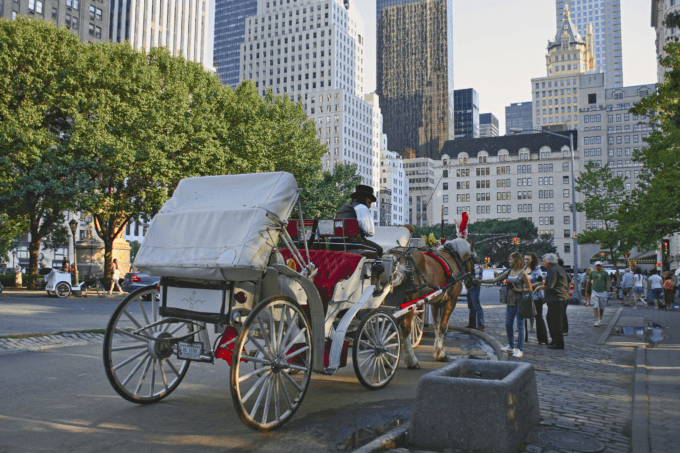
Photo by Tomás Fano, CC-BY SA 2.0 Generic.
This month, the New York City Council passed Intro 943, prohibiting carriage rides.
You might have seen the announcements: “Finally…we are ENDING cruel horse carriages!”
The immediate catalyst was the death of an 18-year-old tourist named Romanch Mahajan, who was fatally injured when a horse bolted in Central Park in June. But the carriage controversy goes back a long time. Activists have stood in the streets calling for an end to carriage horse rides for decades, in cities and towns throughout the world.
If signed by Mayor Mamdani, New York City’s updated law will become effective (with exceptions for special events) on the first day of June 2028. The lag is meant to provide ample time to take the horses off the streets, and to support the transition for the stable owners and carriage drivers. The department of consumer and worker protection is charged with supporting the drivers’ transition to other fields of work. The City Council will also consider compensation for the drivers, including the value of their businesses, permits, and equipment. Union spokespeople say there are no guarantees for the carriage drivers or where the horses will go, and they’ve vowed to sue.
Meanwhile, the American Society for the Prevention of Cruelty to Animals is celebrating with confetti-filled announcements, and a backstory:
“Protecting horses has been part of the ASPCA’s work since we were founded in New York City in 1866. For years, we have pushed for stronger protections for working horses and called for an end to horse-drawn carriages on our hometown’s increasingly congested streets. Better rules can improve some aspects of horse care, but they cannot solve the fundamental problem: Horse-drawn carriages and busy city streets are a dangerous mix. The activity carries inherent risks to horses, workers, passengers and the public.”
All true. And the ASPCA has been attempting for many years to set up sanctuaries. Similarly, the activist group NYCLASS, founded 2008, says: “We have fought so hard for the day when these horses can run free at sanctuaries…”
The story is still unfolding. The new law will allow the horses’ owners to continue owning them. These horses, alas, will always exist within the pipeline of breeding, use, and handoffs. The question now is who will own them next.
The New York Times has published an opinion piece by Mary Haverstick, suggesting that human workers and horses become miserable if they are taken out of the commercial system that exploits them.
“Like many domesticated animals, horses thrive when given something to do. Daily physical and mental stimulation does a soul good — an axiom that applies equally well to horses and people.”
Haverstick appears to regard domestication as just a fact of Earthly life. For nearly all the planet’s horses, that may be the way things have gone. But resistance means something. Where is that resistance?
Campaigners are now requesting more donations, and vowing to provide each horse with “a happy ending…with constant love and care at a beautiful farm.”
No matter the intent, that beautiful farm is an example of sprawl. Let’s not forget that electric fences and predator control would be typical features.
Moreover, animal liberation is not about guaranteeing a pain-free, risk-free existence with eternal love and care. Animal liberation is about respect for autonomy. It’s about defending untamed habitat, and challenging commercial breeding in the first place. Too late for that, you say? I hear you. Very few untamed horses exist of the face of the Earth. Yet this is a call to get our act together–and resist the continued human meddling in the evolutionary experiences of other living beings.
Congrats where congrats are due; and when a disgraceful form of commerce is put out to pasture, congrats are indeed due. But let us talk about refugees from the street stables with a respectful acknowledgement of the horses’ true situation. And let us interrogate the assumptions that keep horses under human control.


