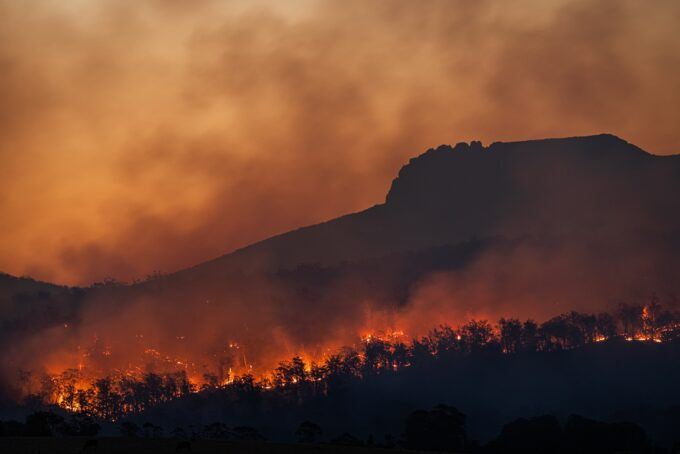
Photo by Matt Palmer
Air pollution kills people, especially severe air pollution, even short-term. The EPA has a 24-hour safety limit for air pollution for this reason. Some landmark historical examples:
On Dec. 5, 1952, the great London Smog Episode smothered London and opened the world’s eyes to how deadly even short-term air pollution can be. Over 13,500 Londoners died and 150,000 were hospitalized during the four-day event or in the four months that followed. A two-day pollution event killed 20 in Donora, PA, in 1948, 0.3% of the town’s population. In the Meuse River Valley, Belgium in 1930, 64 people died within 24 hours of a severe air pollution event.
These are history lessons apparently unlearned by the US Forest Service. On April 9 of this year, the US Forest Service conducted a “prescribed burn” on 330 acres near Helena, MT. By 9:00 pm, the nearest PM2.5 monitors at about 2.5 miles away read a shocking and highly dangerous 732 ug/m3. The air pollution remained significantly elevated until noon the next day. PM2.5 refers to particulate matter 2.5 microns in size and smaller, the most important high-volume type of pollution the EPA routinely monitors. No one knows how this compares to the London Smog Event because no monitoring existed in 1952. But the National Ambient Air Quality Standards (NAAQS) enforced by the EPA, established an annual average limit of 9 ug/m3. Helena residents were breathing pollution nearly 80 times higher than that limit, and over 20 times higher than the EPA’s 24 hr. limit.
PM2.5 levels that high (and they would have been even higher closer to the burn plot) indicate a deadly concentration of air pollution, capable of causing heart attacks, strokes, and sudden death from a variety of causes within hours of exposure. Miscarriages, stillbirths, and a myriad of other poor pregnancy outcomes could have been caused. The lifelong health and organ development of a baby can be altered by even short-term pollution exposure of a pregnant mother.
Moreover, PM2.5 levels often underestimate toxicity because the monitors are poor at capturing the most toxic components of PM2.5, the even smaller “ultrafine” particulate matter (.1microns in size and smaller). And high concentrations of ultrafines is the major reason why smoke from wood burning, whether from a fireplace, wildfire, pizza oven, or prescribed burn, is the most toxic type of pollution the average person routinely inhales.
There is no credible dispute that the Forest Service put the entire town of Helena in a life-threatening situation from their prescribed burn. Whatever the agency’s goals of the intentional burn, they could not have justified the outcome. At the request of Helena residents I reached out to the director that ordered the burn, Emily Platt. She responded, “the forecasted winds were expected to be stronger overnight,” as the only explanation or excuse for the outcome. But she went on to downplay the extreme pollution as “an unavoidable reality of any prescribed fire,” a shocking dismissal of the gravity of what her agency had done. It’s like my telling a family that during an appendectomy we somehow managed to saw off a leg and then excusing it as an “unavoidable reality of having sharp objects in the operating room.”
Ms. Platt and the Forest Service remain undaunted. The agency went for an encore of sending the health of Helena residents up in smoke. On Sept. 16, their “prescribed burn” smothered Helena again, this time with PM2.5 levels even higher, spiking to 789 ug/m3.
The agency should be prohibited from using the term “prescribed,” because no physician would prescribe this kind of public health menace. Ms. Platt published a recent Op Ed offering an extremely one-sided portrayal of the research on prescribed burns, while ignoring a large body of research that gives another black eye to the presumptive therapeutics of “prescribed burns.” On a national scale, at least 10,000 people die annually from wildfire smoke, but slightly more die from prescribed burn smoke. No physician would be allowed to perform a “preventive” operation where over half the patients died. Further contradicting claims that human health is being protected by prescribed burns, modeling suggests the health burden and daily health care costs are nearly five times higher for prescribed burns compared to wildfires, per hectare burned. There are multiple physio-chemical reasons why lower-temperature prescribed burns can produce emissions with more toxicity than higher-temperature wildfires.
This kind of complete disregard for human health under the auspices of protecting the public is reminiscent of the contemptible comment by a U.S. Army officer during the Vietnam War who infamously pronounced, “It became necessary to destroy the town to save it.” And the Forest Service’s war on our health should be viewed with an equal amount of outrage and contempt.