Naming is ownership. Alas, language can easily be manipulated. Nuance and context are often missing. Is it the Falklands or the Maldives, Taiwan or Chinese Taipei, Derry or Londonderry? Typically, the answer lies on which side of a border one lives, supercharged by national pride. Lake Ontario was named from the Wendat word “Ontari’io” over four centuries ago, long before the United States or Canada were formed. Indeed, much of our problems with names stem from past colonization.
For more than two centuries, Westerners referred to the Chinese capital as Peking, now called Beijing throughout the English-speaking world since 1979, when the Chinese government started to encourage the pinyin system of converting Mandarin into the Latin alphabet rather than the earlier Chinese Postal Map rendering, itself derived from an eighteenth-century British method. British colonialism also renamed Bombay in 1661, part translating the previous colonial Portuguese name Bom Bahia (“good bay”). In 1995, the newly elected local Shiv Sena-BJP coalition government restored the name Mumbai at its first cabinet meeting, named for the city’s goddess Mumba, a local incarnation of the Hindu deity Parvati.
“Indian” has wrongly been used to collectively name Indigenous inhabitants of the Americas since Europeans began arriving from the late fifteenth century. Perpetuated in modern minds by countless Hollywood westerns, the naming makes no sense, attributed to the poor navigational skills of Cristóbal Colón (a.k.a. Christopher Columbus), who wrongly believed he and his crew had circumnavigated the globe. Colón may or may not have come from Catalonia (Catalunya/Cataluña/Catalonha) as the Spanish royalty of the time – Colón’s benefactors Isabel and Fernando – wanted the world to believe. Native American, First Nations, or Indigenous tribal names are all appropriate, such as the Huron-Wendat First Nation, from whose language we get Ontario, meaning “big beautiful lake.”
“Eskimo” is also a derogatory European naming for over 150,000 Inuit, who mostly live in northern Canada and Greenland, millennia before Europeans ever transited the Atlantic Ocean in large numbers. Indigenous words can be hard to translate into other languages, especially with numerous local dialects (Inuktitut syllabics are now part of the million-symbol Unicode text encoding system, along with Cherokee, Cree, and other Indigenous languages). Given the harsh polar conditions, there are also many Inuit names for snow and ice. As noted in the Canadian Encyclopaedia, one sinks in maujaq, while ilusaq is a building material. Unfortunately, because of global warming there is less siku sea ice every year, for which there are “no fewer than 93 different words.” Preserving a language is as hard as stopping the shrinking albedo in the Arctic, now at its lowest level because of increasing greenhouse gases.
In his 1980 play Translations, Irish dramatist Brian Friel wrote about the problems English ordnance surveyors had in converting local Gaelic place names to English, for example, Cnoc Ban as a similar-sounding Knockban instead of the translated Fair Hill. When the local translator Owen states, “A new map is being made of the whole country,” the assigned British cartographer Captain Lancey replies “Is that all?” Later on, Owen wonders about how to translate Bun na hAbhann, noting that Bun (bottom) and Abha (river) signify “mouth of the river,” but he gives up when no suitable English sounds can be found, stating, “We are trying to denominate and at the same time describe that tiny area of soggy, rocky, sandy ground where that little stream enters the sea, an area known locally as Bun na hAbhann… Burnfoot! What about Burnfoot?” All the while, the Irish language was banned, kept alive by local “hedge schools” that took place in secret, away from foreign administrative eyes. The first performance was in Derry, a name accepted by everyone other than the British government.
Language oddities arise in any translation. The city of Baltimore, Maryland, is named for the first Lord Baltimore, an English politician living in Longford, Ireland, who took his ennobled name as was customary from a coastal village, and whose son was the first proprietor of Maryland. Baltimore is the anglicized name of Baile an Tí Mhóir in West Cork, meaning “the town of the big house,” while the original Irish name is Dún na Séad, meaning “fort of the jewels.” One dual-language name is hard enough. Maybe it has to do with the thrice-distilled Irish whiskey, derived from uisce beatha, literally “water of life.”
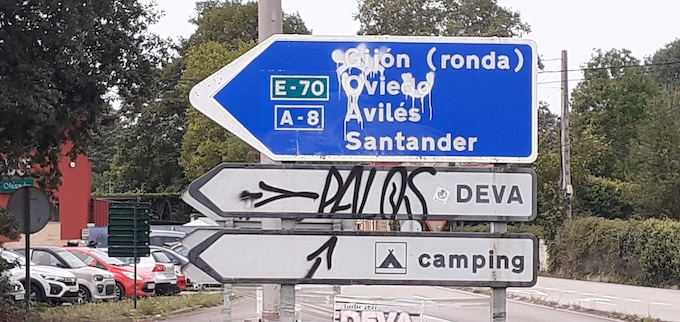
Whether Baltimore came from Baile an Tí Mhóir or vice versa, few locals today are bothered, although some place names have been painted over in larger Irish-speaking regions, such as road signs in Kerry, Ireland, where the unpopular official Irish “An Daingean” has been overwritten with the more common anglicized Dingle to suit tourist interests. New signs are now bilingual. Conversely, in Asturias, northern Spain, road signs have been defaced to support a vanishing minority local language, for example, the last syllable of the capital Oviedo marked up to read Uviéu in Asturiano or the Spanish “g” and “j” crossed-out with the letter “x” to indicate Xixón instead of Gijón, Asturias’s most populous city. In some cases, bilingual signs are now in use.
Ontario began using French translations beside or below English on federal government road signage in the 1970s without much backlash, perhaps even helping the predominantly anglophone population to understand Canada’s co-official language, for example, the four directions nord/sud/est/ouest. In the next-door francophone-majority province of Quebec, the 1977 Bill 101 enshrined the French language in law rather than bilingualism, banning English-only signs to help the francophone community from being swallowed in a majority English-speaking North American continent.
The law is not dissimilar to Canadian Content rules for music that supports Canadian artists within a wider American cultural market (as of 1999, 35% of broadcast songs must be Canadian). Bill 101’s goal was to preserve French-Canadian culture, although some companies, notably the Bank of Montreal and the Royal Bank, moved their headquarters from Montreal to Toronto, while pointed debates added to separatist tensions, resulting in a narrowly defeated 1995 Parti Québécois referendum.
In August of this year, French language rights were cited as one of the reasons for the failure of US-Canada trade talks, with the Charter of the French Language – a.k.a. Bill 101 or its amended Bill 96 – once again at the forefront of cultural survival (along with free-market forestry, supply management dairy farming, and restricted manufacturing). US trade representatives stated that Canadian legislation contravenes US-Canada trade agreements, while Canada declared that French-language provisions must be included in any deal as proscribed by Canadian law. History, culture, and language is identity, not to be lost in the simplifications of the market or in another’s economic nationalism.
In a CBC interview, Blue Rodeo singer Jim Cuddy reiterated the importance of preserving Canadian culture and internet discoverability, “We are a small country and we will absolutely be swamped unless we keep some kind of mechanism in place to make sure there is discoverability. I’m one hundred percent in support of having French language preserved on those sites.” For now at least, unless the US gets its way, Snap, Crackle, and Pop will share a Rice Krispies cereal box with Cric! Crac! Croc!
Name changes can perpetuate political survival. Set up after the 1921 partition of Ireland into Northern Ireland (“the North”) and the eventual Republic of Ireland (“the South”), the 1925 Irish Boundary Commission allowed three predominantly Catholic Ulster counties from the North to join the South, such that Northern Ireland became more pro-unionist than it otherwise would be. That single designation has deterred a referendum on Irish reunification as dissenting northerners maintain a larger-percentage unionist population in the diminished nationalist six-county Northern Ireland.
Former UK prime minister Gordon Brown recently stated “of course, in the long term, Ireland will be united.” But if the original nine-county statelet had been kept – where Northern Ireland remained synonymous with Ulster – agreement could have come sooner than a vague future promise. Alas, as Trinity College Dublin provost John Pentland Mahaffy once wryly noted, “In Ireland, the inevitable never happens and the unexpected constantly occurs.” Even the geography is mixed up on the Emerald Isle: the northernmost point of the South (Tor Beg Rock, County Donegal) is more than 100 kilometres further north than the southernmost point of the North (Cranfield Point, County Down).
The use of “Middle East” for the Persian/Arabian Gulf countries is also contentious, where “east” means east of the European powers that dominated politics in the region after the break-up of the Ottoman Empire. “West Asia” could just as easily apply, but is also a relative reference to somewhere else. Iran prefers the Persian Gulf, Arabian countries the Arabian Gulf, while some just call it “the Gulf,” a neutral term that doesn’t help out of context. Decolonizing language is difficult enough when we don’t all speak the same language. Maybe we should call countries and regions by what they call themselves, however hard to do. Same with people.
Created by rich trading nations for commercial purposes, maps reinforce identity issues. The 1569 Mercator map is a Eurocentric, “equidistant” rendering that shrinks the importance of equatorial countries to keep relative distances accurate for navigation, favouring northern Europe yet showing Africa as equal in size to Greenland when it is 14 times larger. All maps suffer from distortion when a 3D globe is projected onto a 2D plane, but the Mercator map is unfair and damaging to African interests. On September 4th, the United Nations endorsed a resolution to use an “equal-area” relative size map, based on the Gall-Peters projection. Only one country voted against the resolution – the United States – which declared the initiative part of a “radical ideological project.”
As overseen by the United Nations Group of Experts on Geographical Names, it is difficult to satisfy both domestic and international interests on maps. Unilaterally renaming shared bodies of water (hydronyms), however, can only be misconstrued as hostile, for example, the shared Gulf of Mexico and Lake Ontario, and even the US state of New Mexico. Memes are the measure of a growing slushbrain culture to distract from political problems or hasten the drumbeats of war, abetted by online mapping services such as Google Maps rubber-stamping American presidential whims. Accompanied by pathetic AI slop, the name “America” is brazenly being used as a branding feature. Calvin Coolidge famously said “The chief business of the American people is business,” but he didn’t proscribe exclusive naming rights.
Disagreements over names can even lead to a dangerous future. The “Las Malvinas son Argentinas” sign unfurled at the end of the 2026 Argentine-UK FIFA semi final – that incurred a miniscule 30,000 swiss-franc fine – has rekindled memories of the 1982 Falklands War between the UK and Argentina that killed over 900 people. The renewed sabre rattling is intended to stir up trouble, but may have more to do with oil rights in the 1.7-billion barrel Sea Lion oil field, 130 miles north of the Falklands, rather than the welfare of roughly 3,000 British citizens (and hundreds of thousands of penguins).
Some names and their usage are humorous misunderstandings, such as John F. Kennedy’s famous 1963 Berlin Wall Soviet admonishment, “Ich bin ein Berliner.” A Berliner is a jelly donut. Others are important business appellations, such as “Scotch Whisky” being granted US trademark certification according to established production requirements (distilled, yeast-fermented, and matured only in Scotland). Similar constraints govern the sale of sausage, chocolate, and beer. “The battle of the Buds” is a century-old trademark dispute over the name Budweiser, which may or may not have been copied from the Czech brewing company Budvar by the world’s largest beermaker Anheuser-Busch. Trademarks are serious business, where two can never be one, although different pronunciations of tomato, potato, or pyjama needn’t be a reason to call the whole thing off. Nor should anyone unilaterally change someone else’s name.
To ease the nomenclature challenges of an online globalized marketplace, the practice of internationalization (I18n) and localization (L10n) in the 1970s stripped out language data from application codes, such as in a standard word processor menu, easily seen by toggling the language option (e.g., File/Edit/View/ … /Help in English, Fichier/Édition/Affichage/ … /Aide in French). Pioneered by American high-tech companies such as DEC, IBM, and Sun Microsystems/Oracle, I18n and L10n continue to facilitate updates without programmers worrying about the final product, using macro placeholders for local names within the code. Very little advanced thinking is needed to tame the Babylonian complexities of modern global translation.
More worrisome is the slow creep of the private into the public, where names are for commercial purposes. Picasso is a car, Newton is a computer, Shirley Temple is a drink, reproduced by 24/7 AI slop where anybody can be anybody. Former public spaces are also being turned into privately branded playgrounds of the rich, such as professional sports stadiums: TD Garden (replaced Boston Garden, 1995), MetLife Stadium (Giants Stadium, 2010), and Reliant Astrodome (Houston Astrodome, 2000, once considered the eighth wonder of the world) among others. Private ownership of our cities is a reminder of who owns our formerly shared commons, including hoardings, city-styled merch, and patchwork jerseys.
In Consumed: How Markets Corrupt Children, Infantilize Adults, and Swallow Citizens Whole, American political theorist Benjamin Barber noted that consumerism is set by the advertizers and marketers, an ongoing private takeover in place since Reagan and Thatcher, where “the principal project of neoliberals who want to privatize has been to undo the regulatory civic work of the civic consumer movements of the 1930s and 1940s.” Andy Consumer may know he is being conned, but sees “it is advertizing that makes America hum.” Standardization is key.
It is no wonder politics has become controlled by private interests after the 2010 Citizens United Act permitted unregulated election spending, citing donation restrictions as anti free speech, albeit not for everyone such as unions. How did the Republican party become the party of the working class? Is it because billionaire spending increased one-hundredfold? And now, a reality TV president calling the shots on what is and isn’t “American” or “great.” Trump has plastered his name on everything from towers to steaks and shoes to watches, simple Branding 101, where name recognition is all. The devil you know, even at the ballot box.
Gaudily blending politics with idolatry, Trump’s name is on government monuments, buildings, and the one-dollar bill (in Trump We Trust?). He’s like a kid shouting, “Look at me Mom” over and over as he waits to cannonball off the low diving board. But who would ever presume to add their name to an existing performing arts centre built as a testament to a beloved assassinated president, other than a self-serving huckster? Renaming gulfs, lakes, and oceans is just an extension of the growing private-ownership con American style.
Can anyone doubt the purpose of the US Department of Defense renamed the Department of War? In a world where lies rule, “special military operation,” “short-term excursion,” and “small potatoes” are dressed-up as euphemisms for more bloody wars, costing billions of dollars in taxpayer funds and billions more in an increased cost of living. War is an excuse for failed diplomacy, an abomination for all, forever tied to resources rather than ideology. Iran controls (with Qatar) the world’s largest natural gas field, South Pars/North Dome in the middle of the Gulf. Pars is in homage to Iran’s former name Persia, after Parsa, home of Cyrus the Great.
Of course, one person’s freedom fighter is another’s terrorist. One person’s self-anointed “greatest” (unabashedly ascribed by Trump to himself) is another’s “moron” as labelled by Rex Tillerson, the former ExxonMobil CEO and Trump’s fired first secretary of state. Stable genius or meme-sharing troll? Funny stand-up comedian or offensive clown? Does the MAGA base know that “al-Qaeda” means “the base.”
Language has always been an instrument of dominance. In the information age, words are now on the frontlines of the battle for our hearts, minds, and dollars. In the run-up to the US-Canada trade talks, US commerce secretary Howard Lutnick called Canada a “socialist regime” that has been “feeding off” the US for decades. The political right in Canada could indeed be considered left of the political left in the United States, but no one who knows anything would consider the former banker turned prime minister Mark Carney as a leader of a “socialist regime.”
We get the shorthand meaning of “conservative” and “liberal” as “right” and “left” from the National Assembly of the first French Republic, where those who sat on the right of the parliament supported the king’s absolute veto, while those on the left did not (such as Georges Danton). But do “right” and “left” have any meaning today when as Carney noted, in response to US trade threats, “America wants our land, our resources, our water, our country. These are not idle threats. President Trump is trying to break us so America can own us.” Perhaps everyone is a socialist compared to the absolutists running the far-right United States.
Names also define the core of one’s being, hence Trump’s boorish name-calling and insults. In Alex Haley’s 1976 Pulitzer Prize winning novel Roots and 1977s hit miniseries, Kunta Kinte (played by LeVar Burton) never answers to Toby, the name given to him in bonds. Similarly, Donald Trump likes to emphasize Barack Obama’s Arabic middle name Hussein, meaning “beautiful,” relishing in his mean-spirited bullying. Clearly Americans can separate fact from fiction, twice electing Obama president (with higher percentage electoral seats and popular vote than Trump). Same goes for purposely maligning the Michigan senate candidate Abdul El-Sayad on name alone. When it comes to identity, 2 plus 2 equals 4.
Trump’s repeated name-calling of opponents (especially women, which don’t bear repeating) are childish attempts to belittle others, parroted without criticism by slavish media outlets. That such hatred is normalized by a sycophantic press is one of the saddest revelations of the current US presidency, while the lies and insults by him and those in his administration are indeed “beneath their office.” Trump’s family name is “Drumpf,” anglicized by his German grandfather. Little mention is made of his family or his wife being immigrants.
University of Toronto psychology professor and professional provocateur Jordan Peterson opened up a cultural can of worms when he refused to refer to students by their chosen pronoun (“they” instead of “he” or “she”), citing left-wing political activism and authoritarianism that is “started by people’s attempts to control the ideological and linguistic territory.” Although Peterson claimed he was warning about freedom of speech, such alarmist attitudes deny people the right to label themselves. Odd that he is less apt to criticize real authoritarian bullying and the obvious dictatorial renaming of long-established place names.
As noted in the feminist manual, “What you don’t name doesn’t exist.” We now use chairperson, ombudsperson, congressperson in regular discourse. Whether etymologically correct or not, there is nothing wrong with “herstory” instead of “history” to describe one’s past. Too bad Neil Armstrong didn’t say, “That’s one small step for a person, one giant leap for peoplekind.” Perhaps Elon Musk will correct the record when “they” land on Mars.
Gauche Indigenous nicknames for American sports teams are just as testy: Atlanta Braves, Chicago Blackhawks, Kansas City Chiefs. Under commercial pressure, the Washington Redskins were renamed the Washington Football Team in 2020 and then the Commanders two years later, followed by the Cleveland Indians becoming the Guardians in 2022. For years, baseball TV analyst Jerry Howarth refused to repeat offensive nicknames, using “the Clevelanders” after receiving a letter from an Indigenous listener in 1992. Long-time sportscaster John Hancock agreed, stating “I can’t imagine following a team that is referred to as ‘White Anglo-Saxons’ or something like that, it’s ridiculous.” Indeed, there is no reason to keep a name just because it has been around for as long as anyone can remember.
Even pronunciation can mark a stolen identity. Is the “c” in Celtic hard or soft? Surprisingly in the US it is soft. French names abound in Mississippi River states, where early fur trappers paddled and portaged across the continental interior in the name of the French crown and Hudson’s Bay Company, back when Quebec was known as New France. Two such coureurs des bois (wood-runners) Pierre-Esprit Radisson and Médard Chouart des Groseilliers are a mouthful to be sure, often called Radish and Gooseberry by bemused schoolchildren, yet immortalised as Les Voyageurs hockey teams, first in Montreal and then in Nova Scotia. Should one pronounce Detroit, Illinois, Des Moines, New Orleans, etc., as French words?
Some naming conventions may seem trivial but rarely come without consequence. The European Union instructs its citizens to refer to the plural of the euro currency as the euro, that is, without an “s” as in standard English noun pluralization. In Ireland – the only English- speaking country in the EU after Brexit – such wrong-headed advice demands ghetto-style pronunciation, such as one beer, two beer, one euro, two euro, but is ignored by many. In Canada, the government can’t agree on a national spelling – is it normalization or normalisation? Who dictates common usage anyway? Does it matter – yes. Should such decisions be left to a spell-checker – no.
It took until 1934 for James Joyce’s Ulysses to be unbanned in the United States for perceived illicit sexual content, blasphemy, and “coarse thought.” As noted by Judge John M. Woolsey in his ruling, “The words which are criticized as dirty are old Saxon words known to almost all men and, I venture, to many women, and are such words as would be naturally and habitually used,” adding about the theme of sex, “it must always be remembered that his locale was Celtic and his season spring.” He might well have added that the water of life was on sale, Prohibition having only been repealed in 1933 after 14 dry years.
Language inconsistencies can be found everywhere, from tapestries to empires. The Bayeux Tapestry is not a tapestry, but an embroidery, now on display in England for the first time in 1,000 years. The 68-metre (74-yard) embroidery depicts the conquest of England by William, Duke of Normandy, who would become the first English king, justifying the Norman conquest for future generations and another 300 years of war. As has been often cited, the Holy Roman Empire was neither holy, Roman, nor an empire. One wonders how long the United States can remain united.
The Canadian Broadcasting Corporation’s longstanding language guidance calls for the words “terrorist” and “terrorism” only from attributed sources – thus not in a casual factual way – upsetting Fox News et al. when the policy was made public prior to the twenty-fifth anniversary of the September 11 World Trade Centre attack. Although the practice is shared by other major news organizations, including the Associated Press, Reuters, and the BBC, FBI chief Kash Patel called the policy “A bastardization of history.” Perhaps the CBC was being singled out for criticism during the US-Canada trade talks.
Patel neglected to mention, however, the Canadian assistance that followed 9/11 as 7,000 American travellers were stranded in Ganders, Newfoundland, stuck in the aftermath of the destruction with no hope of getting home. The call went out “to lend a hand, do what you can” as the town of Gander (pop. 10,000) opened their doors and hearts to help the “plane people.” Lasting relationships were made and the bittersweet ordeal made into the 2013 Broadway musical Come From Away, celebrating neighbourly care.
One of the most shameful name changes is US government officials rebranding “global warming” as “climate change” during the second Bush administration, advising candidates not to worry voters. Heartland Institute and Peabody Energy coal lobbyist Fred Palmer began an anti-science crusade in 1988 after a Sports Illustrated article complained of record temperatures and drought. The goal was to “reposition global warming as theory (not fact)” and to spread untruths about the human causes of global warming. As Palmer stated, “It’s hard not to concede that coal hasn’t been put on Earth as part of a divine plan.” The cost of such simple-sounding nomenclature? We all know now.
Suffice it to say, the oil industry knew about the causes and the extent of the problem as far back as 1976, as told by Exxon scientist James Black, “There is general scientific agreement that the most likely manner in which mankind is influencing the global climate is through carbon dioxide release from the burning of fossil fuels.” Black further noted two years later at a talk entitled “The Greenhouse Effect,” “A possible result might be a shift of both the desert and the fertile areas of the globe toward higher latitudes. Some countries would benefit, but others would have their agricultural output reduced or destroyed.” Nothing like the truth in writing to set the record straight.
I had a childhood friend who arrogantly tried to tell me how to pronounce my last name, according to him with a heavily aspirated “h.” What a maroon. What an ignoramus. What a Trump. No one owns another’s name, no matter how much they try. There are as many language stories as there are people. What’s in a name? Everything.