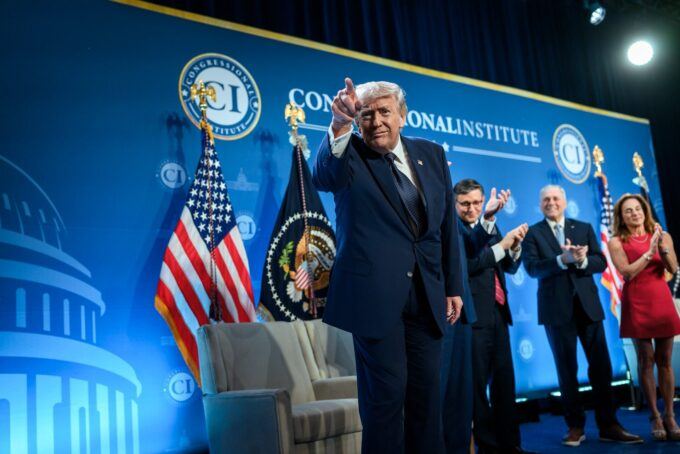
Photograph Source: Office of Speaker Mike Johnson – Public Domain
A Democratic congressional analysis does not prove financial motive, but it highlights a deeper accountability problem when a president can shape energy markets while holding substantial energy investments.
On September 2, renewed U.S.-Iran fighting kept Brent crude near $95 a barrel, another reminder that decisions made in Washington and Tehran can move energy markets within hours. A little more than a week earlier, the Democratic minority of Congress’s Joint Economic Committee released an analysis that raises a different question about the same volatility: who bears the costs of war, and who is positioned to benefit from it?
Using Trump’s 2025 financial disclosure and changes in energy-stock prices between January 2 and August 17, the committee estimated that the value of his oil and gas holdings had increased by between $4.6 million and $15.5 million. It also estimated that Americans had spent an additional $71.5 billion on gasoline since the Iran war began on February 28. The first figure is an estimate covering stock-price changes from the start of the year, not proof that the war itself produced every dollar of the increase. Nor does it establish that Trump launched or prolonged the conflict for personal gain. But the juxtaposition exposes a broader political-economy problem: the costs of war can be widely distributed while some financial gains remain concentrated in private hands.
Public Costs, Private Gains
The economic structure is straightforward. The federal government finances military operations with public resources. Households absorb higher fuel and transportation costs. Businesses face more expensive inputs. At the same time, energy companies can benefit when supply disruptions and geopolitical risk raise oil and refined-product prices.
The Joint Economic Committee’s Democratic staff estimated that more than 20 major oil and gas companies earned about $125.2 billion in the first half of 2026. Trump’s 2025 disclosure showed between $12.5 million and $45.6 million in oil and gas stocks. Applying market-price changes through August 17, the committee estimated that those holdings were then worth between roughly $17.2 million and $61.1 million.
Those numbers require care. Financial disclosure forms report assets in ranges rather than exact values, and the committee’s calculation is an estimate. The relevant question is therefore not whether the report proves corruption. It does not. The stronger question is whether a political system should be comfortable with a president retaining substantial exposure to an industry whose value can be affected by decisions over war, sanctions, shipping routes and energy policy.
War is usually discussed in the language of deterrence, security and national interest, but it also redistributes economic risk and reward. The Iran conflict has raised gasoline and transportation costs for households while creating favorable conditions for parts of the energy sector. For one group, instability appears as a higher bill. For another, it can appear as stronger earnings or asset values.
That asymmetry gives the issue political force. The committee says Americans have paid an average of $604 more per family for gasoline since the war began, while major energy companies have reported unusually strong profits. The point is not that every dollar of corporate profit is caused by the war or that higher energy-company earnings are inherently improper. It is that the burdens and benefits created by the conflict are not distributed evenly.
The same distinction matters when assessing Trump. A president does not have to personally place a trade for his policies to affect the value of assets he owns. Escalation can disrupt supply; disruption can raise prices; higher prices can support energy-company profits and share values. That chain does not establish motive, but it explains why the overlap between public power and private financial exposure deserves scrutiny.
The Accountability Problem
Defenders of the president can reasonably argue that there is no evidence showing Trump began the Iran war to enrich himself or personally ordered trades in response to military developments. That distinction is essential. An argument about conflicts of interest should not become an unsupported allegation about motive.
But the absence of proof of a corrupt motive does not eliminate the governance problem. Trump’s annual financial disclosure, certified and made public through the U.S. Office of Government Ethics, provides the underlying record of his holdings. The question is whether existing safeguards are sufficient when the president possesses extraordinary authority over foreign policy while maintaining financial interests in sectors directly exposed to those decisions.
Senator Chris Van Hollen has framed the criticism more sharply, accusing Trump of turning the White House into a “pay-to-play casino” and saying the president is profiting while Americans face higher prices. The language is partisan and deliberately provocative. Still, it points toward a broader concern: public confidence depends not only on the absence of a proven crime but also on a credible separation between public decision-making and private gain.
The relationship between Washington, energy companies, defense contractors and wealthy donors long predates Trump. What makes the current case especially visible is the overlap between presidential authority, personal financial holdings and a war whose economic consequences are transmitted through energy markets.
The question of who pays is therefore as important as who gains. If households spend billions more on gasoline, they bear part of the war’s indirect economic burden. If the government spends more on military operations, taxpayers finance that cost. If energy companies benefit from higher prices, shareholders capture part of the upside. “Shared sacrifice” becomes misleading when risks and rewards move in different directions.
For a working household, the war can mean a more expensive commute and higher prices. For an energy investor, the same instability can lift asset values. That does not make every gain illegitimate, but it makes the distributional consequences of war a legitimate subject of democratic scrutiny.
The stakes grow as the conflict drags on. Reuters has described the six-month confrontation as an increasingly entrenched struggle over energy flows and the Strait of Hormuz, with fuel prices elevated and neither side able to force a decisive outcome. The longer that situation persists, the harder it becomes to separate military strategy from the domestic economic interests created by the conflict.
The deepest risk is not simply that one president’s portfolio may have risen in value. It is that citizens may lose confidence that decisions over war and peace are insulated from private financial interests. Democracies also depend on trust that extraordinary powers are exercised for public purposes.
The controversy over Trump’s energy holdings should therefore be treated as more than a partisan dispute about one politician’s wealth. It raises a basic question about the political economy of modern war: when the public finances the conflict, households absorb its costs and private investors can benefit from the disruption, what safeguards ensure that decisions about escalation and peace remain anchored in the public interest?
That question does not prove that Trump went to war for profit. It is more important precisely because it does not depend on proving motive. It asks whether the institutional distance between presidential power and private capital is strong enough to preserve public trust when the consequences of war can move markets—and enrich those already positioned to benefit from them.